Thank you for visiting SNEWPapers!
Sign up free
Literary
February 24, 1838
The Columbia Democrat
Bloomsburg, Columbia County, Pennsylvania
What is this article about?
Rev. Timothy Flint's essay urges Americans to devote more energy to improving agriculture than to political disputes, highlighting England's scientific farming success and portraying farmers as noble contributors to national wealth, morals, and prosperity.
Clipping
OCR Quality
98%
Excellent
Full Text
FARMING.
By the Rev. Timothy Flint.
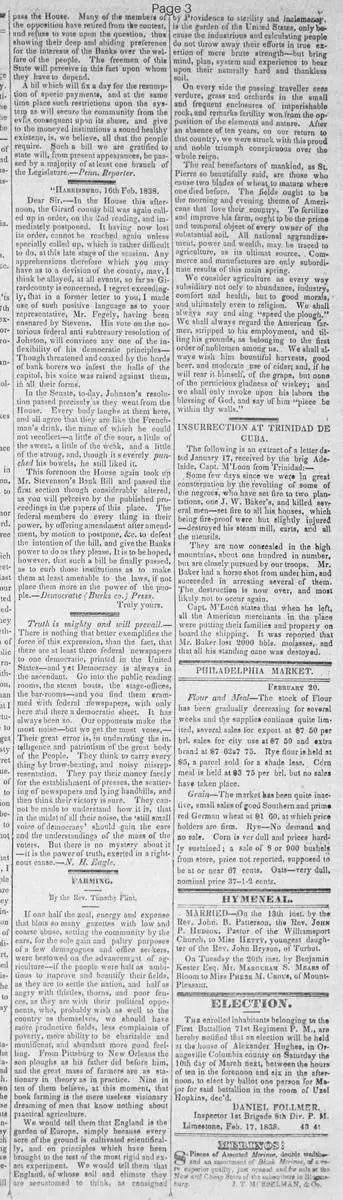
If one half the zeal, energy and expense that blots so many gazettes with low and coarse abuse, setting the community by the ears, for the sole gain and paltry purposes of a few demagogues and office seekers, were bestowed on the advancement of agriculture—if the people were half as ambitious to improve and beautify their fields, as they are to settle the nation, and half as angry with thistles, thorns, and poor fences, as they are with their political opponents, who, probably wish as well to the country as themselves, we should have more productive fields, less complaints of poverty, more ability to be charitable and munificent, and abundant more good feeling. From Pittsburg to New Orleans tho son ploughs as his father did before him, and the great mass of farmers are as stationary in theory as in practice. Nine in ten of them believe, at this moment, that book farming is the mere useless visionary dreaming of men that know nothing about practical agriculture.
We would tell them that England is the garden of Europe, simply because every acre of the ground is cultivated scientifically, and on principles which have been brought to the test of the most rigid and exact experiment. We would tell them that England, of whose soil and climate they are accustomed to think, as consigned by Providence to sterility and inclemency, is the garden of the United States, only because the industrious and calculating people do not throw away their efforts in true exertion of mere brute strength—but bring mind, plan, system and experience to bear upon their naturally hard and thankless soil. On every side the passing traveller sees verdure, grass and orchards in the small and frequent enclosures of imperishable rock, and remarks fertility won from the opposition of the elements and nature. After an absence of ten years, on our return to that country, we were struck with this proud and noble triumph conspicuous over the whole reign.
The real benefactors of mankind, as St. Pierre so beautifully said, are those who cause two blades of wheat to mature where one grew before. The fields ought to be the morning and evening theme of Americans that love their country. To fertilize and improve his farm, ought to be the prime and temporal object of every owner of the substantial soil. All national aggrandizement, power and wealth, may be traced to agriculture, as its ultimate source. Commerce and manufactures are only subordinate results of this main spring.
We consider agriculture as every way subsidiary not only to abundance, industry, comfort and health, but to good morals, and ultimately even to religion. We shall always say and sing "speed the plough." We shall always regard the American farmer, stripped to his employment, and tilling his grounds, as belonging to the first order of noblemen among us. We shall always wish him bountiful harvests, good beer, and moderate use of cider; and, if he will rear it himself, of the grape, but none of the pernicious gladness of whiskey; and we shall only invoke upon his labors the blessing of God, and say of him "peace be within thy walls."
By the Rev. Timothy Flint.
If one half the zeal, energy and expense that blots so many gazettes with low and coarse abuse, setting the community by the ears, for the sole gain and paltry purposes of a few demagogues and office seekers, were bestowed on the advancement of agriculture—if the people were half as ambitious to improve and beautify their fields, as they are to settle the nation, and half as angry with thistles, thorns, and poor fences, as they are with their political opponents, who, probably wish as well to the country as themselves, we should have more productive fields, less complaints of poverty, more ability to be charitable and munificent, and abundant more good feeling. From Pittsburg to New Orleans tho son ploughs as his father did before him, and the great mass of farmers are as stationary in theory as in practice. Nine in ten of them believe, at this moment, that book farming is the mere useless visionary dreaming of men that know nothing about practical agriculture.
We would tell them that England is the garden of Europe, simply because every acre of the ground is cultivated scientifically, and on principles which have been brought to the test of the most rigid and exact experiment. We would tell them that England, of whose soil and climate they are accustomed to think, as consigned by Providence to sterility and inclemency, is the garden of the United States, only because the industrious and calculating people do not throw away their efforts in true exertion of mere brute strength—but bring mind, plan, system and experience to bear upon their naturally hard and thankless soil. On every side the passing traveller sees verdure, grass and orchards in the small and frequent enclosures of imperishable rock, and remarks fertility won from the opposition of the elements and nature. After an absence of ten years, on our return to that country, we were struck with this proud and noble triumph conspicuous over the whole reign.
The real benefactors of mankind, as St. Pierre so beautifully said, are those who cause two blades of wheat to mature where one grew before. The fields ought to be the morning and evening theme of Americans that love their country. To fertilize and improve his farm, ought to be the prime and temporal object of every owner of the substantial soil. All national aggrandizement, power and wealth, may be traced to agriculture, as its ultimate source. Commerce and manufactures are only subordinate results of this main spring.
We consider agriculture as every way subsidiary not only to abundance, industry, comfort and health, but to good morals, and ultimately even to religion. We shall always say and sing "speed the plough." We shall always regard the American farmer, stripped to his employment, and tilling his grounds, as belonging to the first order of noblemen among us. We shall always wish him bountiful harvests, good beer, and moderate use of cider; and, if he will rear it himself, of the grape, but none of the pernicious gladness of whiskey; and we shall only invoke upon his labors the blessing of God, and say of him "peace be within thy walls."
What sub-type of article is it?
Essay
What themes does it cover?
Agriculture Rural
Moral Virtue
Patriotism
What keywords are associated?
Agriculture
Farming
Scientific Cultivation
National Prosperity
American Farmers
Moral Improvement
What entities or persons were involved?
By The Rev. Timothy Flint.
Literary Details
Title
Farming.
Author
By The Rev. Timothy Flint.
Subject
Advancement Of Agriculture
Form / Style
Prose Essay
Key Lines
The Real Benefactors Of Mankind, As St. Pierre So Beautifully Said, Are Those Who Cause Two Blades Of Wheat To Mature Where One Grew Before.
We Shall Always Regard The American Farmer, Stripped To His Employment, And Tilling His Grounds, As Belonging To The First Order Of Noblemen Among Us.