Thank you for visiting SNEWPapers!
Sign up free
The Weekly Minnesotian
Saint Paul, Ramsey County, Minnesota
What is this article about?
The Senate Committee on Indian Affairs issues a unanimous report exonerating former Minnesota Governor Alexander Ramsey of charges related to payments under the 1851 treaties of Traverse des Sioux and Mendota, praising his conduct as commendable and in line with treaty stipulations and official instructions.
Clipping
OCR Quality
Full Text
ST. PAUL, SATURDAY, MARCH 25, 1854.
Report on the Ramsey Case.
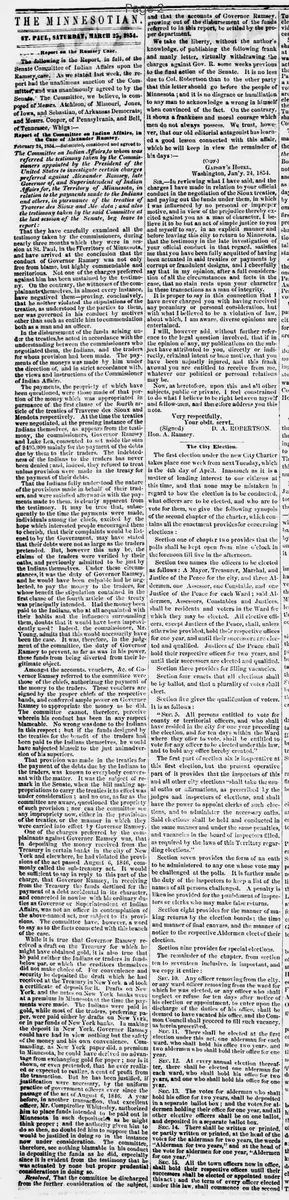
The following is the Report, in full, of the Senate Committee of Indian Affairs upon the Ramsey case. As we stated last week, the report had the unanimous sanction of the Committee, and was unanimously agreed to by the Senate. The Committee, we believe, is composed of Messrs. Atchison, of Missouri, Jones, of Iowa, and Sebastian, of Arkansas Democrats; and Messrs. Cooper, of Pennsylvania, and Bell, of Tennessee, Whigs:--
Report of the Committee on Indian Affairs, in the Case of Alexander Ramsey.
February 24, 1854.--Submitted, considered and agreed to.
The Committee on Indian Affairs, to whom was referred the testimony taken by the Commissioners appointed by the President of the United States to investigate certain charges preferred against Alexander Ramsey, late Governor of, and Superintendent of Indian Affairs for, the Territory of Minnesota, in relation to the payments made to the Indians and others, in pursuance of the treaties of Traverse des Sioux and Mendota; and also the testimony taken by the said Committee at the last session of the Senate, beg leave to report:
That they have carefully examined all the testimony taken by the commissioners, during nearly three months which they were in session at St. Paul, in the Territory of Minnesota, and have arrived at the conclusion that the conduct of Governor Ramsey was not only free from blame, but highly commendable and meritorious. Not one of the charges preferred against him has been sustained by the testimony. On the contrary, the witnesses of the complainants themselves, in almost every instance, have negatived them--proving conclusively that he neither violated the stipulations of the treaties, as understood by the parties to them, nor was governed in his conduct by motives other than such as entitle him to commendation both as a man and an officer.
In the disbursement of the funds arising under the treaties, he acted in accordance with the understanding between the commissioners who negotiated them, the Indians, and the traders for whom provision had been made. The payments of the moneys was made by him under the direction of, and in strict accordance with, the views and instructions of the Commissioner of Indian Affairs.
The payments, the propriety of which have been questioned, were those made of that portion of the money which was appropriated in pursuance of the first clause of the fourth article of the treaties of Traverse des Sioux and Mendota respectively. At the time the treaties were negotiated, at the pressing instance of the Indians themselves, as appears from the testimony, the commissioners, Governor Ramsey and Luke Lea, consented to set aside the sum of $495,000 mainly for the payment of the debts due by them to their traders. The indebtedness of the Indians to the traders has never been denied: and, indeed, they refused to treat unless provision were made in the treaty for the payment of their debts.
That the Indians fully understood the nature of the provisions made in behalf of their traders, and were satisfied afterwards with the payments made to them, is clearly apparent from the testimony. It may be true that, subsequently to the time the payments were made, individuals among the chiefs, excited by the hope which interested people encouraged them to cherish, that their complaints would be listened to by the Government, may have stated that their debts were not as large as the traders pretended. But, however this may be, the claims of the traders were verified by their oaths, and previously admitted to be just by the Indians themselves. Under these circumstances, it was the duty of Governor Ramsey, and he would have been culpable had he neglected, to pay the money to the traders, for whose benefit the stipulation contained in the first clause of the fourth article of the treaty was principally intended. Had the money been paid to the Indians, who at all acquainted with their habits and the influences surrounding them, doubts that it would have been improvidently used? Indeed, the commissioner, Mr. Young, admits that this would necessarily have been the case. It was, therefore, in the judgment of the committee, the duty of Governor Ramsey to prevent, as far as was in his power, these funds from being diverted from their legitimate object.
Amongst the accounts, vouchers, &c., of Governor Ramsey referred to the committee were those of the chiefs, authorizing the payment of the money to the traders. These vouchers are signed by the proper chiefs of the respective bands, and conferred ample power on Governor Ramsey to appropriate the money as he did. The committee cannot, therefore, perceive wherein his conduct has been in any respect blameable. No wrong was done to the Indians in this respect: but if the funds designed by the treaties for the benefit of the traders had been paid to the Indians themselves, he would have subjected himself to the just animadversion of his superiors.
That provision was made in the treaties for the payment of the debts due by the Indians to the traders, was known to everybody conversant with the matter. It was the subject of remark in the Senate, when the bill making appropriations to carry the treaties into effect was under consideration; and no one, as far as the committee are aware, questioned the propriety of such provision; nor can the committee see any impropriety now, either in the provisions of the treaties, or the manner in which they were carried into effect by Governor Ramsey.
One of the charges preferred by the complainants against Governor Ramsey was, that in depositing the money received from the Treasury in certain banks in the city of New York and elsewhere, he had violated the provisions of the act passed August 6, 1846, commonly called the sub-treasury act. It would be sufficient to say in reply to this part of the charge, that Governor Ramsey, in receiving from the Treasury the funds destined for the payment of a debt accidental in its character, and connected in nowise with his ordinary duties as Governor or Superintendent of Indian Affairs, was not an officer in contemplation of the above-named act, nor subject to its provisions. The committee have, however, a word to say as to the facts connected with this branch of the case.
While it is true that Governor Ramsey received a draft on the Treasury for which he might have obtained gold, it is also true that he paid neither the Indians or traders in funds below par, or which the creditors themselves did not make choice of. For convenience and security he deposited the draft which he had received at the Treasury in New York and took a certificate of deposit for it. Drafts on New York, and the notes on New York banks were at a premium in Minnesota at the time the payments were made. The Indians were paid in gold, while most of the traders, preferring paper, were paid either by drafts on New York, or in par funds of New York banks. In making the deposit in New York, Governor Ramsey could have had in view nothing but the safety of the money and his own convenience. Commanding, as New York paper did, a premium in Minnesota, he could have derived no advantage from exchanging gold for paper; nor is it shown, or even pretended, that he ever realized or expected to realize, a cent of profit from the transaction. But he has been justified, if justification were necessary, by the uniform practice of government officers ever since the passage of the act of August 6, 1846. A year before, in another transaction, that excellent officer, Mr. Comptroller Whittelsey, authorized him to place funds intended to be paid out in Minnesota in such depositories as he might think proper; and the authority given him to do so then, no doubt led him to suppose that he would be justified in doing so in the instance now under consideration. The committee, therefore, see nothing blamable in his conduct in depositing the funds as he did, especially since it is evident from the testimony that he was actuated by none but proper prudential considerations in doing so.
Resolved, That the committee be discharged from the further consideration of the subject, and that the accounts of Governor Ramsey, growing out of the disbursement of the funds referred to in this report, be settled by the proper department.
What sub-type of article is it?
What themes does it cover?
What keywords are associated?
What entities or persons were involved?
Where did it happen?
Story Details
Key Persons
Location
Territory Of Minnesota, St. Paul, New York
Event Date
February 24, 1854
Story Details
The Senate Committee on Indian Affairs examines testimony and unanimously clears Governor Alexander Ramsey of charges regarding payments to Indians and traders under the treaties of Traverse des Sioux and Mendota, affirming his actions were dutiful, commendable, and in accordance with treaty understandings and official instructions, including handling of funds and deposits.