Thank you for visiting SNEWPapers!
Sign up free
Editorial
July 24, 1844
New Haven Daily Herald
New Haven, New Haven County, Connecticut
What is this article about?
This editorial criticizes the Texas annexation treaty for potentially requiring the US to repudiate part of Texas's public debt if it exceeds $10 million, as stipulated in Articles V and VI. It highlights Gen. Jackson's strong endorsement and praises senators who rejected it to avoid such repudiation.
Clipping
OCR Quality
98%
Excellent
Full Text
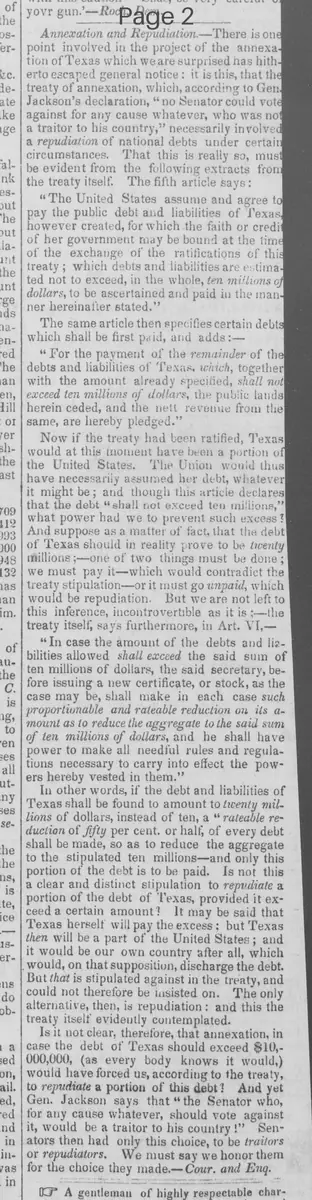
Annexation and Repudiation.—There is one point involved in the project of the annexation of Texas which we are surprised has hitherto escaped general notice: it is this, that the treaty of annexation, which, according to Gen. Jackson's declaration, "no Senator could vote against for any cause whatever, who was not a traitor to his country," necessarily involved a repudiation of national debts under certain circumstances. That this is really so, must be evident from the following extracts from the treaty itself. The fifth article says:
"The United States assume and agree to pay the public debt and liabilities of Texas however created, for which the faith or credit of her government may be bound at the time of the exchange of the ratifications of this treaty; which debts and liabilities are estimated not to exceed, in the whole, ten millions of dollars, to be ascertained and paid in the manner hereinafter stated."
The same article then specifies certain debts which shall be first paid, and adds:-
"For the payment of the remainder of the debts and liabilities of Texas, which, together with the amount already specified, shall not exceed ten millions of dollars, the public lands herein ceded, and the nett revenue from the same, are hereby pledged."
Now if the treaty had been ratified, Texas would at this moment have been a portion of the United States. The Union would thus have necessarily assumed her debt, whatever it might be; and though this article declares that the debt "shall not exceed ten millions," what power had we to prevent such excess?
And suppose as a matter of fact, that the debt of Texas should in reality prove to be twenty millions;—one of two things must be done; we must pay it—which would contradict the treaty stipulation—or it must go unpaid, which would be repudiation. But we are not left to this inference, incontrovertible as it is;—the treaty itself, says furthermore, in Art. VI,—
"In case the amount of the debts and liabilities allowed shall exceed the said sum of ten millions of dollars, the said secretary, before issuing a new certificate, or stock, as the case may be, shall make in each case such proportionable and rateable reduction on its amount as to reduce the aggregate to the said sum of ten millions of dollars, and he shall have power to make all needful rules and regulations necessary to carry into effect the powers hereby vested in them."
In other words, if the debt and liabilities of Texas shall be found to amount to twenty millions of dollars, instead of ten, a "rateable reduction of fifty per cent. or half, of every debt shall be made, so as to reduce the aggregate to the stipulated ten millions—and only this portion of the debt is to be paid. Is not this a clear and distinct stipulation to repudiate a portion of the debt of Texas, provided it exceed a certain amount? It may be said that Texas herself will pay the excess: but Texas then will be a part of the United States; and it would be our own country after all, which would, on that supposition, discharge the debt. But that is stipulated against in the treaty, and could not therefore be insisted on. The only alternative, then, is repudiation: and this the treaty itself evidently contemplated.
Is it not clear, therefore, that annexation, in case the debt of Texas should exceed $10,000,000, (as every body knows it would,) would have forced us, according to the treaty, to repudiate a portion of this debt? And yet Gen. Jackson says that "the Senator who, for any cause whatever, should vote against it, would be a traitor to his country!" Senators then had only this choice, to be traitors or repudiators. We must say we honor them for the choice they made.—Cour. and Enq.
"The United States assume and agree to pay the public debt and liabilities of Texas however created, for which the faith or credit of her government may be bound at the time of the exchange of the ratifications of this treaty; which debts and liabilities are estimated not to exceed, in the whole, ten millions of dollars, to be ascertained and paid in the manner hereinafter stated."
The same article then specifies certain debts which shall be first paid, and adds:-
"For the payment of the remainder of the debts and liabilities of Texas, which, together with the amount already specified, shall not exceed ten millions of dollars, the public lands herein ceded, and the nett revenue from the same, are hereby pledged."
Now if the treaty had been ratified, Texas would at this moment have been a portion of the United States. The Union would thus have necessarily assumed her debt, whatever it might be; and though this article declares that the debt "shall not exceed ten millions," what power had we to prevent such excess?
And suppose as a matter of fact, that the debt of Texas should in reality prove to be twenty millions;—one of two things must be done; we must pay it—which would contradict the treaty stipulation—or it must go unpaid, which would be repudiation. But we are not left to this inference, incontrovertible as it is;—the treaty itself, says furthermore, in Art. VI,—
"In case the amount of the debts and liabilities allowed shall exceed the said sum of ten millions of dollars, the said secretary, before issuing a new certificate, or stock, as the case may be, shall make in each case such proportionable and rateable reduction on its amount as to reduce the aggregate to the said sum of ten millions of dollars, and he shall have power to make all needful rules and regulations necessary to carry into effect the powers hereby vested in them."
In other words, if the debt and liabilities of Texas shall be found to amount to twenty millions of dollars, instead of ten, a "rateable reduction of fifty per cent. or half, of every debt shall be made, so as to reduce the aggregate to the stipulated ten millions—and only this portion of the debt is to be paid. Is not this a clear and distinct stipulation to repudiate a portion of the debt of Texas, provided it exceed a certain amount? It may be said that Texas herself will pay the excess: but Texas then will be a part of the United States; and it would be our own country after all, which would, on that supposition, discharge the debt. But that is stipulated against in the treaty, and could not therefore be insisted on. The only alternative, then, is repudiation: and this the treaty itself evidently contemplated.
Is it not clear, therefore, that annexation, in case the debt of Texas should exceed $10,000,000, (as every body knows it would,) would have forced us, according to the treaty, to repudiate a portion of this debt? And yet Gen. Jackson says that "the Senator who, for any cause whatever, should vote against it, would be a traitor to his country!" Senators then had only this choice, to be traitors or repudiators. We must say we honor them for the choice they made.—Cour. and Enq.
What sub-type of article is it?
Imperialism
Economic Policy
Foreign Affairs
What keywords are associated?
Texas Annexation
Debt Repudiation
Annexation Treaty
Jackson Declaration
Senate Vote
What entities or persons were involved?
Gen. Jackson
Senators
Texas
United States
Cour. And Enq.
Editorial Details
Primary Topic
Texas Annexation Treaty And Debt Repudiation
Stance / Tone
Critical Opposition To The Treaty
Key Figures
Gen. Jackson
Senators
Texas
United States
Cour. And Enq.
Key Arguments
The Treaty Assumes Us Payment Of Texas Debts Up To $10 Million.
If Debts Exceed $10 Million, Article Vi Mandates Rateable Reduction, Amounting To Repudiation.
Annexation Would Force The Us To Repudiate Excess Debt As Texas Becomes Part Of The Union.
Gen. Jackson Declared Opposition To The Treaty As Treason.
Senators Who Voted Against It Chose Integrity Over Repudiation.