Thank you for visiting SNEWPapers!
Sign up free
Alexandria Daily Advertiser
Alexandria, Virginia
What is this article about?
In a House debate on January 30, Mr. Lucas argues against validating Georgia land claims from the 1795 act, citing fraud by land companies who misstated acreage to buy 35-40 million acres for $500,000, intended as 31.75 million, and deceived citizen subscribers on pricing.
Merged-components note: These components form a single continued narrative story reporting on the congressional debate on the Georgia claims, as indicated by '(Continued.)' and seamless text flow across sequential reading orders.
Clipping
OCR Quality
Full Text
OF THE
UNITED STATES.
HOUSE OF REPRESENTATIVES.
WEDNESDAY, Jan. 30.
Debate on the Georgia CLAIMS.
(Continued.)
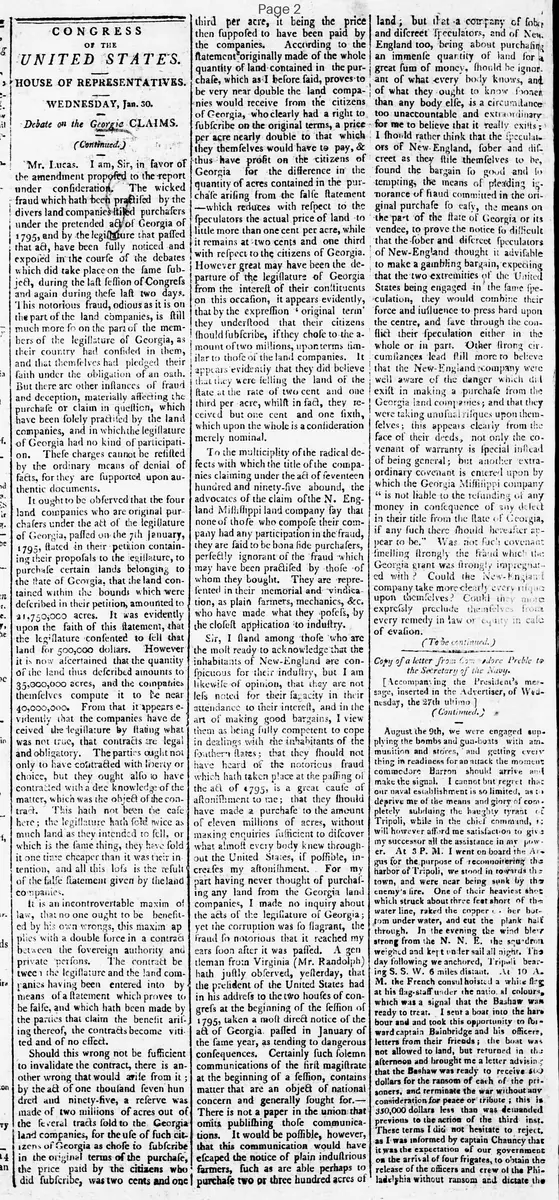
Mr. Lucas. I am, Sir, in favor of the amendment proposed to the report under consideration. The wicked fraud which hath been practiced by the divers land companies styled purchasers under the pretended act of Georgia of 1795, and by the legislature that passed that act, have been fully noticed and exposed in the course of the debates which did take place on the same subject, during the last session of Congress and again during these last two days. This notorious fraud, odious as it is on the part of the land companies, is still much more so on the part of the members of the legislature of Georgia, as their country had confided in them, and that themselves had pledged their faith under the obligation of an oath. But there are other instances of fraud and deception, materially affecting the purchase or claim in question, which have been solely practiced by the land companies, and in which the legislature of Georgia had no kind of participation.
These charges cannot be resisted by the ordinary means of denial of facts, for they are supported upon authentic documents.
It ought to be observed that the four land companies who are original purchasers under the act of the legislature of Georgia, passed on the 7th January, 1795, stated in their petition containing their proposals to the legislature, to purchase certain lands belonging to the state of Georgia. that the land contained within the bounds which were described in their petition, amounted to 31,750,000 acres. It was evidently upon the faith of this statement, that the legislature consented to sell that land for 500,000 dollars. However it is now ascertained that the quantity of the land thus described amounts to 35,000,000 acres, and the companies themselves compute it to be near 40,000,000. From that it appears evidently that the companies have deceived the legislature by stating what was not true, that contracts are legal and obligatory. The parties ought not only to have contracted with liberty of choice, but they ought also to have contracted with a due knowledge of the matter, which was the object of the contract.
This hath not been the case here: the legislature hath sold twice as much land as they intended to sell, or which is the same thing, they have sold it one half cheaper than it was their intention, and all this loss is the result of the false statement given by the land companies.
It is an incontrovertible maxim of law, that no one ought to be benefited by his own wrongs, this maxim applies with a double force in a contract between the sovereign authority and private persons. The contract between the legislature and the land companies having been entered into by means of a statement which proves to be false, and which hath been made by the parties that claim the benefit arising thereof, the contracts become vitiated and of no effect.
Should this wrong not be sufficient to invalidate the contract, there is another wrong that would arise from it ; by the act of one thousand seven hundred and ninety-five, a reserve was made of two millions of acres out of the several tracts sold to the Georgia land companies, for the use of such citizens of Georgia as chose to subscribe in the original terms of the purchase. the price paid by the citizens who did subscribe, was two cents and one
third per acre, it being the price then supposed to have been paid by the companies. According to the statement originally made of the whole quantity of land contained in the purchase, which as I before said, proves to be very near double the land companies would receive from the citizens of Georgia, who clearly had a right to subscribe on the original terms, a price per acre nearly double to that which they themselves would have to pay, & thus have profit on the citizens of Georgia for the difference in the quantity of acres contained in the purchase arising from the false statement --which reduces with respect to the speculators the actual price of land to little more than one cent per acre, while it remains at two cents and one third with respect to the citizens of Georgia. However great may have been the departure of the legislature of Georgia from the interest of their constituents on this occasion, it appears evidently, that by the expression original terms they understood that their citizens should subscribe, if they chose to the amount of two millions, upon terms similar to those of the land companies. It appears evidently that they did believe that they were selling the land of the state at the rate of two cents and one third per acre, whilst in fact, they received but one cent and one sixth, which upon the whole is a consideration merely nominal.
To the multiplicity of the radical defects with which the title of the companies claiming under the act of seventeen hundred and ninety-five abound, the advocates of the claim of the N. England Mississippi land company say that none of those who compose their company had any participation in the fraud, they are said to be bona fide purchasers, perfectly ignorant of the fraud which may have been practiced by those of whom they bought. They are represented in their memorial and vindication, as plain farmers, mechanics, &c. who have made what they possess, by the closest application to industry.
Sir, I stand among those who are the most ready to acknowledge that the inhabitants of New-England are conspicuous for their industry, but I am likewise of opinion, that they are not less noted for their sagacity in their attendance to their interest, and in the art of making good bargains, I view them as being fully competent to cope in dealings with the inhabitants of the southern states: that they should not have heard of the notorious fraud which hath taken place at the passing of the act of 1795, is a great cause of astonishment to me; that they should have made a purchase to the amount of eleven millions of acres, without making enquiries sufficient to discover what almost every body knew throughout the United States, if possible, increases my astonishment. For my part having never thought of purchasing any land from the Georgia land companies, I made no inquiry about the acts of the legislature of Georgia; yet the corruption was so flagrant, the fraud so notorious that it reached my ears soon after it was passed. A gentleman from Virginia (Mr. Randolph) hath justly observed, yesterday, that the president of the United States had in his address to the two houses of congress at the beginning of the session of 1795, taken a most direct notice of the act of Georgia. passed in January of the same year, as tending to dangerous consequences. Certainly such solemn communications of the first magistrate at the beginning of a session, contains matters that are an object of national concern and generally ought for.
There is not a paper in the union that omits publishing those communications. It would be possible, however, that this communication would have escaped the notice of plain industrious farmers, such as are able perhaps to purchase two or three hundred acres of
land: but that a company of sober and discreet speculators, and of New-England too, being about purchasing an immense quantity of land for great sum of money, should be ignorant of what every body knows, and of what they ought to know sooner than any body else, is a circumstance too unaccountable and extraordinary for me to believe that it really exists ; I should rather think that the speculators of New-England. sober and discreet as they stile themselves to be, found the bargain so good and so tempting, the means of pleading ignorance of fraud committed in the original purchase so easy, the means on the part of the state of Georgia or its vendee, to prove the notice so difficult that the sober and discreet speculators of New-England thought it advisable to make a gambling bargain, expecting that the two extremities of the United States being engaged in the same speculation, they would combine their force and influence to press hard upon the centre, and save through the conflict their peculation either in the whole or in part. Other strong circumstances lead still more to believe that the New-England company were well aware of the danger which did exist in making a purchase from the Georgia land companies; and that they were taking unusual risques upon themselves; this appears clearly from the face of their deeds, not only the covenant of warranty is special instead of being general; but another extraordinary covenant is entered upon by which the Georgia Mississippi company " is not liable to the refunding of any money in consequence of any defect in their title from the state of Georgia, if any such there should hereafter appear to be." Was not such covenant smelling strongly the fraud which the Georgia grant was strongly impregnated with ? Could the New-England company take more clearly every risque upon themselves? Could they more expressly preclude themselves from every remedy in law or equity in case of evasion.
( To be continued. )
What sub-type of article is it?
What themes does it cover?
What keywords are associated?
What entities or persons were involved?
Where did it happen?
Story Details
Key Persons
Location
United States House Of Representatives
Event Date
Wednesday, Jan. 30
Story Details
Mr. Lucas exposes fraud in the 1795 Georgia land act where companies understated acreage to purchase vast lands cheaply, deceiving the legislature and citizens on subscription terms, arguing the contracts are invalid and New England buyers were aware of the fraud.