Thank you for visiting SNEWPapers!
Sign up free
Story
November 13, 1880
Clarksville Weekly Chronicle
Clarksville, Montgomery County, Tennessee
What is this article about?
Prof. Palmieri lectures on foretelling earthquakes using signs like atmospheric changes, well drying, and animal unease, proposing seismographic stations for advance warnings, drawing from his volcanic studies at Mt. Vesuvius.
Clipping
OCR Quality
98%
Excellent
Full Text
Prof. Palmieri on Earthquakes.
London Daily News.
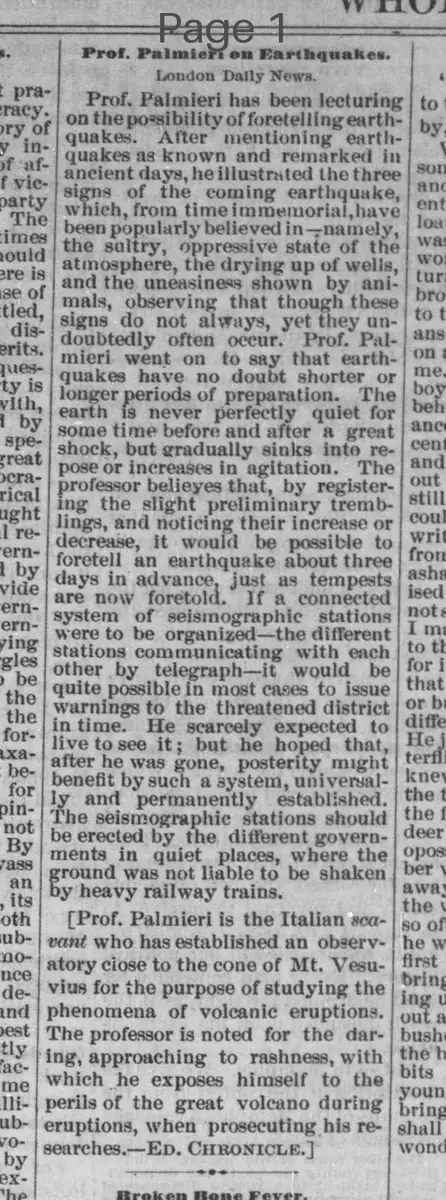
Prof. Palmieri has been lecturing on the possibility of foretelling earthquakes. After mentioning earthquakes as known and remarked in ancient days, he illustrated the three signs of the coming earthquake, which, from time immemorial, have been popularly believed in--namely, the sultry, oppressive state of the atmosphere, the drying up of wells, and the uneasiness shown by animals, observing that though these signs do not always, yet they undoubtedly often occur. Prof. Palmieri went on to say that earthquakes have no doubt shorter or longer periods of preparation. The earth is never perfectly quiet for some time before and after a great shock, but gradually sinks into repose or increases in agitation. The professor believes that, by registering the slight preliminary tremblings, and noticing their increase or decrease, it would be possible to foretell an earthquake about three days in advance, just as tempests are now foretold. "If a connected system of seismographic stations were to be organized--the different stations communicating with each other by telegraph--it would be quite possible in most cases to issue warnings to the threatened district in time. He scarcely expected to live to see it; but he hoped that, after he was gone, posterity might benefit by such a system, universally and permanently established. The seismographic stations should be erected by the different governments in quiet places, where the ground was not liable to be shaken by heavy railway trains.
[Prof. Palmieri is the Italian scientist who has established an observatory close to the cone of Mt. Vesuvius for the purpose of studying the phenomena of volcanic eruptions. The professor is noted for the daring, approaching to rashness, with which he exposes himself to the perils of the great volcano during eruptions, when prosecuting his researches.--ED. CHRONICLE.]
London Daily News.
Prof. Palmieri has been lecturing on the possibility of foretelling earthquakes. After mentioning earthquakes as known and remarked in ancient days, he illustrated the three signs of the coming earthquake, which, from time immemorial, have been popularly believed in--namely, the sultry, oppressive state of the atmosphere, the drying up of wells, and the uneasiness shown by animals, observing that though these signs do not always, yet they undoubtedly often occur. Prof. Palmieri went on to say that earthquakes have no doubt shorter or longer periods of preparation. The earth is never perfectly quiet for some time before and after a great shock, but gradually sinks into repose or increases in agitation. The professor believes that, by registering the slight preliminary tremblings, and noticing their increase or decrease, it would be possible to foretell an earthquake about three days in advance, just as tempests are now foretold. "If a connected system of seismographic stations were to be organized--the different stations communicating with each other by telegraph--it would be quite possible in most cases to issue warnings to the threatened district in time. He scarcely expected to live to see it; but he hoped that, after he was gone, posterity might benefit by such a system, universally and permanently established. The seismographic stations should be erected by the different governments in quiet places, where the ground was not liable to be shaken by heavy railway trains.
[Prof. Palmieri is the Italian scientist who has established an observatory close to the cone of Mt. Vesuvius for the purpose of studying the phenomena of volcanic eruptions. The professor is noted for the daring, approaching to rashness, with which he exposes himself to the perils of the great volcano during eruptions, when prosecuting his researches.--ED. CHRONICLE.]
What sub-type of article is it?
Curiosity
Historical Event
What themes does it cover?
Catastrophe
Triumph
What keywords are associated?
Earthquakes
Foretelling
Seismographic Stations
Prof. Palmieri
Mt. Vesuvius
Volcanic Observatory
What entities or persons were involved?
Prof. Palmieri
Where did it happen?
Mt. Vesuvius
Story Details
Key Persons
Prof. Palmieri
Location
Mt. Vesuvius
Story Details
Prof. Palmieri discusses ancient signs of earthquakes and proposes using seismographic stations to predict them three days in advance via telegraphic communication, based on preliminary tremblings.