Thank you for visiting SNEWPapers!
Sign up free
Editorial
July 21, 1827
Constitutional Whig
Richmond, Virginia
What is this article about?
The editorial quotes the Troy Sentinel defending the U.S. administration against opposition accusations of losing the West India trade, asserting it continues via neutral ports with costs borne by British planters, not American exporters. Only one-seventh of U.S. exports went directly to British West Indies previously.
Clipping
OCR Quality
95%
Excellent
Full Text
COLONIAL TRADE.
The Troy Sentinel, published in the interior of New-York, contains the following correct views in relation to the so much talked of Colonial trade.
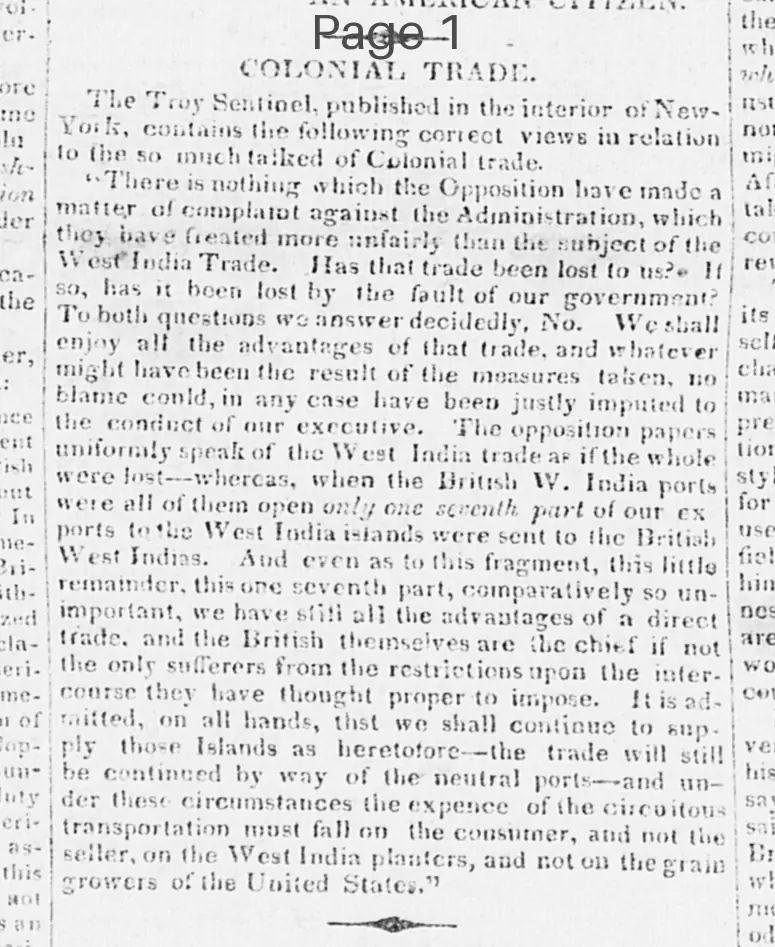
"There is nothing which the Opposition have made a matter of complaint against the Administration, which they have treated more unfairly than the subject of the West India Trade. Has that trade been lost to us? If so, has it been lost by the fault of our government? To both questions we answer decidedly. No. We shall enjoy all the advantages of that trade, and whatever might have been the result of the measures taken, no blame could, in any case have been justly imputed to the conduct of our executive. The opposition papers uniformly speak of the West India trade as if the whole were lost—whereas, when the British W. India ports were all of them open only one seventh part of our exports to the West India islands were sent to the British West Indies. And even as to this fragment, this little remainder, this one seventh part, comparatively so unimportant, we have still all the advantages of a direct trade, and the British themselves are the chief if not the only sufferers from the restrictions upon the intercourse they have thought proper to impose. It is admitted, on all hands, that we shall continue to supply those Islands as heretofore—the trade will still be continued by way of the neutral ports—and under these circumstances the expense of the circuitous transportation must fall on the consumer, and not the seller, on the West India planters, and not on the grain growers of the United States."
The Troy Sentinel, published in the interior of New-York, contains the following correct views in relation to the so much talked of Colonial trade.
"There is nothing which the Opposition have made a matter of complaint against the Administration, which they have treated more unfairly than the subject of the West India Trade. Has that trade been lost to us? If so, has it been lost by the fault of our government? To both questions we answer decidedly. No. We shall enjoy all the advantages of that trade, and whatever might have been the result of the measures taken, no blame could, in any case have been justly imputed to the conduct of our executive. The opposition papers uniformly speak of the West India trade as if the whole were lost—whereas, when the British W. India ports were all of them open only one seventh part of our exports to the West India islands were sent to the British West Indies. And even as to this fragment, this little remainder, this one seventh part, comparatively so unimportant, we have still all the advantages of a direct trade, and the British themselves are the chief if not the only sufferers from the restrictions upon the intercourse they have thought proper to impose. It is admitted, on all hands, that we shall continue to supply those Islands as heretofore—the trade will still be continued by way of the neutral ports—and under these circumstances the expense of the circuitous transportation must fall on the consumer, and not the seller, on the West India planters, and not on the grain growers of the United States."
What sub-type of article is it?
Trade Or Commerce
Economic Policy
Partisan Politics
What keywords are associated?
West India Trade
Colonial Trade
Administration Defense
Opposition Criticism
Neutral Ports
British Restrictions
U.S. Exports
What entities or persons were involved?
Administration
Opposition
Troy Sentinel
British West Indies
West India Planters
Grain Growers Of The United States
Editorial Details
Primary Topic
Defense Of Administration On West India Trade Restrictions
Stance / Tone
Supportive Of Administration, Refuting Opposition
Key Figures
Administration
Opposition
Troy Sentinel
British West Indies
West India Planters
Grain Growers Of The United States
Key Arguments
West India Trade Has Not Been Lost To The U.S.
Loss Not Due To Fault Of U.S. Government
Only One Seventh Of U.S. Exports Went To British West Indies Even When Ports Were Open
Trade Continues Via Neutral Ports
British Restrictions Harm Their Own Planters More Than U.S. Sellers
Expense Of Circuitous Trade Falls On West India Consumers, Not U.S. Grain Growers