Thank you for visiting SNEWPapers!
Sign up free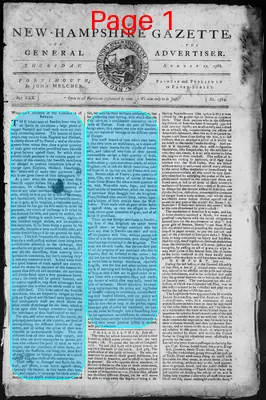
Fowle's New Hampshire Gazette And General Advertiser
Portsmouth, Rockingham County, New Hampshire
What is this article about?
William's account details Sweden's commerce challenges: limited specie, volatile exchange rates causing merchant losses, trade imbalances with France and the Baltic, monopolies inflating prices, and restrictive laws deterring foreign merchants, hindering economic flourishing.
Clipping
OCR Quality
Full Text
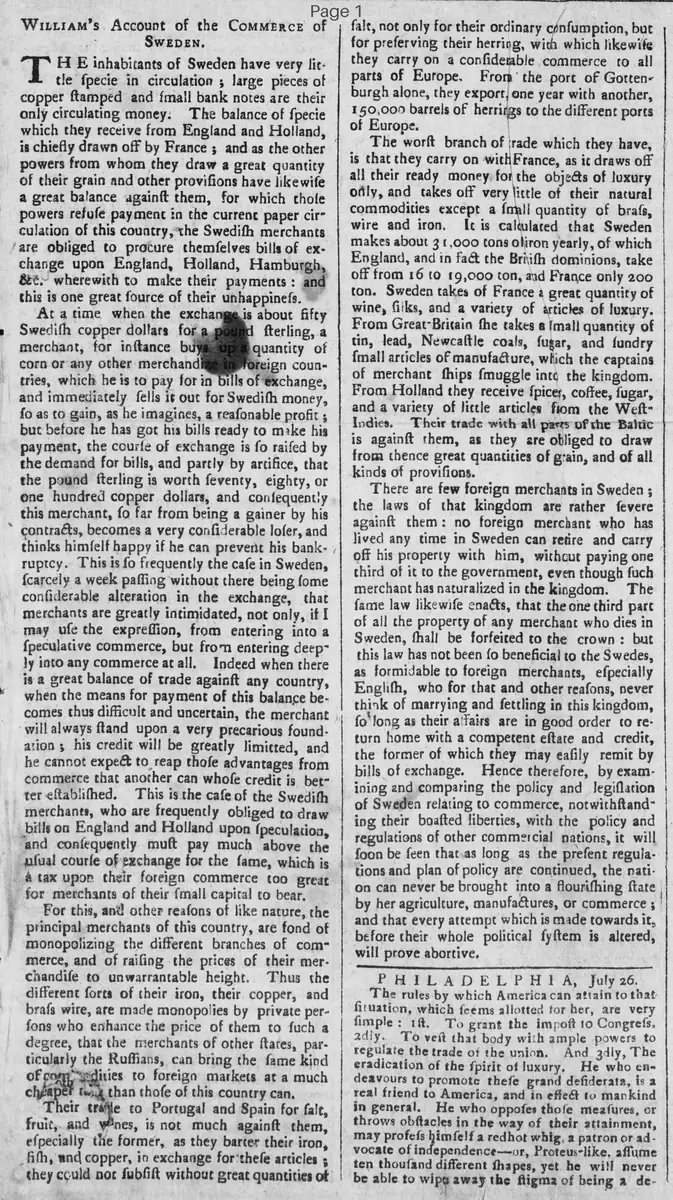
The inhabitants of Sweden have very little specie in circulation; large pieces of copper stamped and small bank notes are their only circulating money. The balance of specie which they receive from England and Holland, is chiefly drawn off by France; and as the other powers from whom they draw a great quantity of their grain and other provisions have likewise a great balance against them, for which those powers refuse payment in the current paper circulation of this country, the Swedish merchants are obliged to procure themselves bills of exchange upon England, Holland, Hamburgh, &c.--wherewith to make their payments: and this is one great source of their unhappiness.
At a time when the exchange is about fifty Swedish copper dollars for a pound sterling, a merchant, for instance buys up a quantity of corn or any other merchandize in foreign countries, which he is to pay for in bills of exchange, and immediately sells it out for Swedish money, so as to gain, as he imagines, a reasonable profit; but before he has got his bills ready to make his payment, the course of exchange is so raised by the demand for bills, and partly by artifice, that the pound sterling is worth seventy, eighty, or one hundred copper dollars, and consequently this merchant, so far from being a gainer by his contracts, becomes a very considerable loser, and thinks himself happy if he can prevent his bankruptcy. This is so frequently the case in Sweden, scarcely a week passing without there being some considerable alteration in the exchange, that merchants are greatly intimidated, not only, if I may use the expression, from entering into a speculative commerce, but from entering deeply into any commerce at all. Indeed when there is a great balance of trade against any country, when the means for payment of this balance becomes thus difficult and uncertain, the merchant will always stand upon a very precarious foundation; his credit will be greatly limited, and he cannot expect to reap those advantages from commerce that another can whose credit is better established. This is the case of the Swedish merchants, who are frequently obliged to draw bills on England and Holland upon speculation, and consequently must pay much above the usual course of exchange for the same, which is a tax upon their foreign commerce too great for merchants of their small capital to bear.
For this, and other reasons of like nature, the principal merchants of this country, are fond of monopolizing the different branches of commerce, and of raising the prices of their merchandize to unwarrantable height. Thus the different sorts of their iron, their copper, and brass wire, are made monopolies by private persons who enhance the price of them to such a degree, that the merchants of other states, particularly the Russians, can bring the same kind of commodities to foreign markets at a much cheaper rate than those of this country can.
Their trade to Portugal and Spain for salt, fruit, and wines, is not much against them, especially the former, as they barter their iron, fish, and copper, in exchange for those articles; they could not subsist without great quantities of salt, not only for their ordinary consumption, but for preserving their herring, with which likewise they carry on a considerable commerce to all parts of Europe. From the port of Gothenburg alone, they export, one year with another, 150,000 barrels of herrings to the different ports of Europe.
The worst branch of trade which they have, is that they carry on with France, as it draws off all their ready money for the objects of luxury only, and takes off very little of their natural commodities except a small quantity of brass, wire and iron. It is calculated that Sweden makes about 300,000 tons of iron yearly, of which England, and in fact the British dominions, take off from 16000 to 19000 tons, and France only 200 tons. Sweden takes of France a great quantity of wine, silks, and a variety of articles of luxury. From Great-Britain she takes a small quantity of tin, lead, Newcastle coals, sugar, and sundry small articles of manufacture, which the captains of merchant ships smuggle into the kingdom. From Holland they receive spices, coffee, sugar, and a variety of little articles from the West-Indies. Their trade with all parts of the Baltic is against them, as they are obliged to draw from thence great quantities of grain, and of all kinds of provisions.
There are few foreign merchants in Sweden; the laws of that kingdom are rather severe against them: no foreign merchant who has lived any time in Sweden can retire and carry off his property with him, without paying one third of it to the government, even though such merchant has naturalized in the kingdom. The same law likewise enacts, that the one third part of all the property of any merchant who dies in Sweden, shall be forfeited to the crown: but this law has not been so beneficial to the Swedes, as formidable to foreign merchants, especially English, who for that and other reasons, never think of marrying and settling in this kingdom, so long as their affairs are in good order to return home with a competent estate and credit, the former of which they may easily remit by bills of exchange. Hence therefore, by examining and comparing the policy and legislation of Sweden relating to commerce, notwithstanding their boasted liberties, with the policy and regulations of other commercial nations, it will soon be seen that as long as the present regulations and plan of policy are continued, the nation can never be brought into a flourishing state by her agriculture, manufactures, or commerce; and that every attempt which is made towards it, before their whole political system is altered, will prove abortive.
What sub-type of article is it?
What keywords are associated?
What entities or persons were involved?
Where did it happen?
Foreign News Details
Primary Location
Sweden
Key Persons
Outcome
sweden faces trade imbalances, volatile exchange rates leading to merchant losses and bankruptcies, monopolies raising prices, and restrictive laws deterring foreign investment, preventing economic flourishing.
Event Details
William's account describes Sweden's monetary system reliant on copper and notes, trade deficits with France and Baltic regions, favorable barter with Portugal and Spain, iron production and exports, luxury imports, and policies hindering commerce and foreign merchants.