Thank you for visiting SNEWPapers!
Sign up free
Literary
July 26, 1842
The Middlebury People's Press
Middlebury, Addison County, Vermont
What is this article about?
A physician aids a destitute widow and her children during a storm, learning she is the disowned daughter of a wealthy merchant for marrying poorly. He orchestrates their reunion, leading to the merchant's forgiveness and the family's restoration to comfort.
Clipping
OCR Quality
95%
Excellent
Full Text
Miscellaneous.
From the Saturday Courier.
The Merchant and His Daughter.
A Tale of Real Life.
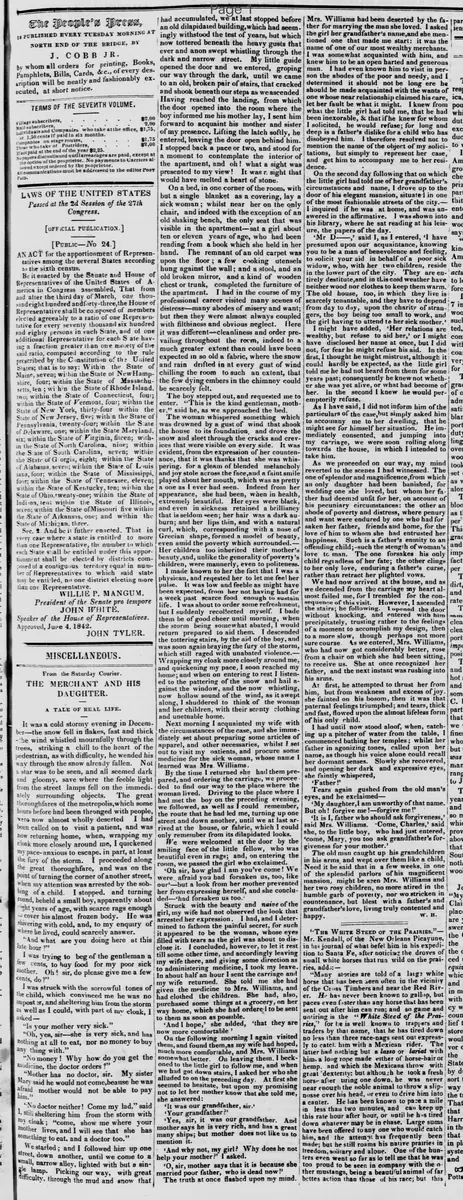
It was a cold stormy evening in December—the snow fell in flakes, fast and thick—the wind whistled mournfully through the trees, striking a chill to the heart of the pedestrian, as with difficulty, he wended his way through the snow already fallen. Not a star was to be seen, and all seemed dark and gloomy, save where the feeble light from the street lamps fell on the immediately surrounding objects. The great thoroughfares of the metropolis, which some hours before had been thronged with people, were now almost wholly deserted. I had been called on to visit a patient, and was now returning home, when, wrapping my cloak more closely around me, I quickened my pace—anxious to escape, in part, at least, the fury of the storm. I proceeded along the great thoroughfare, and was on the point of turning the corner of another street, when my attention was arrested by the sobbing of a child. I stopped, and turning round, beheld a small boy, apparently about eight years of age, with scarce rags enough to cover his almost frozen body. He was shivering with cold, and, to my enquiry of where he lived, could scarcely answer.
"And what are you doing here at this late hour?"
"I was trying to beg of the gentlemen a few cents, to buy food for my poor sick mother. Oh! sir, do please give me a few cents, do?"
I was struck with the sorrowful tones of the child, which convinced me he was no impostor, and sheltering him from the storm as well as I could, with part of my cloak, I asked—
"Is your mother very sick."
"Oh, yes, sir—she is very sick, and has nothing at all to eat, nor no money to buy anything with."
"No money! Why how do you get the medicine, the doctor orders?"
"Mother has no doctor, sir. My sister Mary said he would not come, because he was afraid mother would not be able to pay him."
"No doctor neither! Come my lad," said I, still sheltering him from the storm with my cloak; "come, show me where your mother lives, and I will see that she has something to eat, and a doctor too."
We started; and I followed him: up one street, down another, until we come to a small, narrow alley, lighted with but a single lamp. Picking our way, with great difficulty, through the mud and snow that had accumulated, we at last stopped before an old dilapidated building, which had seemingly withstood the test of years, but which now tottered beneath the heavy gusts that ever and anon swept whistling through the dark and narrow street. My little guide opened the door and we entered, groping our way through the dark, until we came to an old, broken pair of stairs, that cracked and shook beneath our steps as we ascended. Having reached the landing, from which the door opened into the room where the boy informed me his mother lay, I sent him forward to acquaint his mother and sister of my presence. Lifting the latch softly, he entered, leaving the door open behind him. I stepped back a pace or two, and stood for a moment to contemplate the interior of the apartment, and oh! what a sight was presented to my view! It was a sight that would have melted a heart of stone. On a bed, in one corner of the room, with but a single blanket as a covering, lay a sick woman; whilst near her on the only chair, and indeed with the exception of an old shaking bench, the only seat that was visible in the apartment—sat a girl about ten or eleven years of age, who had been reading from a book which she held in her hand. The remnant of an old carpet was upon the floor; a few cooking utensils hung against the wall; and a stool, and an old broken mirror, and a kind of wooden chest or trunk, completed the furniture of the apartment. I had in the course of my professional career visited many scenes of distress—many abodes of misery and want; but then they were almost always coupled with filthiness and obvious neglect. Here it was different—cleanliness and order prevailed throughout the room, indeed to a much greater extent than could have been expected in so old a fabric, where the snow and rain drifted in at every gust of wind chilling the room to such an extent, that the few dying embers in the chimney could be scarcely felt. The boy stepped out, and requested me to enter. "This is the kind gentleman, mother," said he, as we approached the bed. The woman whispered something which was drowned by a gust of wind that shook the house to its foundation, and drove the snow and sleet through the cracks and crevices that were visible on every side. It was evident, from the expression of her countenance, that it was thanks that she was whispering, for a gleam of blended melancholy and joy stole across the face, and a faint smile played about her mouth, which was as pretty a one as I ever had seen. Indeed from her appearance, she had been, when in health, extremely beautiful. Her eyes were black, and even in sickness retained a brilliancy that is seldom seen; her hair was a dark auburn; and her lips thin, and with a natural curl, which, corresponding with a nose of Grecian shape, formed a model of beauty, even amid the poverty which surrounded. Her children too inherited their mother's beauty, and, unlike the generality of poverty's children, were mannerly, even to politeness. I made known to her the fact that I was a physician, and requested her to let me feel her pulse. It was low and feeble as might have been expected, from her not having had for a week past scarce food enough to sustain life. I was about to order some refreshment, but I suddenly recollected myself. I bade them be of good cheer until morning, when the storm being somewhat abated, I would return prepared to aid them. I descended the tottering stairs, by the aid of the boy, and was soon again braving the fury of the storm, which still raged with unabated violence. Wrapping my cloak more closely around me, and quickening my pace, I soon reached my home; and when on entering to rest I listened to the pattering of the snow and hail against the window, and the now whistling, now hollow sound of the wind, as it swept along, I shuddered to think of the woman and her children, with their scanty clothing and untenable home. Next morning I acquainted my wife with the circumstances of the case, and she immediately set about preparing some articles of apparel, and other necessaries, whilst I set out to visit my patients, and procure some medicine for the sick woman, whose name I learned was Mrs. Williams. By the time I returned she had them prepared, and ordering the carriage, we proceeded to find our way to the place where the woman lived. Driving to the place where I had met the boy on the preceding evening, we followed, as well as I could remember, the route that he had led me, turning up one street and down another, until we at last arrived at the house, or fabric, which I could only remember from its dilapidated looks. We were welcomed at the door by the smiling face of the little fellow, who was beautiful even in rags; and, on entering the room, we passed the girl who exclaimed, "Oh sir, how glad I am you've come! We were afraid you had forsaken us, too, like our"—but a look from her mother prevented her from expressing herself, and she concluded—"had forsaken us too." Struck with the beauty and naivete of the girl, my wife had not observed the look that arrested her expression. I had, and I determined to fathom the painful secret, for such it appeared to be the woman, whose eyes filled with tears as the girl was about to disclose it. I concluded, however, to let it rest till some other time, and accordingly leaving my wife there, and giving some direction as to administering medicine, I took my leave. In about half an hour I sent the carriage and my wife returned. She told me she had given the medicine to Mrs. Williams, and had clothed the children. She had, also, purchased some things at a grocery, on her way home, which she had ordered to be sent to them as soon as possible. "And I hope," she added, "that they are now more comfortable." On the following morning I again visited them, and found them, as my wife had hoped, much more comfortable, and Mrs. Williams somewhat better. On leaving them, I beckoned to the little girl to follow me, and when we had got down stairs, I asked her who she alluded to on the preceding day. At first she seemed to hesitate, but upon my promising not to let her mother know that she told me, she answered: "It was our grandfather, sir." "Your grandfather?" "Yes, sir, it was our grandfather. And mother says he is very rich, and has a great many ships; but mother does not like us to mention it." "And why not, my girl? Why does he not help your mother?" I asked. "O, sir, mother says that it is because she married poor father, who is dead now!" The truth at once flashed upon my mind. Mrs. Williams had been deserted by the father for marrying the man she loved. I asked the girl her grandfather's name, and she mentioned one that made me start: it was the name of one of our most wealthy merchants. I was somewhat acquainted with him, and knew him to be an open hearted and generous man. I had even known him to visit in person the abodes of the poor and needy, and I determined it should not be long ere he should be made acquainted with the wants of one whose near relationship claimed his care, let her fault be what it might. I knew from what the little girl had told me, that he had been inexorable, & that if he knew for whom I solicited, he would refuse; for long and deep is a father's dislike for a child who has disobeyed him. I therefore resolved not to mention the name of the object of my solicitations, but simply to represent her case and get him to accompany me to her residence. On the second day following that on which the little girl had told me of her grandfather's circumstances and name, I drove up to the door of his elegant mansion, situated in one of the most fashionable streets of the city.— I inquired if he was at home, and was answered in the affirmative. I was shown into his library, where he sat reading at his leisure, the papers of the day. "Mr. D.," said I, as I entered, "I have presumed upon our acquaintance, knowing you to be a man of benevolence and feeling, to solicit your aid in behalf of a poor sick widow, who, with her two children, reside in the lower part of the city. They are entirely destitute, and in this cold weather have neither wood nor clothes to keep them warm. The old house, too, in which they live is scarcely tenantable, and they have to depend from day to day, upon the charity of strangers, the boy being too small to work, and the girl having to attend to her sick mother." I might have added, "Her relations are wealthy, but refuse to aid her," or I might have disclosed her name at once, but I did not, for fear he might refuse his aid. In the first, I thought he might mistrust, although it could hardly be expected, as the little girl told me he had not heard from them for some years past; consequently he knew not whether she was yet alive, or what had become of her. In the second I knew he would peremptorily refuse. As I have said, I did not inform him of the particulars of the case, but simply asked him to accompany me to her dwelling, that he might see for himself her situation. He immediately consented, and jumping into my carriage, we were soon rolling along towards the house, in which I intended to take him. As we proceeded on our way, my mind reverted to the scenes I had witnessed. The one of splendor and magnificence, from which an only daughter had been banished, for wedding one she loved, but whom her father had deemed unfit for her, on account of his pecuniary circumstances: the other an abode of poverty and distress, where penury and want were endured by one who had forsaken her father, friends and home, for the love of him to whom she had entrusted her happiness. Such is a father's enmity to an offending child;—such the strength of woman's love to man. The one forsakes his only child regardless of her fate; the other clings to her only love, enduring a father's curse, rather than retract her plighted vows. We had now arrived at the house, and as we descended from the carriage my heart almost failed me, for I trembled for the consequence of this visit. However, I ascended the stairs; he following. I opened the door without knocking, and entered with him precipitately, trusting rather to the feelings of a moment to accomplish my design, than to a more slow, though perhaps not more sure course. As we entered, Mrs. Williams, who had now got considerably better, rose from a chair on which she had been sitting, to receive us. She at once recognized her father, and the next instant was rushing into his arms. At first, he attempted to thrust her from him, but from weakness and excess of joy, she fainted on his bosom, then it was that paternal feelings triumphed; and tears, thick and fast, flowed upon the almost lifeless form of his only child. I had until now stood aloof, when, catching up a pitcher of water from the table, I commenced bathing her temples; whilst her father in agonizing tones, called upon her name, as though his voice alone could recall her dormant senses. Slowly she recovered, and opening her dark and expressive eyes, she faintly whispered, "Father!" Tears again gushed from the old man's eyes, and he exclaimed "My daughter, I am unworthy of that name. But oh! forgive me! forgive me!" "It is I, father who should ask forgiveness," said Mrs. Williams. "Come, Charles," said she, to the little boy, who had just entered, "come, Mary, you too ask grandfather's forgiveness for your mother." The old man caught up his grandchildren in his arms, and wept over them like a child. Need it be said that in a few weeks, in one of the splendid parlors of his magnificent mansion, might be seen Mrs. Williams and her two rosy children, no more attired in the humble garb of poverty, nor woe stricken in countenance, but blest with a father's and grandfather's love, living truly contented and happy.
W. H.
From the Saturday Courier.
The Merchant and His Daughter.
A Tale of Real Life.
It was a cold stormy evening in December—the snow fell in flakes, fast and thick—the wind whistled mournfully through the trees, striking a chill to the heart of the pedestrian, as with difficulty, he wended his way through the snow already fallen. Not a star was to be seen, and all seemed dark and gloomy, save where the feeble light from the street lamps fell on the immediately surrounding objects. The great thoroughfares of the metropolis, which some hours before had been thronged with people, were now almost wholly deserted. I had been called on to visit a patient, and was now returning home, when, wrapping my cloak more closely around me, I quickened my pace—anxious to escape, in part, at least, the fury of the storm. I proceeded along the great thoroughfare, and was on the point of turning the corner of another street, when my attention was arrested by the sobbing of a child. I stopped, and turning round, beheld a small boy, apparently about eight years of age, with scarce rags enough to cover his almost frozen body. He was shivering with cold, and, to my enquiry of where he lived, could scarcely answer.
"And what are you doing here at this late hour?"
"I was trying to beg of the gentlemen a few cents, to buy food for my poor sick mother. Oh! sir, do please give me a few cents, do?"
I was struck with the sorrowful tones of the child, which convinced me he was no impostor, and sheltering him from the storm as well as I could, with part of my cloak, I asked—
"Is your mother very sick."
"Oh, yes, sir—she is very sick, and has nothing at all to eat, nor no money to buy anything with."
"No money! Why how do you get the medicine, the doctor orders?"
"Mother has no doctor, sir. My sister Mary said he would not come, because he was afraid mother would not be able to pay him."
"No doctor neither! Come my lad," said I, still sheltering him from the storm with my cloak; "come, show me where your mother lives, and I will see that she has something to eat, and a doctor too."
We started; and I followed him: up one street, down another, until we come to a small, narrow alley, lighted with but a single lamp. Picking our way, with great difficulty, through the mud and snow that had accumulated, we at last stopped before an old dilapidated building, which had seemingly withstood the test of years, but which now tottered beneath the heavy gusts that ever and anon swept whistling through the dark and narrow street. My little guide opened the door and we entered, groping our way through the dark, until we came to an old, broken pair of stairs, that cracked and shook beneath our steps as we ascended. Having reached the landing, from which the door opened into the room where the boy informed me his mother lay, I sent him forward to acquaint his mother and sister of my presence. Lifting the latch softly, he entered, leaving the door open behind him. I stepped back a pace or two, and stood for a moment to contemplate the interior of the apartment, and oh! what a sight was presented to my view! It was a sight that would have melted a heart of stone. On a bed, in one corner of the room, with but a single blanket as a covering, lay a sick woman; whilst near her on the only chair, and indeed with the exception of an old shaking bench, the only seat that was visible in the apartment—sat a girl about ten or eleven years of age, who had been reading from a book which she held in her hand. The remnant of an old carpet was upon the floor; a few cooking utensils hung against the wall; and a stool, and an old broken mirror, and a kind of wooden chest or trunk, completed the furniture of the apartment. I had in the course of my professional career visited many scenes of distress—many abodes of misery and want; but then they were almost always coupled with filthiness and obvious neglect. Here it was different—cleanliness and order prevailed throughout the room, indeed to a much greater extent than could have been expected in so old a fabric, where the snow and rain drifted in at every gust of wind chilling the room to such an extent, that the few dying embers in the chimney could be scarcely felt. The boy stepped out, and requested me to enter. "This is the kind gentleman, mother," said he, as we approached the bed. The woman whispered something which was drowned by a gust of wind that shook the house to its foundation, and drove the snow and sleet through the cracks and crevices that were visible on every side. It was evident, from the expression of her countenance, that it was thanks that she was whispering, for a gleam of blended melancholy and joy stole across the face, and a faint smile played about her mouth, which was as pretty a one as I ever had seen. Indeed from her appearance, she had been, when in health, extremely beautiful. Her eyes were black, and even in sickness retained a brilliancy that is seldom seen; her hair was a dark auburn; and her lips thin, and with a natural curl, which, corresponding with a nose of Grecian shape, formed a model of beauty, even amid the poverty which surrounded. Her children too inherited their mother's beauty, and, unlike the generality of poverty's children, were mannerly, even to politeness. I made known to her the fact that I was a physician, and requested her to let me feel her pulse. It was low and feeble as might have been expected, from her not having had for a week past scarce food enough to sustain life. I was about to order some refreshment, but I suddenly recollected myself. I bade them be of good cheer until morning, when the storm being somewhat abated, I would return prepared to aid them. I descended the tottering stairs, by the aid of the boy, and was soon again braving the fury of the storm, which still raged with unabated violence. Wrapping my cloak more closely around me, and quickening my pace, I soon reached my home; and when on entering to rest I listened to the pattering of the snow and hail against the window, and the now whistling, now hollow sound of the wind, as it swept along, I shuddered to think of the woman and her children, with their scanty clothing and untenable home. Next morning I acquainted my wife with the circumstances of the case, and she immediately set about preparing some articles of apparel, and other necessaries, whilst I set out to visit my patients, and procure some medicine for the sick woman, whose name I learned was Mrs. Williams. By the time I returned she had them prepared, and ordering the carriage, we proceeded to find our way to the place where the woman lived. Driving to the place where I had met the boy on the preceding evening, we followed, as well as I could remember, the route that he had led me, turning up one street and down another, until we at last arrived at the house, or fabric, which I could only remember from its dilapidated looks. We were welcomed at the door by the smiling face of the little fellow, who was beautiful even in rags; and, on entering the room, we passed the girl who exclaimed, "Oh sir, how glad I am you've come! We were afraid you had forsaken us, too, like our"—but a look from her mother prevented her from expressing herself, and she concluded—"had forsaken us too." Struck with the beauty and naivete of the girl, my wife had not observed the look that arrested her expression. I had, and I determined to fathom the painful secret, for such it appeared to be the woman, whose eyes filled with tears as the girl was about to disclose it. I concluded, however, to let it rest till some other time, and accordingly leaving my wife there, and giving some direction as to administering medicine, I took my leave. In about half an hour I sent the carriage and my wife returned. She told me she had given the medicine to Mrs. Williams, and had clothed the children. She had, also, purchased some things at a grocery, on her way home, which she had ordered to be sent to them as soon as possible. "And I hope," she added, "that they are now more comfortable." On the following morning I again visited them, and found them, as my wife had hoped, much more comfortable, and Mrs. Williams somewhat better. On leaving them, I beckoned to the little girl to follow me, and when we had got down stairs, I asked her who she alluded to on the preceding day. At first she seemed to hesitate, but upon my promising not to let her mother know that she told me, she answered: "It was our grandfather, sir." "Your grandfather?" "Yes, sir, it was our grandfather. And mother says he is very rich, and has a great many ships; but mother does not like us to mention it." "And why not, my girl? Why does he not help your mother?" I asked. "O, sir, mother says that it is because she married poor father, who is dead now!" The truth at once flashed upon my mind. Mrs. Williams had been deserted by the father for marrying the man she loved. I asked the girl her grandfather's name, and she mentioned one that made me start: it was the name of one of our most wealthy merchants. I was somewhat acquainted with him, and knew him to be an open hearted and generous man. I had even known him to visit in person the abodes of the poor and needy, and I determined it should not be long ere he should be made acquainted with the wants of one whose near relationship claimed his care, let her fault be what it might. I knew from what the little girl had told me, that he had been inexorable, & that if he knew for whom I solicited, he would refuse; for long and deep is a father's dislike for a child who has disobeyed him. I therefore resolved not to mention the name of the object of my solicitations, but simply to represent her case and get him to accompany me to her residence. On the second day following that on which the little girl had told me of her grandfather's circumstances and name, I drove up to the door of his elegant mansion, situated in one of the most fashionable streets of the city.— I inquired if he was at home, and was answered in the affirmative. I was shown into his library, where he sat reading at his leisure, the papers of the day. "Mr. D.," said I, as I entered, "I have presumed upon our acquaintance, knowing you to be a man of benevolence and feeling, to solicit your aid in behalf of a poor sick widow, who, with her two children, reside in the lower part of the city. They are entirely destitute, and in this cold weather have neither wood nor clothes to keep them warm. The old house, too, in which they live is scarcely tenantable, and they have to depend from day to day, upon the charity of strangers, the boy being too small to work, and the girl having to attend to her sick mother." I might have added, "Her relations are wealthy, but refuse to aid her," or I might have disclosed her name at once, but I did not, for fear he might refuse his aid. In the first, I thought he might mistrust, although it could hardly be expected, as the little girl told me he had not heard from them for some years past; consequently he knew not whether she was yet alive, or what had become of her. In the second I knew he would peremptorily refuse. As I have said, I did not inform him of the particulars of the case, but simply asked him to accompany me to her dwelling, that he might see for himself her situation. He immediately consented, and jumping into my carriage, we were soon rolling along towards the house, in which I intended to take him. As we proceeded on our way, my mind reverted to the scenes I had witnessed. The one of splendor and magnificence, from which an only daughter had been banished, for wedding one she loved, but whom her father had deemed unfit for her, on account of his pecuniary circumstances: the other an abode of poverty and distress, where penury and want were endured by one who had forsaken her father, friends and home, for the love of him to whom she had entrusted her happiness. Such is a father's enmity to an offending child;—such the strength of woman's love to man. The one forsakes his only child regardless of her fate; the other clings to her only love, enduring a father's curse, rather than retract her plighted vows. We had now arrived at the house, and as we descended from the carriage my heart almost failed me, for I trembled for the consequence of this visit. However, I ascended the stairs; he following. I opened the door without knocking, and entered with him precipitately, trusting rather to the feelings of a moment to accomplish my design, than to a more slow, though perhaps not more sure course. As we entered, Mrs. Williams, who had now got considerably better, rose from a chair on which she had been sitting, to receive us. She at once recognized her father, and the next instant was rushing into his arms. At first, he attempted to thrust her from him, but from weakness and excess of joy, she fainted on his bosom, then it was that paternal feelings triumphed; and tears, thick and fast, flowed upon the almost lifeless form of his only child. I had until now stood aloof, when, catching up a pitcher of water from the table, I commenced bathing her temples; whilst her father in agonizing tones, called upon her name, as though his voice alone could recall her dormant senses. Slowly she recovered, and opening her dark and expressive eyes, she faintly whispered, "Father!" Tears again gushed from the old man's eyes, and he exclaimed "My daughter, I am unworthy of that name. But oh! forgive me! forgive me!" "It is I, father who should ask forgiveness," said Mrs. Williams. "Come, Charles," said she, to the little boy, who had just entered, "come, Mary, you too ask grandfather's forgiveness for your mother." The old man caught up his grandchildren in his arms, and wept over them like a child. Need it be said that in a few weeks, in one of the splendid parlors of his magnificent mansion, might be seen Mrs. Williams and her two rosy children, no more attired in the humble garb of poverty, nor woe stricken in countenance, but blest with a father's and grandfather's love, living truly contented and happy.
W. H.
What sub-type of article is it?
Prose Fiction
What themes does it cover?
Moral Virtue
Love Romance
Commerce Trade
What keywords are associated?
Merchant Daughter
Family Reconciliation
Poverty Distress
Forgiveness
Moral Tale
What entities or persons were involved?
W. H.
Literary Details
Title
The Merchant And His Daughter. A Tale Of Real Life.
Author
W. H.
Key Lines
Such Is A Father's Enmity To An Offending Child;—Such The Strength Of Woman's Love To Man. The One Forsakes His Only Child Regardless Of Her Fate; The Other Clings To Her Only Love, Enduring A Father's Curse, Rather Than Retract Her Plighted Vows.