Thank you for visiting SNEWPapers!
Sign up free
Literary
November 28, 1821
The Hillsborough Recorder
Hillsboro, Orange County, North Carolina
What is this article about?
Excerpt from Dr. Lathrop's memoir detailing his preaching philosophy: promoting genuine religion without stirring unnecessary disputes, including an anecdote where he advises a parishioner against fixating on fashions in dress, urging self-reflection on personal faults instead of judging others.
Clipping
OCR Quality
95%
Excellent
Full Text
The Rambler.
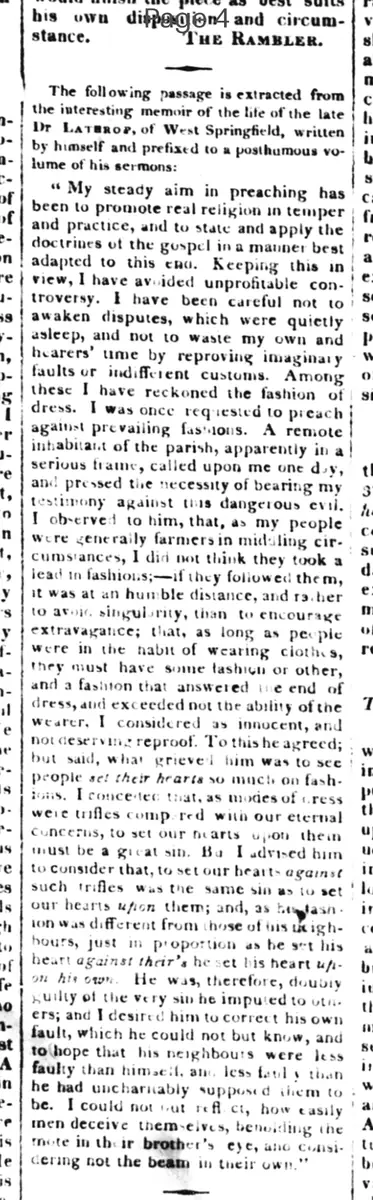
The following passage is extracted from the interesting memoir of the life of the late Dr. Lathrop, of West Springfield, written by himself and prefixed to a posthumous volume of his sermons:
"My steady aim in preaching has been to promote real religion in temper and practice, and to state and apply the doctrines of the gospel in a manner best adapted to this end. Keeping this in view, I have avoided unprofitable controversy. I have been careful not to awaken disputes, which were quietly asleep, and not to waste my own and hearers' time by reproving imaginary faults or indifferent customs. Among these I have reckoned the fashion of dress. I was once requested to preach against prevailing fashions. A remote inhabitant of the parish, apparently in a serious frame, called upon me one day, and pressed the necessity of bearing my testimony against this dangerous evil. I observed to him, that, as my people were generally farmers in middling circumstances, I did not think they took a lead in fashions;—if they followed them, it was at a humble distance, and rather to avoid singularity, than to encourage extravagance; that, as long as people were in the habit of wearing clothes, they must have some fashion or other, and a fashion that answered the end of dress, and exceeded not the ability of the wearer, I considered as innocent, and not deserving reproof. To this he agreed; but said, what grieved him was to see people set their hearts so much on fashions. I conceded that, as modes of dress were trifles compared with our eternal concerns, to set our hearts upon them must be a great sin. But I advised him to consider that, to set our hearts against such trifles was the same sin as to set our hearts upon them; and, as his passion was different from those of his neighbors, just in proportion as he set his heart against theirs he set his heart upon his own. He was, therefore, doubly guilty of the very sin he imputed to others; and I desired him to correct his own fault, which he could not but know, and to hope that his neighbours were less faulty than himself, and less fault than he had uncharitably supposed them to be. I could not but reflect, how easily men deceive themselves, beholding the mote in their brother's eye, and considering not the beam in their own.'"
The following passage is extracted from the interesting memoir of the life of the late Dr. Lathrop, of West Springfield, written by himself and prefixed to a posthumous volume of his sermons:
"My steady aim in preaching has been to promote real religion in temper and practice, and to state and apply the doctrines of the gospel in a manner best adapted to this end. Keeping this in view, I have avoided unprofitable controversy. I have been careful not to awaken disputes, which were quietly asleep, and not to waste my own and hearers' time by reproving imaginary faults or indifferent customs. Among these I have reckoned the fashion of dress. I was once requested to preach against prevailing fashions. A remote inhabitant of the parish, apparently in a serious frame, called upon me one day, and pressed the necessity of bearing my testimony against this dangerous evil. I observed to him, that, as my people were generally farmers in middling circumstances, I did not think they took a lead in fashions;—if they followed them, it was at a humble distance, and rather to avoid singularity, than to encourage extravagance; that, as long as people were in the habit of wearing clothes, they must have some fashion or other, and a fashion that answered the end of dress, and exceeded not the ability of the wearer, I considered as innocent, and not deserving reproof. To this he agreed; but said, what grieved him was to see people set their hearts so much on fashions. I conceded that, as modes of dress were trifles compared with our eternal concerns, to set our hearts upon them must be a great sin. But I advised him to consider that, to set our hearts against such trifles was the same sin as to set our hearts upon them; and, as his passion was different from those of his neighbors, just in proportion as he set his heart against theirs he set his heart upon his own. He was, therefore, doubly guilty of the very sin he imputed to others; and I desired him to correct his own fault, which he could not but know, and to hope that his neighbours were less faulty than himself, and less fault than he had uncharitably supposed them to be. I could not but reflect, how easily men deceive themselves, beholding the mote in their brother's eye, and considering not the beam in their own.'"
What sub-type of article is it?
Essay
What themes does it cover?
Religious
Moral Virtue
Social Manners
What keywords are associated?
Preaching
Religion
Fashion
Self Deception
Morality
Gospel
Customs
What entities or persons were involved?
Dr. Lathrop
Literary Details
Author
Dr. Lathrop
Subject
Preaching Against Fashions In Dress
Form / Style
Reflective Prose Memoir Excerpt
Key Lines
My Steady Aim In Preaching Has Been To Promote Real Religion In Temper And Practice, And To State And Apply The Doctrines Of The Gospel In A Manner Best Adapted To This End.
To Set Our Hearts Against Such Trifles Was The Same Sin As To Set Our Hearts Upon Them
How Easily Men Deceive Themselves, Beholding The Mote In Their Brother's Eye, And Considering Not The Beam In Their Own.