Thank you for visiting SNEWPapers!
Sign up free
Portland Gazette
Portland, Cumberland County, Maine
What is this article about?
Notorious swindler and horse thief Obadiah Williams, using aliases like Washington Randolph, arrested in Maryland for horse stealing. Detailed profile of his genteel appearance, deceptive tactics, romantic pursuits, past escapes including from Fredericksburg jail in 1802 after feigned confession, and hopes for his conviction.
Clipping
OCR Quality
Full Text
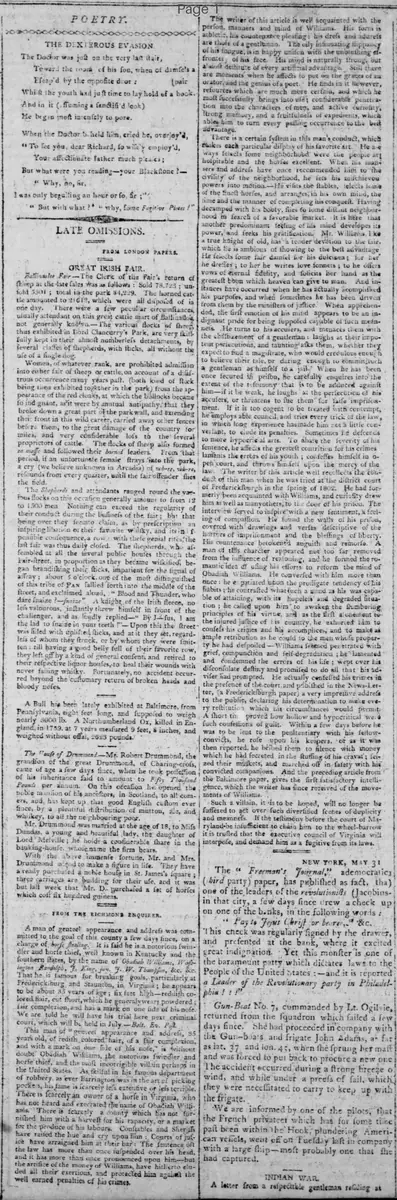
This man of "genteel appearance and address," 35 years old, of reddish colored hair, of a fair complexion, and with a mark on one side of his nose," is without doubt Obadiah Williams, the notorious swindler and horse thief, and the most incorrigible villain perhaps in the United States. As skillful in his famous department of robbery, as ever Barrington was in the art of picking pockets, his fame is scarcely less extensive or less terrible.
There is scarcely an owner of a horse in Virginia, who has not heard and execrated the name of Obadiah Williams. There is scarcely a county which has not furnished him with a harvest for his rapacity, or a market for the produce of his labours. Constables and Sheriffs have raised the hue and cry upon him: Courts of justice have arraigned him at their bar: The sentence of the law has more than once impended over his head, and it has more than once pronounced upon him—but the artifice or the money of Williams, have hitherto eluded all their exertions, and protected him against the well earned penalties of his crimes.
The writer of this article is well acquainted with the person, manners and mind of Williams. His form is athletic, his countenance pleasing: his dress and address are those of a gentleman. The oily insinuating flippancy of his tongue, is in happy unison with the unblushing effrontery of his face. His mind is naturally strong. but almost destitute of every artificial advantage. Still there are moments when he affects to put on the graces of an orator, and the genius of a poet. He finds in it however, resources which are much more certain, and which he most successfully brings into use; considerable penetration into the characters of men, and active curiosity, strong memory, and a fruitfulness of expedients, which enable him to turn every passing occurrence to the best advantage.
There is a certain system in this man's conduct, which makes each particular display of his favorite art. He always selects some neighborhood where the people are hospitable and the horses excellent. When his manners and address have once recommended him to the civility of the neighborhood, he sets his mischievous powers into motion.—He visits the stables, selects some of the finest horses, and arranges, in his own mind, the time and the manner of completing his conquest. Having decamped with his booty, flies to some distant neighborhood in search of a favorable market. It is here that another predominant feeling of his mind develops its power, and seeks its gratification. Mr. Williams, like a true knight of old, has a tender devotion to the fair, which he is ambitious of showing to the best advantage He selects some fair damsel for his dulcinea; for her he dresses; to her he writes love sonnets; to her he offers vows of eternal fidelity, and solicits her hand as the greatest boon which heaven can give to man. And instances have occurred when he has actually accomplished his purpose, and when sometimes he has been driven from them by the ministers of justice. When apprehended, the first emotion of his mind appears to be an indignant pride for being supposed capable of such meannesses. He turns to his accusers, and menaces them with the chastisement of a gentleman: laughs at their impotent persecutions, and tauntingly asks them, whether they expect to find a magistrate, who would be credulous enough to believe their tale, or daring enough to commit such a gentleman as himself to a jail. When he has been once secured in prison, he carefully enquires into the extent of the testimony that is to be adduced against him—if it be weak, he laughs at the persecution of his accusers, or threatens to sue them for false imprisonment. If it is too cogent to be treated with contempt, he employs able counsel, and tries every trick of the law, in which long experience has made him not a little conversant, to elude its penalties. Sometimes he descends to more hypocritical arts. To abate the severity of his sentence, he affects the greatest contrition for his crimes laments the errors of his youth; confesses himself in open court, and throws himself upon the mercy of the law. The writer of this article well recollects the conduct of this man when he was tried at the district court of Fredericksburgh in the spring of 1802. He had formerly been acquainted with Williams, and curiosity drew him as well as many others, to the door of his prison. The interview served to inspire with a new sentiment, a feeling of compassion. He found the walls of his prison, covered with drawings and verses descriptive of the horrors of imprisonment and the blessings of liberty. His countenance betokened anguish and remorse. A man of this character appeared not too far removed from the influence of reasoning, and he formed the romantic idea of using his efforts to reform the mind of Obadiah Williams. He conversed with him more than once: he expatiated upon the profligate tendency of his habits; he contrasted what such a mind as his was capable of attaining, with its hopeless and degraded situation; he called upon him to awaken the slumbering principles of his virtue, and as the first atonement to the injured justice of this country, he exhorted him to confess his crimes and his accomplices, and to make as ample retribution as he could to the men whose property he had despoiled— Williams seemed penetrated with grief, compunction and self-degradation; he lamented and condemned the errors of his life; wept over his disconsolate destiny and promised to do all that his adviser had prompted. He actually confessed his crimes in the presence of the court, and published in the News-Letter, (a Fredericksburg paper) a very impressive address to the public, declaring his determination to make every restitution which his circumstances would permit.
A short time proved how hollow and hypocritical were such confessions of guilt. Within a few days before he was to be sent to the penitentiary with his fellow-convicts, he rose upon his keepers. or as it was then reported, he bribed them to silence with money which he had secreted in the stuffing of his cravat; seized their muskets, and marched off in safety with his convicted companions. And the preceding article from the Baltimore paper, gives the first satisfactory intelligence, which the writer has since received of the movements of Williams.
Such a villain, it is to be hoped, will no longer be suffered to act over such diversified scenes of duplicity and meanness. If the testimony before the court of Maryland—be insufficient to chain him to the wheel-barrow it is trusted that the executive council of Virginia will interpose, and demand him as a fugitive from its laws.
What sub-type of article is it?
What themes does it cover?
What keywords are associated?
What entities or persons were involved?
Where did it happen?
Story Details
Key Persons
Location
Virginia (Fredericksburg, Staunton), Maryland, Kentucky, Southern States
Event Date
Spring Of 1802; July [Upcoming]
Story Details
Notorious swindler Obadiah Williams arrested for horse stealing in Maryland; known for genteel deception, systematic horse thefts, romantic pursuits, jail breaks including 1802 Fredericksburg escape after feigned remorse and confession; writer recounts personal interactions and hopes for conviction.