Thank you for visiting SNEWPapers!
Sign up free
Literary
November 18, 1817
Portland Gazette, And Maine Advertiser
Portland, Cumberland County, Maine
What is this article about?
This essay provides practical advice on preparing wheat seed to prevent smut, including a brine and vitriol treatment from Ireland, seed selection, sowing rates, harvesting tips, and methods to clean smutty wheat using sand instead of water.
Clipping
OCR Quality
95%
Excellent
Full Text
FOR THE GAZETTE.
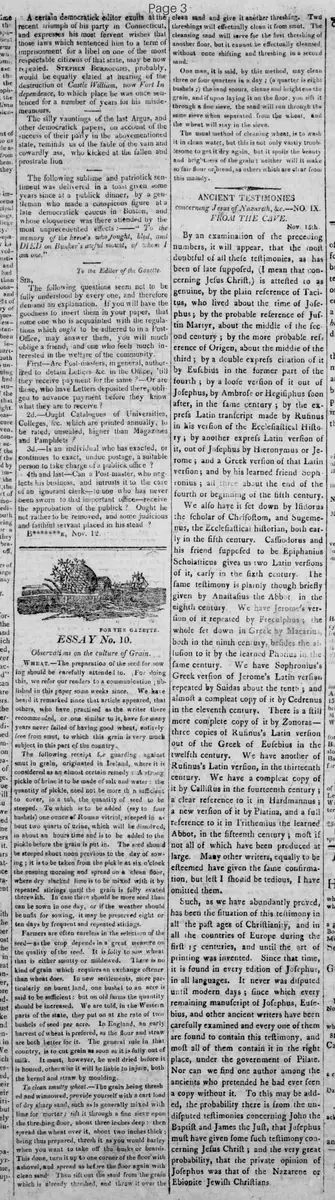
ESSAY No. 10.
Observations on the culture of Grain.
WHEAT.--The preparation of the seed for sowing should be carefully attended to. For doing this, we refer our readers to a communication published in this paper some weeks since. We have heard it remarked since that article appeared, that others, who have practised as the writer there recommended, or one similar to it, have for many years never failed of having good wheat, entirely free from smut, to which this grain is very much subject in this part of the country.
The following receipt for guarding against smut in grain, originated in Ireland, where it is considered as an almost certain remedy: A strong pickle of brine is to be made of salt and water: the quantity of pickle, need not be more than sufficient to cover, in a tub, the quantity of seed to be steeped. To which is to be added (say to four bushels) one ounce of Roman vitriol, steeped in about two quarts of urine, which will be dissolved, in about an hour's time and is to be added to the pickle before the grain is put in. The seed should be steeped about noon previous to the day of sowing; it is to be taken from the pickle at six o'clock the ensuing morning and spread on a clean floor, where dry slacked lime is to be mixed with it by repeated stirrings until the grain is fully saturated therewith. In case there should be more seed than can be sown in one day, or if the weather should be unfit for sowing, it may be preserved eight or ten days by frequent and repeated stirrings.
Farmers are often careless in the selection of the seed--as the crop depends in a great measure on the quality of the seed. It is folly to sow wheat that is either smutty or mildewed. There is no kind of grain which requires an exchange oftener than wheat does. In new settlements, more particularly on burnt land, one bushel to an acre is said to be sufficient: but on old farms the quantity should be increased. We are told, in the Western parts of the state, they put on at the rate of two bushels of seed per acre. In England, an early harvest of wheat is preferred, as the flour and straw are both better for it. The general rule in that country, is to cut grain as soon as it is fully out of milk. It must, however, be well dried before it is housed, otherwise it will be liable to injure, both the kernel and straw by moulding.
To clean smutty wheat.--The grain being threshed and winnowed, provide yourself with a cart load of dry sharp sand, such as is generally mixed with lime for mortar; sift it through a fine sieve upon the threshing floor, about three inches deep: then spread the wheat over it, about two inches thick; being thus prepared, thresh it as you would barley when you want to take off the husks or beards. This done, turn it up to one corner of the floor with a shovel, and spread as before the floor again with clean sand--Then sift out the sand from the grain which is already threshed, and throw it over the clean sand and give it another threshing. Two threshings will effectually clean it from smut. The cleansing sand will serve for the first threshing of another floor, but it cannot be effectually cleansed, without once shifting and threshing in a second sand.
One man, it is said, by this method, may clean three or four quarters in a day; (a quarter is eight bushels; the sand scours, cleans and brightens the grain, and if upon laying it on the floor, you sift it through a fine sieve, the sand will run through the same sieve when separated from the wheat, and the wheat will stay in the sieve.
The usual method of cleaning wheat is to wash it in clean water, but this is not only vastly troublesome to get it dry again, but it spoils the beauty and brightness of the grain; neither will it make so fair flour or bread, as others which are clear from this malady.
ESSAY No. 10.
Observations on the culture of Grain.
WHEAT.--The preparation of the seed for sowing should be carefully attended to. For doing this, we refer our readers to a communication published in this paper some weeks since. We have heard it remarked since that article appeared, that others, who have practised as the writer there recommended, or one similar to it, have for many years never failed of having good wheat, entirely free from smut, to which this grain is very much subject in this part of the country.
The following receipt for guarding against smut in grain, originated in Ireland, where it is considered as an almost certain remedy: A strong pickle of brine is to be made of salt and water: the quantity of pickle, need not be more than sufficient to cover, in a tub, the quantity of seed to be steeped. To which is to be added (say to four bushels) one ounce of Roman vitriol, steeped in about two quarts of urine, which will be dissolved, in about an hour's time and is to be added to the pickle before the grain is put in. The seed should be steeped about noon previous to the day of sowing; it is to be taken from the pickle at six o'clock the ensuing morning and spread on a clean floor, where dry slacked lime is to be mixed with it by repeated stirrings until the grain is fully saturated therewith. In case there should be more seed than can be sown in one day, or if the weather should be unfit for sowing, it may be preserved eight or ten days by frequent and repeated stirrings.
Farmers are often careless in the selection of the seed--as the crop depends in a great measure on the quality of the seed. It is folly to sow wheat that is either smutty or mildewed. There is no kind of grain which requires an exchange oftener than wheat does. In new settlements, more particularly on burnt land, one bushel to an acre is said to be sufficient: but on old farms the quantity should be increased. We are told, in the Western parts of the state, they put on at the rate of two bushels of seed per acre. In England, an early harvest of wheat is preferred, as the flour and straw are both better for it. The general rule in that country, is to cut grain as soon as it is fully out of milk. It must, however, be well dried before it is housed, otherwise it will be liable to injure, both the kernel and straw by moulding.
To clean smutty wheat.--The grain being threshed and winnowed, provide yourself with a cart load of dry sharp sand, such as is generally mixed with lime for mortar; sift it through a fine sieve upon the threshing floor, about three inches deep: then spread the wheat over it, about two inches thick; being thus prepared, thresh it as you would barley when you want to take off the husks or beards. This done, turn it up to one corner of the floor with a shovel, and spread as before the floor again with clean sand--Then sift out the sand from the grain which is already threshed, and throw it over the clean sand and give it another threshing. Two threshings will effectually clean it from smut. The cleansing sand will serve for the first threshing of another floor, but it cannot be effectually cleansed, without once shifting and threshing in a second sand.
One man, it is said, by this method, may clean three or four quarters in a day; (a quarter is eight bushels; the sand scours, cleans and brightens the grain, and if upon laying it on the floor, you sift it through a fine sieve, the sand will run through the same sieve when separated from the wheat, and the wheat will stay in the sieve.
The usual method of cleaning wheat is to wash it in clean water, but this is not only vastly troublesome to get it dry again, but it spoils the beauty and brightness of the grain; neither will it make so fair flour or bread, as others which are clear from this malady.
What sub-type of article is it?
Essay
What themes does it cover?
Agriculture Rural
What keywords are associated?
Wheat Cultivation
Smut Prevention
Seed Preparation
Grain Cleaning
Agricultural Practices
Literary Details
Title
Essay No. 10. Observations On The Culture Of Grain.
Subject
Observations On The Culture Of Grain