Thank you for visiting SNEWPapers!
Sign up free
Poem
March 25, 1786
Fowle's New Hampshire Gazette And General Advertiser
Portsmouth, Rockingham County, New Hampshire
What is this article about?
A sonnet extolling the superior elegance of a woman's natural charms—blush, sparkling eyes, and dewy lips—over artificial enhancements like painted blush and affected glances, which fail to touch the heart and fade quickly.
Clipping
OCR Quality
95%
Excellent
Full Text
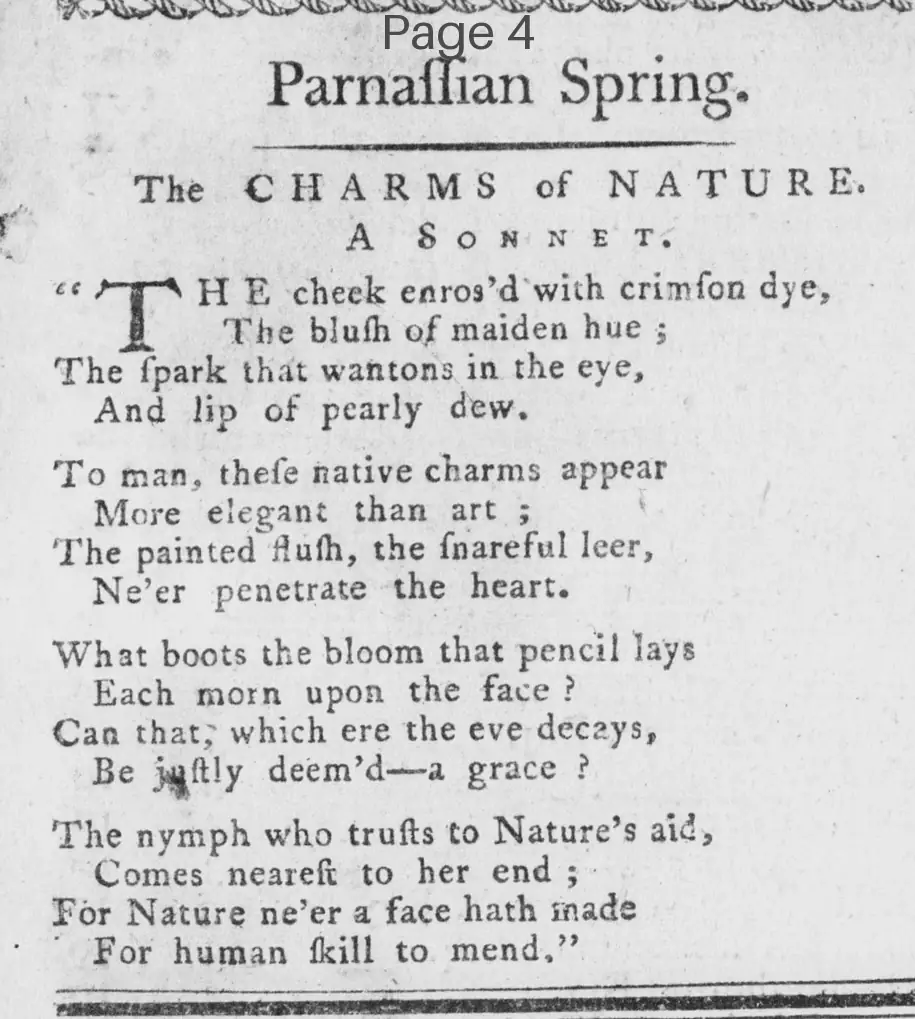
Parnassian Spring.
The CHARMS of NATURE.
A SONNET.
The cheek enros'd with crimson dye,
The blush of maiden hue;
The spark that wantons in the eye,
And lip of pearly dew.
To man, these native charms appear
More elegant than art:
The painted blush, the careful leer,
Ne'er penetrate the heart.
What boots the bloom that pencil lays
Each morn upon the face?
Can that, which ere the eve decays,
Be justly deem'd a grace?
The nymph who trusts to Nature's aid,
Comes nearest to her end;
For Nature ne'er a face hath made
For human skill to mend.
The CHARMS of NATURE.
A SONNET.
The cheek enros'd with crimson dye,
The blush of maiden hue;
The spark that wantons in the eye,
And lip of pearly dew.
To man, these native charms appear
More elegant than art:
The painted blush, the careful leer,
Ne'er penetrate the heart.
What boots the bloom that pencil lays
Each morn upon the face?
Can that, which ere the eve decays,
Be justly deem'd a grace?
The nymph who trusts to Nature's aid,
Comes nearest to her end;
For Nature ne'er a face hath made
For human skill to mend.
What sub-type of article is it?
Sonnet
What themes does it cover?
Moral Virtue
Love Courtship
What keywords are associated?
Natural Charms
Artificial Beauty
Maiden Blush
Nature Vs Art
Sonnet
Poem Details
Title
Parnassian Spring.
Subject
The Charms Of Nature.
Key Lines
The Nymph Who Trusts To Nature's Aid,
Comes Nearest To Her End;
For Nature Ne'er A Face Hath Made
For Human Skill To Mend.