Thank you for visiting SNEWPapers!
Sign up free
Letter to Editor
May 9, 1833
Morning Star
Limerick, York County, Maine
What is this article about?
This letter argues that the name 'Christians' was first applied to disciples by enemies in Antioch as a reproach, not by divine authority or self-assumption. It examines scriptural evidence showing other names for believers and defends the use of denominational names as not contrary to scripture, promoting harmony.
Clipping
OCR Quality
98%
Excellent
Full Text
For the Morning Star.
NAMES. No. 2.
Messrs Editors,
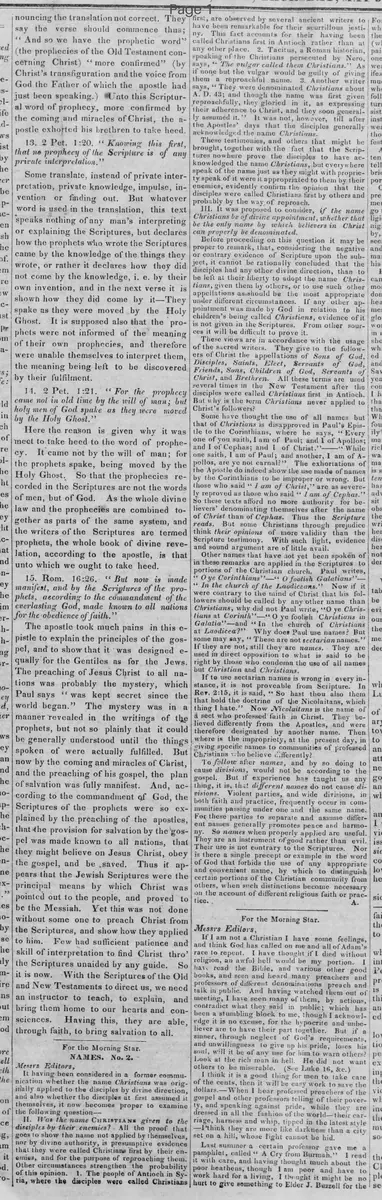
It having been considered in a former communication whether the name Christians was originally applied to the disciples by divine direction, and also whether the disciples at first assumed it themselves, it now becomes proper to examine the following question--
II. Was the name Christians given to the disciples by their enemies? All the proof that goes to show the name not applied by themselves, nor by divine authority, is presumptive evidence that they were called Christians first by their enemies, and for the purpose of reproaching them. Other circumstances strengthen the probability of this opinion. 1. The people of Antioch in Syria, where the disciples were called Christians first, are observed by several ancient writers to have been remarkable for their scurrilous jesting. This fact accounts for their having been called Christians first in Antioch rather than at any other place. 2. Tacitus, a Roman historian, speaking of the Christians persecuted by Nero, says, "The vulgar called them Christians." As if none but the vulgar would be guilty of giving them a reproachful name. 3. Another writer says, "They were denominated Christians about A.D. 43; and though the name was first given reproachfully, they gloried in it, as expressing their adherence to Christ, and they soon generally assumed it." It was not, however, till after the Apostles' days that the disciples generally acknowledged the name Christians. These testimonies, and others that might be brought, together with the fact that the scriptures nowhere prove the disciples to have acknowledged the name Christians, but everywhere speak of the name just as they might with propriety speak of it were it appropriated to them by their enemies, evidently confirm the opinion that the disciples were called Christians first by others and probably by the way of reproach.
III. It was proposed to consider, if the name Christians be of divine appointment, whether that be the only name by which believers in Christ can properly be denominated
Before proceeding on this question it may be proper to remark, that, considering the negative or contrary evidence of Scripture upon the subject, it cannot be rationally concluded that the disciples had any other divine direction, than to be left at their liberty to adopt the name Christians, given them by others, or to use such other appellations as should be the most appropriate under different circumstances. If any other appointment was made by God in relation to his children's being called Christians, evidence of it is not given in the scriptures. From other sources it will be difficult to prove it. These views are in accordance with the usage of the sacred writers. They give to the followers of Christ the appellations of Sons of God, Disciples, Saints, Elect, Servants of God, Friends, Sons, Children of God, Servants of Christ, and Brethren. All these terms are used several times in the New Testament after the disciples were called Christians first in Antioch. But why is the term Christians never applied to Christ's followers? Some have thought the use of all names but that of Christians is disapproved in Paul's Epistle to the Corinthians, where he says, "Every one of you saith, I am of Paul; and I of Apollos; and I of Cephas; and I of Christ."—"While one saith, I am of Paul; and another, I am of Apollos, are ye not carnal?" The exhortations of the Apostle do indeed show the use made of names by the Corinthians to be improper or wrong. But those who said "I am of Christ," are as severely reproved as those who said "I am of Cephas." So these texts afford no more authority for believers' denominating themselves after the name of Christ than of Cephas. Thus the Scripture reads, But some Christians through prejudice think their opinions of more validity than the Scripture testimony. With such light, evidence and sound argument are of little avail. Other names that have not yet been spoken of in these remarks are applied in the scriptures to portions of the Christian church. Paul writes, "O ye Corinthians"—"O foolish Galatians"—"In the church of the Laodiceans." Now if it were contrary to the mind of Christ that his followers should be called by any other name than Christians, why did not Paul write, "O ye Christians at Corinth"—"O ye foolish Christians in Galatia"—and "In the church of Christians at Laodicea?" Why does Paul use names? But some may say, "These are not sectarian names." If they are not, still they are names. They are used in direct opposition to what is said to be right by those who condemn the use of all names but Christian and Christians. If to use sectarian names is wrong in every instance, it is not proveable from Scripture. In Rev. 2:15, it is said, "So hast thou also them that hold the doctrine of the Nicolaitans, which thing I hate." Now Nicolaitans is the name of a sect who professed faith in Christ. They believed differently from the Apostles, and were therefore designated by another name. Then where is the impropriety, at the present day, in giving specific names to communities of professed Christians who believe differently? To follow after names, and by so doing to cause divisions, would not be according to the gospel. But if experience has taught us anything, it is, that different names do not cause divisions. Violent parties, and wide divisions, in both faith and practice, frequently occur in communities passing under one and the same name. For these parties to separate and assume different names generally promotes peace and harmony. So names when properly applied are useful. They are an instrument of good rather than evil. Their use is not contrary to the scriptures. Nor is there a single precept or example in the word of God that forbids the use of any appropriate and convenient name, by which to distinguish certain portions of the Christian community from others, when such distinctions become necessary on the account of different religious faith or practice.
A.
NAMES. No. 2.
Messrs Editors,
It having been considered in a former communication whether the name Christians was originally applied to the disciples by divine direction, and also whether the disciples at first assumed it themselves, it now becomes proper to examine the following question--
II. Was the name Christians given to the disciples by their enemies? All the proof that goes to show the name not applied by themselves, nor by divine authority, is presumptive evidence that they were called Christians first by their enemies, and for the purpose of reproaching them. Other circumstances strengthen the probability of this opinion. 1. The people of Antioch in Syria, where the disciples were called Christians first, are observed by several ancient writers to have been remarkable for their scurrilous jesting. This fact accounts for their having been called Christians first in Antioch rather than at any other place. 2. Tacitus, a Roman historian, speaking of the Christians persecuted by Nero, says, "The vulgar called them Christians." As if none but the vulgar would be guilty of giving them a reproachful name. 3. Another writer says, "They were denominated Christians about A.D. 43; and though the name was first given reproachfully, they gloried in it, as expressing their adherence to Christ, and they soon generally assumed it." It was not, however, till after the Apostles' days that the disciples generally acknowledged the name Christians. These testimonies, and others that might be brought, together with the fact that the scriptures nowhere prove the disciples to have acknowledged the name Christians, but everywhere speak of the name just as they might with propriety speak of it were it appropriated to them by their enemies, evidently confirm the opinion that the disciples were called Christians first by others and probably by the way of reproach.
III. It was proposed to consider, if the name Christians be of divine appointment, whether that be the only name by which believers in Christ can properly be denominated
Before proceeding on this question it may be proper to remark, that, considering the negative or contrary evidence of Scripture upon the subject, it cannot be rationally concluded that the disciples had any other divine direction, than to be left at their liberty to adopt the name Christians, given them by others, or to use such other appellations as should be the most appropriate under different circumstances. If any other appointment was made by God in relation to his children's being called Christians, evidence of it is not given in the scriptures. From other sources it will be difficult to prove it. These views are in accordance with the usage of the sacred writers. They give to the followers of Christ the appellations of Sons of God, Disciples, Saints, Elect, Servants of God, Friends, Sons, Children of God, Servants of Christ, and Brethren. All these terms are used several times in the New Testament after the disciples were called Christians first in Antioch. But why is the term Christians never applied to Christ's followers? Some have thought the use of all names but that of Christians is disapproved in Paul's Epistle to the Corinthians, where he says, "Every one of you saith, I am of Paul; and I of Apollos; and I of Cephas; and I of Christ."—"While one saith, I am of Paul; and another, I am of Apollos, are ye not carnal?" The exhortations of the Apostle do indeed show the use made of names by the Corinthians to be improper or wrong. But those who said "I am of Christ," are as severely reproved as those who said "I am of Cephas." So these texts afford no more authority for believers' denominating themselves after the name of Christ than of Cephas. Thus the Scripture reads, But some Christians through prejudice think their opinions of more validity than the Scripture testimony. With such light, evidence and sound argument are of little avail. Other names that have not yet been spoken of in these remarks are applied in the scriptures to portions of the Christian church. Paul writes, "O ye Corinthians"—"O foolish Galatians"—"In the church of the Laodiceans." Now if it were contrary to the mind of Christ that his followers should be called by any other name than Christians, why did not Paul write, "O ye Christians at Corinth"—"O ye foolish Christians in Galatia"—and "In the church of Christians at Laodicea?" Why does Paul use names? But some may say, "These are not sectarian names." If they are not, still they are names. They are used in direct opposition to what is said to be right by those who condemn the use of all names but Christian and Christians. If to use sectarian names is wrong in every instance, it is not proveable from Scripture. In Rev. 2:15, it is said, "So hast thou also them that hold the doctrine of the Nicolaitans, which thing I hate." Now Nicolaitans is the name of a sect who professed faith in Christ. They believed differently from the Apostles, and were therefore designated by another name. Then where is the impropriety, at the present day, in giving specific names to communities of professed Christians who believe differently? To follow after names, and by so doing to cause divisions, would not be according to the gospel. But if experience has taught us anything, it is, that different names do not cause divisions. Violent parties, and wide divisions, in both faith and practice, frequently occur in communities passing under one and the same name. For these parties to separate and assume different names generally promotes peace and harmony. So names when properly applied are useful. They are an instrument of good rather than evil. Their use is not contrary to the scriptures. Nor is there a single precept or example in the word of God that forbids the use of any appropriate and convenient name, by which to distinguish certain portions of the Christian community from others, when such distinctions become necessary on the account of different religious faith or practice.
A.
What sub-type of article is it?
Religious
Philosophical
Persuasive
What themes does it cover?
Religion
Morality
What keywords are associated?
Christians Name Origin
Divine Appointment
Scriptural Names
Denominational Names
Religious Sects
Antioch Disciples
Tacitus Reference
What entities or persons were involved?
A.
Messrs Editors
Letter to Editor Details
Author
A.
Recipient
Messrs Editors
Main Argument
the name 'christians' was likely first given by enemies as a reproach, not divinely appointed or self-assumed; scriptures use various other names for believers and do not mandate 'christians' as the sole proper name, allowing for denominational distinctions to promote harmony.
Notable Details
References Antioch's Scurrilous Jesting
Cites Tacitus On Nero's Persecutions
Quotes Anonymous Writer On A.D. 43 Origin
Discusses New Testament Names Like Sons Of God, Disciples, Saints
Analyzes 1 Corinthians On Party Names
References Addresses To Corinthians, Galatians, Laodiceans
Cites Revelation 2:15 On Nicolaitans