Thank you for visiting SNEWPapers!
Sign up free
Story
June 4, 1882
The Daily Astorian
Astoria, Clatsop County, Oregon
What is this article about?
Editorial criticizes the U.S. government's delay in publishing the 1880 census results, two years after collection, which hinders apportionment of representatives and public access to vital statistics, while officials profit from unofficial books exploiting the delay.
Clipping
OCR Quality
98%
Excellent
Full Text
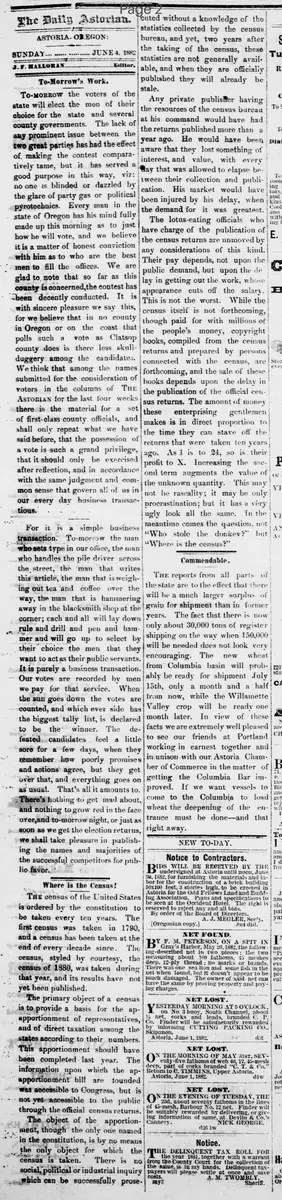
Where is the Census?
The census of the United States is ordered by the constitution to be taken every ten years. The first census was taken in 1790, and a census has been taken at the end of every decade since. The census, styled by courtesy, the census of 1880, was taken during that year, and its results have not yet been published.
The primary object of a census is to provide a basis for the apportionment of representatives, and of direct taxation among the states according to their numbers. This apportionment should have been completed last year. The information upon which the apportionment bill is founded was accessible to Congress, but is not yet accessible to the public through the official census returns.
The object of the apportionment, though the only one named in the constitution, is by no means the only object for which the census is taken. There is no social, political or industrial inquiry which can be successfully prosecuted without a knowledge of the statistics collected by the census bureau, and yet, two years after the taking of the census, these statistics are not generally available, and when they are officially published they will already be stale.
Any private publisher having the resources of the census bureau at his command would have had the returns published more than a year ago. He would have been aware that they lost something of interest, and value, with every day that was allowed to elapse between their collection and publication. His market would have been injured by his delay, when the demand for it was greatest.
The lotus-eating officials who have charge of the publication of the census returns are unmoved by any considerations of this kind. Their pay depends, not upon the public demand, but upon the day in getting out the work, whose appearance cuts off the salary.
This is not the worst. While the census itself is not forthcoming, though paid for with millions of the people's money, copyright books, compiled from the census returns and prepared by persons connected with the census, are forthcoming, and the sale of these books depends upon the delay in the publication of the official census returns. The amount of money these enterprising gentlemen makes is in direct proportion to the time they can stave off the returns that were taken ten years ago. As 1 is to 24, so is their profit to X. Increasing the second term augments the value of the unknown quantity. This may not be rascality; it may be only procrastination; but it has a very ugly look all the same. In the meantime comes the question, not "Who stole the donkey?" but "Where is the census?"
The census of the United States is ordered by the constitution to be taken every ten years. The first census was taken in 1790, and a census has been taken at the end of every decade since. The census, styled by courtesy, the census of 1880, was taken during that year, and its results have not yet been published.
The primary object of a census is to provide a basis for the apportionment of representatives, and of direct taxation among the states according to their numbers. This apportionment should have been completed last year. The information upon which the apportionment bill is founded was accessible to Congress, but is not yet accessible to the public through the official census returns.
The object of the apportionment, though the only one named in the constitution, is by no means the only object for which the census is taken. There is no social, political or industrial inquiry which can be successfully prosecuted without a knowledge of the statistics collected by the census bureau, and yet, two years after the taking of the census, these statistics are not generally available, and when they are officially published they will already be stale.
Any private publisher having the resources of the census bureau at his command would have had the returns published more than a year ago. He would have been aware that they lost something of interest, and value, with every day that was allowed to elapse between their collection and publication. His market would have been injured by his delay, when the demand for it was greatest.
The lotus-eating officials who have charge of the publication of the census returns are unmoved by any considerations of this kind. Their pay depends, not upon the public demand, but upon the day in getting out the work, whose appearance cuts off the salary.
This is not the worst. While the census itself is not forthcoming, though paid for with millions of the people's money, copyright books, compiled from the census returns and prepared by persons connected with the census, are forthcoming, and the sale of these books depends upon the delay in the publication of the official census returns. The amount of money these enterprising gentlemen makes is in direct proportion to the time they can stave off the returns that were taken ten years ago. As 1 is to 24, so is their profit to X. Increasing the second term augments the value of the unknown quantity. This may not be rascality; it may be only procrastination; but it has a very ugly look all the same. In the meantime comes the question, not "Who stole the donkey?" but "Where is the census?"
What sub-type of article is it?
Historical Event
Curiosity
What themes does it cover?
Justice
Misfortune
What keywords are associated?
Census Delay
1880 Census
Government Inefficiency
Public Statistics
Apportionment
Where did it happen?
United States
Story Details
Location
United States
Event Date
1880
Story Details
The article discusses the constitutional requirement for a U.S. census every ten years, notes the delay in publishing the 1880 census results two years after collection, criticizes officials for procrastination and profiting from unofficial books, and highlights the impact on apportionment and public access to statistics.