Thank you for visiting SNEWPapers!
Sign up free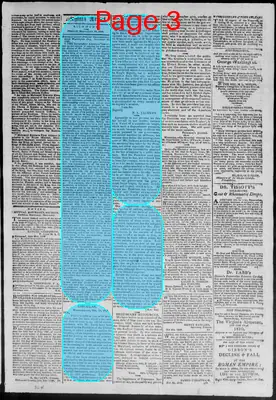
Virginia Argus
Richmond, Virginia
What is this article about?
The Virginia Argus reports on a letter from Washington detailing British Minister F.J. Jackson's circular to English agents in the US, criticizing the US government's decision to end negotiations with him. The circular, dated Nov. 13, 1809, announces his move to New York. The paper includes extracts from Vattel affirming Jackson's diplomatic inviolability despite the tensions.
Merged-components note: The extract of the letter discusses the Jackson circular, which is quoted directly in the following component, forming a single piece of domestic news about diplomatic affairs.
Clipping
OCR Quality
Full Text
RICHMOND,
FRIDAY, NOVEMBER 24, 1809.
Extract of a letter from our Correspondent, dated Washington City, November 21, 1809.
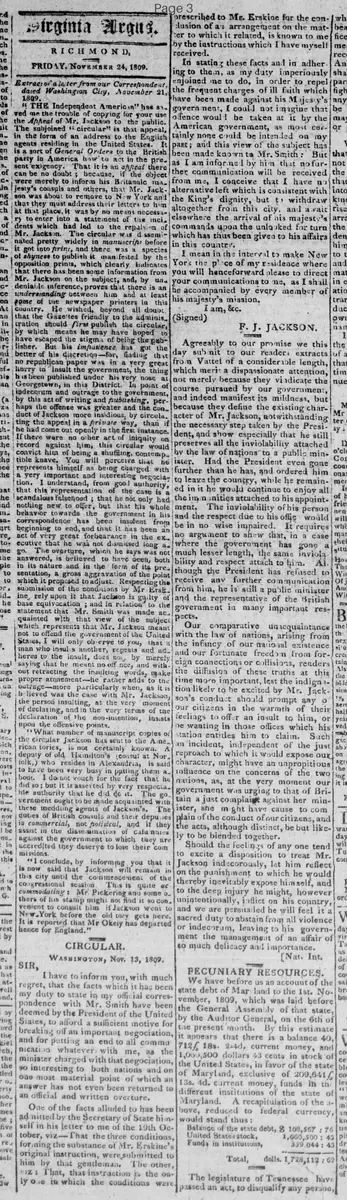
"THE Independent American" has saved me the trouble of copying for your use the Appeal of Mr. Jackson to the public. The subjoined "circular" is that appeal, in the form of an address to the English agents residing in the United States. It is a sort of General Orders to the British party in America how to act in the present exigency. That it is an appeal there can be no doubt; because, if the object were merely to inform his Britannic majesty's consuls and others, that Mr. Jackson was about to remove to New York and that they must address their letters to him at that place, it was by no means necessary to enter into a statement of the incidents which had led to the repulsion of Mr. Jackson. The circular was disseminated pretty widely in manuscript before it got into print, and there was a species of shyness to publish it manifested by the opposition prints, which clearly indicates that there has been some information from Mr. Jackson on the subject, and, by undeniable inference, proves that there is an understanding between him and at least some of the newspaper printers in this country. He wished, beyond all doubt, that the Gazettes friendly to the administration should first publish the circular, by which means he may have hoped to have escaped the stigma of being the publisher. But his impatience has got the better of his discretion-for, finding that no republican paper was in a very great hurry to insult the government, the thing has been published under his very nose at Georgetown, in this District. In point of indecorum and outrage to the government, by this act of writing and publishing, perhaps the offence was greater and the conduct of Jackson more insidious, by circulating the appeal in a private way, than if he had come out openly in the first instance. If there were no other act of iniquity on record against him, this circular would convict him of being a shuffling, contemptible knave. You will perceive that he represents himself as being charged with a very important and interesting negociation. I understand, from good authority, that this representation of the case is a scandalous falsehood; that he not only had nothing new to offer, but that his whole behavior towards the government in his correspondence has been insolent from beginning to end, and that it has been an act of very great forbearance in the executive that he was not dismissed long ago. The overture, which he says was not answered, is believed to have been, both in its nature and in the form of its presentation, a gross aggravation of the point which it proposed to adjust. Respecting the submission of the conditions by Mr. Erskine, rely upon it that Jackson is guilty of base equivocation; and in relation to the statement that Mr. Smith was made acquainted with that view of the subject which represents that Mr. Jackson meant not to offend the government of the United States, I will only observe to you, that a man who insults another, repeats and adheres to the insult, does not, by merely saying that he meant no offence, and without retracting the insulting words, make proper atonement--he rather adds to the outrage--more particularly when, as it is believed was the case with Mr. Jackson, the person insulting, at the very moment of declaring, and in the very terms of the declaration of the non-intention, insists upon the offensive points. What number of manuscript copies of the circular Jackson has sent to the American tories, is not certainly known. A deputy of old Hamilton's (consul at Norfolk,) who resides in Alexandria, is said to have been very busy in putting them about. I do not vouch for the fact that he did so: but it is asserted by very respectable authority that he did do it. The government ought to be made acquainted with these meddling agents of Jackson's. The duties of British consuls and their deputies is commercial, not political, and if they assist in the dissemination of calumnies against the government to which they are accredited they deserve to lose their commissions. I conclude, by informing, you that it is now said that Jackson will remain in this city until the commencement of the congressional session. This is quite accommodating: Mr. Pickering and some others of his stamp might not find it so convenient to consult him if Jackson went to New York before the old tory gets here. It is reported that Mr. Oakley has departed hence for England."
CIRCULAR.
Washington, Nov. 13, 1809.
SIR,
I have to inform you, with much regret, that the facts which it has been my duty to state in my official correspondence with Mr. Smith have been deemed by the President of the United States, to afford a sufficient motive for breaking off an important negociation, and for putting an end to all communication whatever with me, as the minister charged with that negociation, so interesting to both nations and on one most material point of which an answer has not even been returned to an official and written overture. One of the facts alluded to has been admitted by the Secretary of State himself in his letter to me of the 19th October, viz—That the three conditions, forming the substance of Mr. Erskine's original instruction, were submitted to him by that gentleman. The other, viz: That, that instruction is the only one in which the conditions were prescribed to Mr. Erskine for the conclusion of an arrangement on the matter to which it related, is known to me by the instructions which I have myself received. In stating these facts and in adhering to them, as my duty imperiously enjoined me to do, in order to repel the frequent charges of ill faith which have been made against his Majesty's government, I could not imagine that offence would be taken at it by the American government, as most certainly none could be intended on my part; and this view of the subject has been made known to Mr. Smith: But as I am informed by him that no further communication will be received from me, I conceive that I have no alternative left which is consistent with the King's dignity, but to withdraw altogether from this city, and await elsewhere the arrival of his majesty's commands upon the unlooked for turn which has thus been given to his affairs in this country. I mean in the interval to make New York the place of my residence where you will henceforward please to direct your communications to me, as I shall be accompanied by every member of his majesty's mission,
I am, &c.
(Signed) F. J. JACKSON.
Agreeably to our promise we this day submit to our readers extracts from Vattel of a considerable length, which merit a dispassionate attention, not merely because they vindicate the course pursued by our government, and indeed manifest its mildness, but because they define the existing character of Mr. Jackson, notwithstanding the necessary step taken by the President, and show especially that he still preserves all the inviolability attached by the law of nations to a public minister. Had the President even gone further than he has, and ordered him to leave the country, while he remained in it he would continue to enjoy all the immunities attached to his appointment. The inviolability of his person and the respect due to his office would be in no wise impaired. It requires no argument to shew that, in a case where the government has gone a much lesser length, the same inviolability and respect attach to him. Although the President has refused to receive any further communication from him, he is still a public minister and the representative of the British government in many important respects.
Our comparative unacquaintance with the law of nations, arising from the infancy of our national existence and our fortunate freedom from foreign connections or collisions, renders the diffusion of these truths at this time more important, lest the indignation likely to be excited by Mr. Jackson's conduct should prompt any of our citizens in the warmth of their feelings to offer an insult to him, or be wanting in those offices which his station entitles him to claim. Such an incident, independent of the just reproach to which it would expose our character, might have an unpropitious influence on the concerns of the two nations, as, at the very moment our government was urging to that of Britain a just complaint against her minister, she might have cause to complain of the conduct of our citizens, and the acts, although distinct, be but likely to be blended together. Should the feelings of any one tend to excite a disposition to treat Mr. Jackson indecorously, let him reflect on the punishment to which he would thereby inevitably expose himself, and to the deep injury he might, however unintentionally, inflict on his country, and we are persuaded he will feel it a sacred duty to abstain from all violence or indecorum, leaving to his government the management of an affair of so much delicacy and importance.
[Nat. Int.
What sub-type of article is it?
What keywords are associated?
What entities or persons were involved?
Where did it happen?
Domestic News Details
Primary Location
Washington City
Event Date
November 21, 1809
Key Persons
Outcome
breaking off of important negotiation; end to all communication with jackson; jackson to withdraw to new york; affirmation of jackson's diplomatic inviolability under law of nations.
Event Details
Extract of letter criticizing Jackson's circular to English agents, disseminated in manuscript and published, portraying it as an appeal against US government's decision to end negotiations due to his statements on Erskine's instructions. Circular dated Nov. 13, 1809, expresses regret and announces move to New York. Newspaper includes Vattel extracts vindicating US government's mild course and urging respect for Jackson's status to avoid international incidents.