Thank you for visiting SNEWPapers!
Sign up free
Editorial
August 27, 1926
Union Labor Bulletin
Little Rock, Pulaski County, Arkansas
What is this article about?
Maude Royden argues that success requires working with others, necessitating compromise on non-essentials. She contrasts impractical cranks and prigs, who insist on every principle, with effective reformers, saints, and statesmen who focus on fundamentals.
Clipping
OCR Quality
98%
Excellent
Full Text
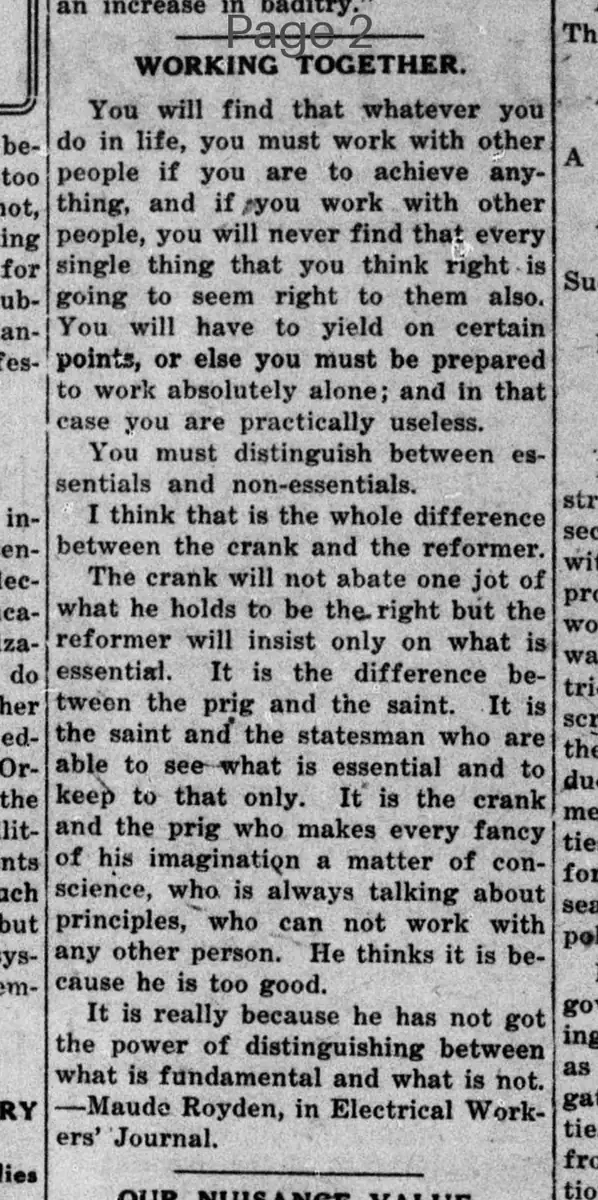
WORKING TOGETHER.
You will find that whatever you do in life, you must work with other people if you are to achieve anything, and if you work with other people, you will never find that every single thing that you think right is going to seem right to them also.
You will have to yield on certain points, or else you must be prepared to work absolutely alone; and in that case you are practically useless.
You must distinguish between essentials and non-essentials.
I think that is the whole difference between the crank and the reformer.
The crank will not abate one jot of what he holds to be the right but the reformer will insist only on what is essential. It is the difference between the prig and the saint. It is the saint and the statesman who are able to see what is essential and to keep to that only. It is the crank and the prig who makes every fancy of his imagination a matter of conscience, who is always talking about principles, who can not work with any other person. He thinks it is because he is too good.
It is really because he has not got the power of distinguishing between what is fundamental and what is not.
—Maude Royden, in Electrical Workers' Journal.
You will find that whatever you do in life, you must work with other people if you are to achieve anything, and if you work with other people, you will never find that every single thing that you think right is going to seem right to them also.
You will have to yield on certain points, or else you must be prepared to work absolutely alone; and in that case you are practically useless.
You must distinguish between essentials and non-essentials.
I think that is the whole difference between the crank and the reformer.
The crank will not abate one jot of what he holds to be the right but the reformer will insist only on what is essential. It is the difference between the prig and the saint. It is the saint and the statesman who are able to see what is essential and to keep to that only. It is the crank and the prig who makes every fancy of his imagination a matter of conscience, who is always talking about principles, who can not work with any other person. He thinks it is because he is too good.
It is really because he has not got the power of distinguishing between what is fundamental and what is not.
—Maude Royden, in Electrical Workers' Journal.
What sub-type of article is it?
Social Reform
Moral Or Religious
What keywords are associated?
Cooperation
Compromise
Reform
Essentials
Crank
Saint
Statesman
What entities or persons were involved?
Maude Royden
Electrical Workers' Journal
Editorial Details
Primary Topic
Importance Of Compromise In Cooperative Reform
Stance / Tone
Advocacy For Practical Distinction Between Essentials And Non Essentials
Key Figures
Maude Royden
Electrical Workers' Journal
Key Arguments
Success Requires Working With Others And Yielding On Non Essentials
Working Alone On Every Point Makes One Useless
Reformers Insist Only On Essentials, Unlike Cranks Who Demand Everything
Saints And Statesmen Focus On Fundamentals, Prigs Treat Fancies As Conscience