Thank you for visiting SNEWPapers!
Sign up free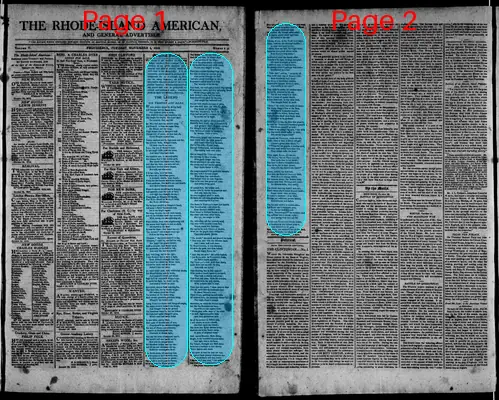
Poem
November 3, 1812
The Rhode Island American, And General Advertiser
Providence, Providence County, Rhode Island
What is this article about?
Ballad narrating the legend of Sir Tristan, a Briton knight, who falls in love with Elba, betrothed to Saxon prince Horsa. Amid Arthur-Hengist wars, captivity leads to secret vows, Horsa's vengeful murder of Tristan, and Elba's tragic discovery and death. (214 characters)
Merged-components note: This is a single poem continued across pages; original label on first part was 'literary' but content is clearly poetry, so merged and relabeled to 'poem'.
Clippings
1 of 2
OCR Quality
92%
Excellent
Full Text
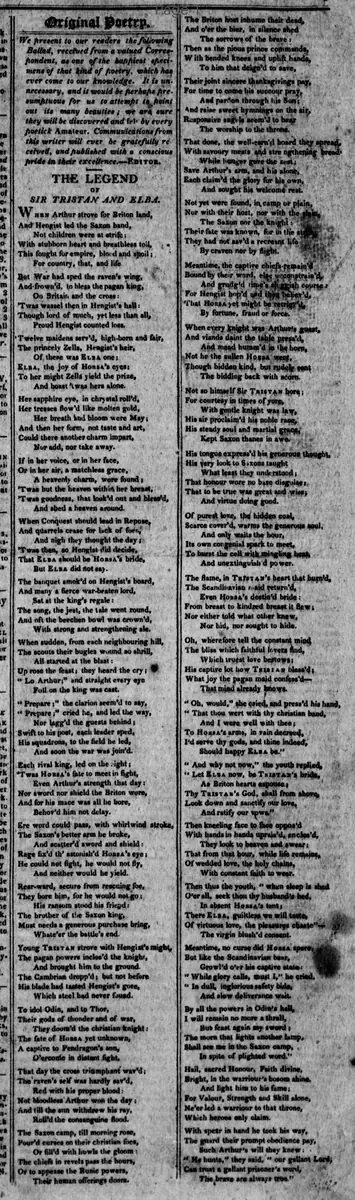
Original Poetry.
We present to our readers the following
Ballad, received from a valued Correspondent,
as one of the happiest specimen of that kind of poetry
which has ever come to our knowledge. It is unnecessary,
and it would be perhaps presumptuous for us to attempt to point
out its many beauties; we are sure
they will be discovered and felt by every
poetic Amateur. Communications from
this writer will ever be gratefully received,
and published with a conscious
pride in their excellence.-Editor.
THE LEGEND
or
SIR TRISTAN AND ELBA.
When Arthur strove on Briton land,
And Hengist led the Saxon band,
Not children were at strife:
With stubborn heart and breathless toil
This fought for empire, blood and spoil;
For country, that, and life
But War had sped the raven's wing,
And frown'd, to bless the pagan king,
On Britain. and the cross:
'Twas wassel then in Hengist's hall:
Though lord of much, yet less than all,
Proud Hengist counted loss.
Twelve maidens serv'd, high-born and fair
The princely Zella, Hengist's heir
Of these was Elba one:
Elba, the joy of Horsa's eyes:
To her might Zella yield the prize,
And boast 'twas hers alone.
Her sapphire eye, in chrystal roll'd,
Her tresses flow'd like molten gold,
Her breath and bloom were May:
And then her form, not taste and art,
Could there another charm impart,
Nor add, nor take away.
If in her voice, or in her face,
Or in her air, a matchless grace,
A heavenly charm, were found;
'Twas but the heaven within her breast;
'Twas goodness, that look'd out and bless'd
And shed a heaven around
When Conquest should lead in Repose
And quarrels cease for lack of foes,
And nigh they thought the day;
'Twas then, so Hengist did decide,
That Elba should be Horsa bride
But Elba did not say.
The banquet smok'd on Hengist's board,
And many a fierce war-beaten lord
Sat at the king's regale:
The song, the jest, the tale went round,
And oft the beechen bowl was crown'd,
With strong and strengthening ale.
When sudden, from each neighbouring hill,
The scouts their bugles wound so shrill
All started at the blast :
Up rose the guest; they heard the cry;
"Lo.Arthur;" and straight every eye
Full.on the king was cast.
" Prepare;" the clarion seem'd to say,
" Prepare;" cried he, and led the way,
Nor lagg'd the guests behind;
Swift to his post, each leader sped,
His squadrons, to the field he led,
And soon the war was join'd.
Each rival king, led on the fight;
T was Horsa's fate to meet in fight,
Even Arthur's strength that day:
Nor sword nor shield the Briton wore,
And for his mace was all be bore,
Behov'd him not delay.
Ere word could' pass, with whirlwind stroke,
The Saxon's better arm he broke,
And scatter'd' sword and shield:
Rage fix'd th' astonish'd Horsa's eye;
He could not fight, he would not fly.
And neither would he yield.
Rear-ward, secure from rescuing foe,
They bore him, for he would not go:
His ransom stood his friend:
The brother of the Saxon king,
Must needs a generous purchase bring,
Whate'er the battle's end.
Young Tristan strove with Hengist's might
The pagan powers inclos'd the knight,
And brought him to the ground.
The Cambrian dropp'd; but not before
His blade had tasted Hengist's gore,
Which steel had never found.
To idol Odin, and to Thor,
Their gods of thunder and of war,
They doom'd the christian knight:
The fate of Horsa yet unknown,
A captive to Pendragon's son,
O'ercome in distant fight.
That day the cross triumphant wav'd;
The raven's iek was hardly sav'd,
Red with his proper blood:
Not bloodless Arthur won the day:
And till the sun withdrew his ray,
Roll'd the consanguine flood.
The Saxon camp, till morning rose,
Pour'd curses on their christian foes,
Or fill'd with howls the gloom:
The chiefs in revels pass the hours,
Or to appease the Runic powers,
Their human offerings doom.
The Briton host inhume their dead
And o'er the bier, in silence shed
The sorrows of the brave:
Then as the pious prince commands
With bended knees and uplift hands
To him that deign'd to save,
Their joint sincere thanksgivings pay
For time to come his succour pray,
And pardon through his Son?
And raise sweet hymnings on the air
Responsive angels seem'd to bear
The worship to the throne.
That done, the well-earn'd board they spread
With savoury meats and strengthening
While hunger gave the zest:
Save Arthur's arm, and his alone.
Each claim'd the glory for his own.
And sought his welcome rest.
Not yet were found, in camp or plain
Nor with their host, nor with the h
The Saxon nor the knight :
Their fate was known, for in the si.
They had not sav'd a recreant life
By craven nor by flight.
Meantime, the captive chiefs remain'd
Bound by their word, else unconstrain'd,
And grudg'd time o l grish course-
For Hengist hop'd and then believ'd,
That Horsa yet might be retriev'd
By fortune, fraud or force.
When every knight was Arthur's guest,
And viands daint the table press'd
And mead humm'd in the horn
Not he the sullen Horsa went,
Though bidden kind, but rudely sent
. The bidding back with scorn.
Not so himself Sir Tristan bore;
For courtesy in times of yore,
With gentle knight was law
His air proclaim'd his noble race,
His steady soul and martial grace.
Kept Saxon thanes in awe.
His tongue express'd his generous thought,
His very look to Saxons taught
What least they understood;
That honour wore no base disguises
That to be true was great and wise;
And virtue doing good.
Of purest love, the hidden coal,
Scarce cover'd, warms the generous soul,
And only waits the hour,
Its own congenial spark to meet,
To burst the cell with mingling heat
And unextinguish'd power.
The flame, in Tristan's heart that burn'd
The Scandinavian maid return'd,
Even Horsa's destin'd bride:
From breast to kindred breast it flew:
Nor either told what other knew,
Nor bid, nor sought to hide.
Oh, wherefore tell the constant mind
The bliss which faithful lovers find,
Which truest love bestows;
His captive lot how Tristan bless'd;
What joy the pagan maid confess'd-
That mind already knows.
" Oh, would," she cried, and press'd his hand,
" That thou wert with thy christian band
And I were well with thee;
To Horsa's arms, in vain decreed,
I'd serve thy gods, and thine indeed
Should happy Elsa be."
"And why not now," the youth replied
" Let Elsa now, be Tristan's bride
As Briton hearts espouse;
Thy Tristan's God, shall from above
Look down and sanctify our love,
And ratify our vows"
Then kneeling face to face oppos'd
With hands in hands uprais'd, enclos'd
They look to heaven and swear;
That from that hour, while life remains
Of wedded love, the holy chains
With constant faith to wear.
Then thus the youth, " when sleep is shed
O'er all, seek thou thy husband's bed
In absent Horsa's tent;
There ELBA, guiltless we will taste
Of virtuous love, the pleasures chaste'.
The virgin blush'd consent.
Meantime, no curse did Horsa spare
But like the Scandinavian bear,
Growl'd o'er his captive state:
" While glory calls, must I," he cried
" In dull, inglorious safety bide
And slow deliverance wait.
By all the powers in Odin's hall
I will remain no more a thrall,
But feast again my sword;
The morn that lights another sun,
Shall see me in the Saxon camp,
In spite of plighted word."
Hail. sacred Honour, Faith divine
Bright, in the warrior's bosom shine.
And light him to his fame:
For Valour, Strength and Skill alone,
Ne'er led a warrior to that throne,
Which heroes only claim.
With spear in hand he took his way.
The guard their prompt obedience pay.
Such Arthur's will they knew:
He hunts," they said. " our gallant Lord
Can trust a gallant prisoner's word,
O'er hill and plain, through vale and wood
While love and vengeance fired his blood,
His eager course he bent,
Nor halted, till, though others slept,
The nightly guard small vigil kept,
He halted in his tent.
"Come, Elfrida, to thy Tristan's arms
Come, with thy yet untasted charms,"
A voice was heard to say;
"Come, bless my bed, my virgin bride,
Impatient love could almost chide
Even night's long delay."
Confounded stood the Saxon chief,
Transfix'd by rage, revenge and grief;
No more he sought to know:
It ask'd no seer, to read his fate,
His passion spurn'd perhaps with hate
Supplanted by a foe!
"Take thou," said he, "may perish all
Who build their rise on others' fall
In such foul favour be their doom
Thy Elfrida's immolated charms,
Reserv'd for happier Tristan's arms
Are victims at thy tomb
Thus while he spoke, his random dart
He hurl'd, directed by his ear,
For all was wrapp'd in dark
But in a heart of purest mould,
In love most true, in war most bold
The weapon found its mark.
"Elfrida," he cried, but spoke no more
The Saxon dragg'd him to the floor
And stain'd it in his murder
And climb'd the bridal, funeral bed,
Profan'd with blood most foully shed,
But more to be profaned.
Twas Elfrida's step the floor that press'd
As well her Tristan murderer guess'd
Had Elfrida guess'd as well!
"Come to my arms," he said, "my bride
Thy stay could almost tempt to chide,
Did not my tongue rebel."
"I come, my Tristan, chide me not,
Hark! what is that, I surely thought
I heard a groan most dread;"
"Twas but the guards, a snoring crew
Till they shall surely have their due,
They cannot wake the dead."
Thine angel, Elfrida, did not cry,
"Fly Elfrida, tis not Tristan-fly
That holds thee to his breast;
This hour is Hell's triumphant hour
Even devils riot in their power,
And even the damn'd are blest"
Above, around, the fatal bed,
Wet with the blood of Tristan shed,
With Elfrida's wrongs defil'd;
Did demons dance in the broken trust
Murder most foul, Revenge and Lust—
St. Aldhelm's smile; they smil'd.
The distant morning flash'd with red,
Around Elfrida's head
Sweet visions play'd round Elfrida's head:
"Sweet victim wake no more,
Or wake to madness! O be blind,
Wrongs yet unknown, pursue behind,
And horror wait before."
The day-star wink'd in eastern skies
Fair Elfrida open'd her lovely eyes,
To bid her lord fare well:
"Now, I'm revenged:" the monster cried
The sufferer with a shriek replied,
And sprung from bed and fell
On her own Tristan's bloody breast
Her footsteps as she lighted press'd,
And slipp'd in his gore.
Speechless, she stretch'd her on the dear
To his chill cheek, her cheek she laid,
And sighing; breath'd no more.
We present to our readers the following
Ballad, received from a valued Correspondent,
as one of the happiest specimen of that kind of poetry
which has ever come to our knowledge. It is unnecessary,
and it would be perhaps presumptuous for us to attempt to point
out its many beauties; we are sure
they will be discovered and felt by every
poetic Amateur. Communications from
this writer will ever be gratefully received,
and published with a conscious
pride in their excellence.-Editor.
THE LEGEND
or
SIR TRISTAN AND ELBA.
When Arthur strove on Briton land,
And Hengist led the Saxon band,
Not children were at strife:
With stubborn heart and breathless toil
This fought for empire, blood and spoil;
For country, that, and life
But War had sped the raven's wing,
And frown'd, to bless the pagan king,
On Britain. and the cross:
'Twas wassel then in Hengist's hall:
Though lord of much, yet less than all,
Proud Hengist counted loss.
Twelve maidens serv'd, high-born and fair
The princely Zella, Hengist's heir
Of these was Elba one:
Elba, the joy of Horsa's eyes:
To her might Zella yield the prize,
And boast 'twas hers alone.
Her sapphire eye, in chrystal roll'd,
Her tresses flow'd like molten gold,
Her breath and bloom were May:
And then her form, not taste and art,
Could there another charm impart,
Nor add, nor take away.
If in her voice, or in her face,
Or in her air, a matchless grace,
A heavenly charm, were found;
'Twas but the heaven within her breast;
'Twas goodness, that look'd out and bless'd
And shed a heaven around
When Conquest should lead in Repose
And quarrels cease for lack of foes,
And nigh they thought the day;
'Twas then, so Hengist did decide,
That Elba should be Horsa bride
But Elba did not say.
The banquet smok'd on Hengist's board,
And many a fierce war-beaten lord
Sat at the king's regale:
The song, the jest, the tale went round,
And oft the beechen bowl was crown'd,
With strong and strengthening ale.
When sudden, from each neighbouring hill,
The scouts their bugles wound so shrill
All started at the blast :
Up rose the guest; they heard the cry;
"Lo.Arthur;" and straight every eye
Full.on the king was cast.
" Prepare;" the clarion seem'd to say,
" Prepare;" cried he, and led the way,
Nor lagg'd the guests behind;
Swift to his post, each leader sped,
His squadrons, to the field he led,
And soon the war was join'd.
Each rival king, led on the fight;
T was Horsa's fate to meet in fight,
Even Arthur's strength that day:
Nor sword nor shield the Briton wore,
And for his mace was all be bore,
Behov'd him not delay.
Ere word could' pass, with whirlwind stroke,
The Saxon's better arm he broke,
And scatter'd' sword and shield:
Rage fix'd th' astonish'd Horsa's eye;
He could not fight, he would not fly.
And neither would he yield.
Rear-ward, secure from rescuing foe,
They bore him, for he would not go:
His ransom stood his friend:
The brother of the Saxon king,
Must needs a generous purchase bring,
Whate'er the battle's end.
Young Tristan strove with Hengist's might
The pagan powers inclos'd the knight,
And brought him to the ground.
The Cambrian dropp'd; but not before
His blade had tasted Hengist's gore,
Which steel had never found.
To idol Odin, and to Thor,
Their gods of thunder and of war,
They doom'd the christian knight:
The fate of Horsa yet unknown,
A captive to Pendragon's son,
O'ercome in distant fight.
That day the cross triumphant wav'd;
The raven's iek was hardly sav'd,
Red with his proper blood:
Not bloodless Arthur won the day:
And till the sun withdrew his ray,
Roll'd the consanguine flood.
The Saxon camp, till morning rose,
Pour'd curses on their christian foes,
Or fill'd with howls the gloom:
The chiefs in revels pass the hours,
Or to appease the Runic powers,
Their human offerings doom.
The Briton host inhume their dead
And o'er the bier, in silence shed
The sorrows of the brave:
Then as the pious prince commands
With bended knees and uplift hands
To him that deign'd to save,
Their joint sincere thanksgivings pay
For time to come his succour pray,
And pardon through his Son?
And raise sweet hymnings on the air
Responsive angels seem'd to bear
The worship to the throne.
That done, the well-earn'd board they spread
With savoury meats and strengthening
While hunger gave the zest:
Save Arthur's arm, and his alone.
Each claim'd the glory for his own.
And sought his welcome rest.
Not yet were found, in camp or plain
Nor with their host, nor with the h
The Saxon nor the knight :
Their fate was known, for in the si.
They had not sav'd a recreant life
By craven nor by flight.
Meantime, the captive chiefs remain'd
Bound by their word, else unconstrain'd,
And grudg'd time o l grish course-
For Hengist hop'd and then believ'd,
That Horsa yet might be retriev'd
By fortune, fraud or force.
When every knight was Arthur's guest,
And viands daint the table press'd
And mead humm'd in the horn
Not he the sullen Horsa went,
Though bidden kind, but rudely sent
. The bidding back with scorn.
Not so himself Sir Tristan bore;
For courtesy in times of yore,
With gentle knight was law
His air proclaim'd his noble race,
His steady soul and martial grace.
Kept Saxon thanes in awe.
His tongue express'd his generous thought,
His very look to Saxons taught
What least they understood;
That honour wore no base disguises
That to be true was great and wise;
And virtue doing good.
Of purest love, the hidden coal,
Scarce cover'd, warms the generous soul,
And only waits the hour,
Its own congenial spark to meet,
To burst the cell with mingling heat
And unextinguish'd power.
The flame, in Tristan's heart that burn'd
The Scandinavian maid return'd,
Even Horsa's destin'd bride:
From breast to kindred breast it flew:
Nor either told what other knew,
Nor bid, nor sought to hide.
Oh, wherefore tell the constant mind
The bliss which faithful lovers find,
Which truest love bestows;
His captive lot how Tristan bless'd;
What joy the pagan maid confess'd-
That mind already knows.
" Oh, would," she cried, and press'd his hand,
" That thou wert with thy christian band
And I were well with thee;
To Horsa's arms, in vain decreed,
I'd serve thy gods, and thine indeed
Should happy Elsa be."
"And why not now," the youth replied
" Let Elsa now, be Tristan's bride
As Briton hearts espouse;
Thy Tristan's God, shall from above
Look down and sanctify our love,
And ratify our vows"
Then kneeling face to face oppos'd
With hands in hands uprais'd, enclos'd
They look to heaven and swear;
That from that hour, while life remains
Of wedded love, the holy chains
With constant faith to wear.
Then thus the youth, " when sleep is shed
O'er all, seek thou thy husband's bed
In absent Horsa's tent;
There ELBA, guiltless we will taste
Of virtuous love, the pleasures chaste'.
The virgin blush'd consent.
Meantime, no curse did Horsa spare
But like the Scandinavian bear,
Growl'd o'er his captive state:
" While glory calls, must I," he cried
" In dull, inglorious safety bide
And slow deliverance wait.
By all the powers in Odin's hall
I will remain no more a thrall,
But feast again my sword;
The morn that lights another sun,
Shall see me in the Saxon camp,
In spite of plighted word."
Hail. sacred Honour, Faith divine
Bright, in the warrior's bosom shine.
And light him to his fame:
For Valour, Strength and Skill alone,
Ne'er led a warrior to that throne,
Which heroes only claim.
With spear in hand he took his way.
The guard their prompt obedience pay.
Such Arthur's will they knew:
He hunts," they said. " our gallant Lord
Can trust a gallant prisoner's word,
O'er hill and plain, through vale and wood
While love and vengeance fired his blood,
His eager course he bent,
Nor halted, till, though others slept,
The nightly guard small vigil kept,
He halted in his tent.
"Come, Elfrida, to thy Tristan's arms
Come, with thy yet untasted charms,"
A voice was heard to say;
"Come, bless my bed, my virgin bride,
Impatient love could almost chide
Even night's long delay."
Confounded stood the Saxon chief,
Transfix'd by rage, revenge and grief;
No more he sought to know:
It ask'd no seer, to read his fate,
His passion spurn'd perhaps with hate
Supplanted by a foe!
"Take thou," said he, "may perish all
Who build their rise on others' fall
In such foul favour be their doom
Thy Elfrida's immolated charms,
Reserv'd for happier Tristan's arms
Are victims at thy tomb
Thus while he spoke, his random dart
He hurl'd, directed by his ear,
For all was wrapp'd in dark
But in a heart of purest mould,
In love most true, in war most bold
The weapon found its mark.
"Elfrida," he cried, but spoke no more
The Saxon dragg'd him to the floor
And stain'd it in his murder
And climb'd the bridal, funeral bed,
Profan'd with blood most foully shed,
But more to be profaned.
Twas Elfrida's step the floor that press'd
As well her Tristan murderer guess'd
Had Elfrida guess'd as well!
"Come to my arms," he said, "my bride
Thy stay could almost tempt to chide,
Did not my tongue rebel."
"I come, my Tristan, chide me not,
Hark! what is that, I surely thought
I heard a groan most dread;"
"Twas but the guards, a snoring crew
Till they shall surely have their due,
They cannot wake the dead."
Thine angel, Elfrida, did not cry,
"Fly Elfrida, tis not Tristan-fly
That holds thee to his breast;
This hour is Hell's triumphant hour
Even devils riot in their power,
And even the damn'd are blest"
Above, around, the fatal bed,
Wet with the blood of Tristan shed,
With Elfrida's wrongs defil'd;
Did demons dance in the broken trust
Murder most foul, Revenge and Lust—
St. Aldhelm's smile; they smil'd.
The distant morning flash'd with red,
Around Elfrida's head
Sweet visions play'd round Elfrida's head:
"Sweet victim wake no more,
Or wake to madness! O be blind,
Wrongs yet unknown, pursue behind,
And horror wait before."
The day-star wink'd in eastern skies
Fair Elfrida open'd her lovely eyes,
To bid her lord fare well:
"Now, I'm revenged:" the monster cried
The sufferer with a shriek replied,
And sprung from bed and fell
On her own Tristan's bloody breast
Her footsteps as she lighted press'd,
And slipp'd in his gore.
Speechless, she stretch'd her on the dear
To his chill cheek, her cheek she laid,
And sighing; breath'd no more.
What sub-type of article is it?
Ballad
What themes does it cover?
War Military
Love Courtship
Death Mourning
What keywords are associated?
Sir Tristan
Elba
King Arthur
Hengist
Horsa
Saxon
Britons
Forbidden Love
Betrayal
Tragedy
What entities or persons were involved?
From A Valued Correspondent
Poem Details
Title
The Legend Of Sir Tristan And Elba.
Author
From A Valued Correspondent
Subject
Legend Of Sir Tristan And Elba
Form / Style
Rhymed Stanzas
Key Lines
When Arthur Strove On Briton Land, And Hengist Led The Saxon Band, Not Children Were At Strife:
Her Sapphire Eye, In Chrystal Roll'd, Her Tresses Flow'd Like Molten Gold, Her Breath And Bloom Were May:
Then Kneeling Face To Face Oppos'd With Hands In Hands Uprais'd, Enclos'd They Look To Heaven And Swear;
"Come, Elfrida, To Thy Tristan's Arms Come, With Thy Yet Untasted Charms," A Voice Was Heard To Say;
Speechless, She Stretch'd Her On The Dear To His Chill Cheek, Her Cheek She Laid, And Sighing; Breath'd No More.