Thank you for visiting SNEWPapers!
Sign up free
Editorial
August 4, 1916
The West Virginian
Fairmont, Marion County, West Virginia
What is this article about?
This editorial criticizes President Wilson's leadership on national defense and praises Republican nominee Charles E. Hughes for promising efficient military and naval preparedness, industrial mobilization, and avoidance of waste, positioning it as common sense rather than militarism amid the 1916 election.
Clipping
OCR Quality
98%
Excellent
Full Text
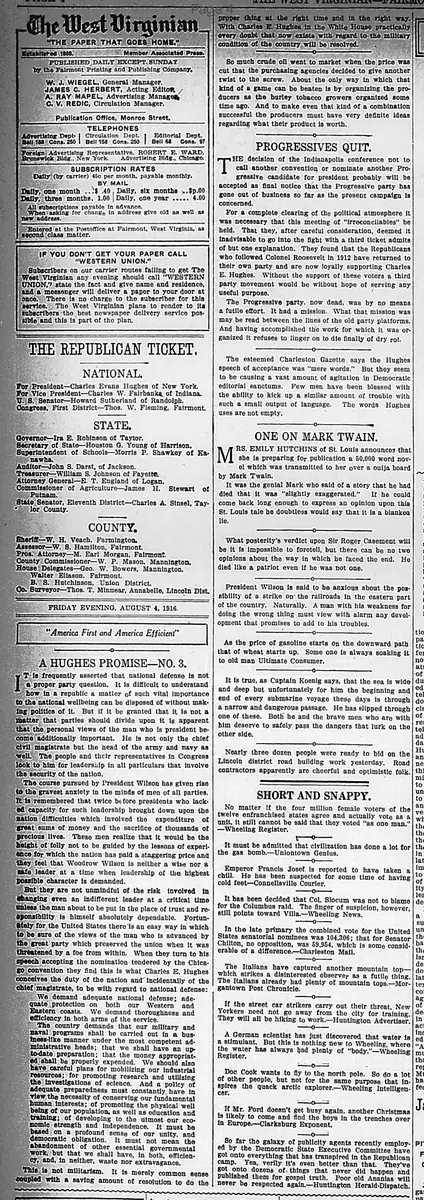
"America First and America Efficient"
A HUGHES PROMISE: NO. 3.
'Tis frequently asserted that national defense is not a proper party question. It is difficult to understand how in a republic a matter of such vital importance to the national wellbeing can be disposed of without making politics of it. But if it be granted that it is not a matter that parties should divide upon it is apparent that the personal views of the man who is president become additionally important. He is not only the chief civil magistrate but the head of the army and navy as well. The people and their representatives in Congress look to him for leadership in all particulars that involve the security of the nation.
The course pursued by President Wilson has given rise to the gravest anxiety in the minds of men of all parties. It is remembered that twice before presidents who lacked capacity for such leadership brought down upon the nation difficulties which involved the expenditure of great sums of money and the sacrifice of thousands of precious lives. These men realize that it would be the height of folly not to be guided by the lessons of experience for which the nation has paid a staggering price and they feel that Woodrow Wilson is neither a wise nor a safe leader at a time when leadership of the highest possible character is demanded.
But they are not unmindful of the risk involved in changing even an indifferent leader at a critical time unless the man about to be put in the place of trust and responsibility is himself absolutely dependable. Fortunately for the United States there is an easy way in which to be sure of the views of the man who is advanced by the great party which preserved the union when it was threatened by a foe from within. When they turn to his speech accepting the nomination tendered by the Chicago convention they find this is what Charles E. Hughes conceives the duty of the nation and incidentally of the chief magistrate, to be with regard to national defense:
We demand adequate national defense; adequate protection on both our Western and Eastern coasts. We demand thoroughness and efficiency in both arms of the service.
The country demands that our military and naval programs shall be carried out in a business-like manner under the most competent administrative heads; that we shall have an up-to-date preparation; that the money appropriated shall be properly expended. We should also have careful plans for mobilizing our industrial resources; for promoting research and utilizing the investigations of science. And a policy of adequate preparedness must constantly have in view the necessity of conserving our fundamental human interests; of promoting the physical well being of our population, as well as education and training; of developing to the utmost our economic strength and independence. It must be based on a profound sense of our unity, and democratic obligation. It must not mean the abandonment of other essential governmental work, but that we shall have, in both, efficiency and, in neither, waste nor extravagance.
This is not militarism. It is merely common sense coupled with a saving amount of resolution to do the proper thing at the right time and in the right way.
With Charles E. Hughes in the White House practically every doubt that now exists with regard to the military condition of the country will be resolved.
A HUGHES PROMISE: NO. 3.
'Tis frequently asserted that national defense is not a proper party question. It is difficult to understand how in a republic a matter of such vital importance to the national wellbeing can be disposed of without making politics of it. But if it be granted that it is not a matter that parties should divide upon it is apparent that the personal views of the man who is president become additionally important. He is not only the chief civil magistrate but the head of the army and navy as well. The people and their representatives in Congress look to him for leadership in all particulars that involve the security of the nation.
The course pursued by President Wilson has given rise to the gravest anxiety in the minds of men of all parties. It is remembered that twice before presidents who lacked capacity for such leadership brought down upon the nation difficulties which involved the expenditure of great sums of money and the sacrifice of thousands of precious lives. These men realize that it would be the height of folly not to be guided by the lessons of experience for which the nation has paid a staggering price and they feel that Woodrow Wilson is neither a wise nor a safe leader at a time when leadership of the highest possible character is demanded.
But they are not unmindful of the risk involved in changing even an indifferent leader at a critical time unless the man about to be put in the place of trust and responsibility is himself absolutely dependable. Fortunately for the United States there is an easy way in which to be sure of the views of the man who is advanced by the great party which preserved the union when it was threatened by a foe from within. When they turn to his speech accepting the nomination tendered by the Chicago convention they find this is what Charles E. Hughes conceives the duty of the nation and incidentally of the chief magistrate, to be with regard to national defense:
We demand adequate national defense; adequate protection on both our Western and Eastern coasts. We demand thoroughness and efficiency in both arms of the service.
The country demands that our military and naval programs shall be carried out in a business-like manner under the most competent administrative heads; that we shall have an up-to-date preparation; that the money appropriated shall be properly expended. We should also have careful plans for mobilizing our industrial resources; for promoting research and utilizing the investigations of science. And a policy of adequate preparedness must constantly have in view the necessity of conserving our fundamental human interests; of promoting the physical well being of our population, as well as education and training; of developing to the utmost our economic strength and independence. It must be based on a profound sense of our unity, and democratic obligation. It must not mean the abandonment of other essential governmental work, but that we shall have, in both, efficiency and, in neither, waste nor extravagance.
This is not militarism. It is merely common sense coupled with a saving amount of resolution to do the proper thing at the right time and in the right way.
With Charles E. Hughes in the White House practically every doubt that now exists with regard to the military condition of the country will be resolved.
What sub-type of article is it?
Military Affairs
Partisan Politics
What keywords are associated?
National Defense
Preparedness
Charles Hughes
Woodrow Wilson
Presidential Election
Military Efficiency
What entities or persons were involved?
Charles E. Hughes
President Wilson
Republican Party
Chicago Convention
Editorial Details
Primary Topic
National Defense Preparedness And Presidential Leadership
Stance / Tone
Supportive Of Charles E. Hughes And Critical Of Woodrow Wilson
Key Figures
Charles E. Hughes
President Wilson
Republican Party
Chicago Convention
Key Arguments
National Defense Is Vital And Requires Strong Presidential Leadership
Wilson's Leadership Has Caused Anxiety Due To Past Presidential Failures
Hughes Promises Adequate And Efficient National Defense Without Militarism
Preparedness Should Include Military, Naval, Industrial Mobilization, And Conservation Of Human Interests