Thank you for visiting SNEWPapers!
Sign up free
Story
February 22, 1957
St. Paul Recorder
Saint Paul, Ramsey County, Minnesota
What is this article about?
In 1956, African Americans made significant strides toward equality, with notable achievements in civil rights, arts, academia, and sports, including the Montgomery bus boycott success and individual triumphs by figures like Autherine Lucy Foster and Jackie Robinson.
Clipping
OCR Quality
100%
Excellent
Full Text
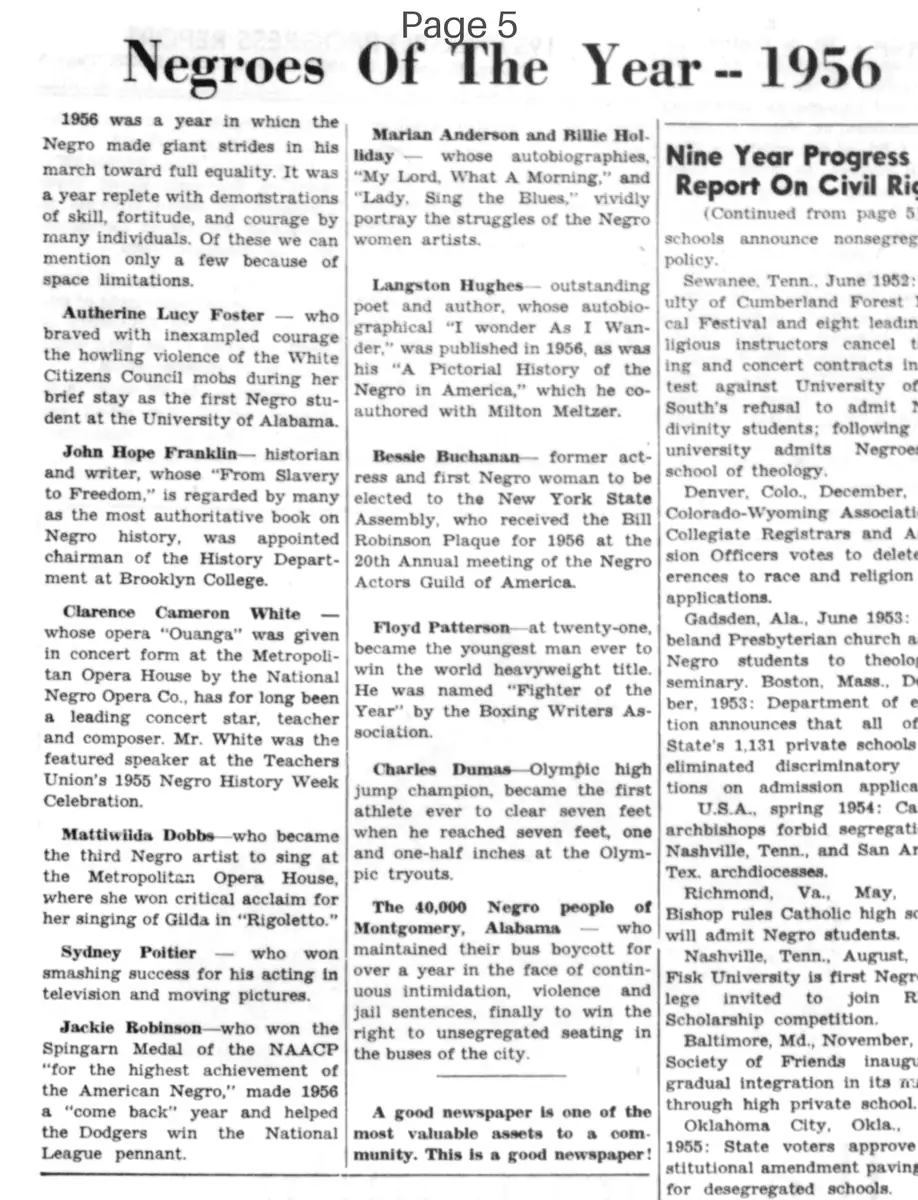
Negroes Of The Year -- 1956
1956 was a year in which the Negro made giant strides in his march toward full equality. It was a year replete with demonstrations of skill, fortitude, and courage by many individuals. Of these we can mention only a few because of space limitations.
Autherine Lucy Foster - who braved with unexampled courage the howling violence of the White Citizens Council mobs during her brief stay as the first Negro student at the University of Alabama.
John Hope Franklin historian and writer, whose "From Slavery to Freedom," is regarded by many as the most authoritative book on Negro history, was appointed chairman of the History Department at Brooklyn College.
Clarence Cameron White — whose opera "Ouanga" was given in concert form at the Metropolitan Opera House by the National Negro Opera Co., has for long been a leading concert star, teacher and composer. Mr. White was the featured speaker at the Teachers Union's 1955 Negro History Week Celebration.
Mattiwilda Dobbs who became the third Negro artist to sing at the Metropolitan Opera House, where she won critical acclaim for her singing of Gilda in "Rigoletto."
Sydney Poitier - who won smashing success for his acting in television and moving pictures.
Jackie Robinson-who won the Spingarn Medal of the NAACP "for the highest achievement of the American Negro." made 1956 a "come back" year and helped the Dodgers win the National League pennant.
Marian Anderson and Billie Holiday- whose autobiographies, "My Lord, What A Morning." and "Lady, Sing the Blues." vividly portray the struggles of the Negro women artists.
Langston Hughes outstanding poet and author, whose autobiographical "I Wonder As I Wander," was published in 1956, as was his "A Pictorial History of the Negro in America," which he co-authored with Milton Meltzer.
Bessie Buchanan- former actress and first Negro woman to be elected to the New York State Assembly, who received the Bill Robinson Plague for 1956 at the 20th Annual meeting of the Negro Actors Guild of America.
Floyd Patterson at twenty-one. became the youngest man ever to win the world heavyweight title. He was named "Fighter of the Year" by the Boxing Writers Association.
Charles Dumas Olympic high jump champion, became the first athlete ever to clear seven feet when he reached seven feet, one and one-half inches at the Olympic tryouts.
The 40,000 Negro people of Montgomery, Alabama — who maintained their bus boycott for over a year in the face of continuous intimidation, violence and jail sentences, finally to win the right to unsegregated seating in the buses of the city
A good newspaper is one of the most valuable assets to a community. This is a good newspaper!
1956 was a year in which the Negro made giant strides in his march toward full equality. It was a year replete with demonstrations of skill, fortitude, and courage by many individuals. Of these we can mention only a few because of space limitations.
Autherine Lucy Foster - who braved with unexampled courage the howling violence of the White Citizens Council mobs during her brief stay as the first Negro student at the University of Alabama.
John Hope Franklin historian and writer, whose "From Slavery to Freedom," is regarded by many as the most authoritative book on Negro history, was appointed chairman of the History Department at Brooklyn College.
Clarence Cameron White — whose opera "Ouanga" was given in concert form at the Metropolitan Opera House by the National Negro Opera Co., has for long been a leading concert star, teacher and composer. Mr. White was the featured speaker at the Teachers Union's 1955 Negro History Week Celebration.
Mattiwilda Dobbs who became the third Negro artist to sing at the Metropolitan Opera House, where she won critical acclaim for her singing of Gilda in "Rigoletto."
Sydney Poitier - who won smashing success for his acting in television and moving pictures.
Jackie Robinson-who won the Spingarn Medal of the NAACP "for the highest achievement of the American Negro." made 1956 a "come back" year and helped the Dodgers win the National League pennant.
Marian Anderson and Billie Holiday- whose autobiographies, "My Lord, What A Morning." and "Lady, Sing the Blues." vividly portray the struggles of the Negro women artists.
Langston Hughes outstanding poet and author, whose autobiographical "I Wonder As I Wander," was published in 1956, as was his "A Pictorial History of the Negro in America," which he co-authored with Milton Meltzer.
Bessie Buchanan- former actress and first Negro woman to be elected to the New York State Assembly, who received the Bill Robinson Plague for 1956 at the 20th Annual meeting of the Negro Actors Guild of America.
Floyd Patterson at twenty-one. became the youngest man ever to win the world heavyweight title. He was named "Fighter of the Year" by the Boxing Writers Association.
Charles Dumas Olympic high jump champion, became the first athlete ever to clear seven feet when he reached seven feet, one and one-half inches at the Olympic tryouts.
The 40,000 Negro people of Montgomery, Alabama — who maintained their bus boycott for over a year in the face of continuous intimidation, violence and jail sentences, finally to win the right to unsegregated seating in the buses of the city
A good newspaper is one of the most valuable assets to a community. This is a good newspaper!
What sub-type of article is it?
Biography
Personal Triumph
Historical Event
What themes does it cover?
Triumph
Bravery Heroism
Justice
What keywords are associated?
African American Achievements
1956
Civil Rights
Arts
Sports
Integration
Bus Boycott
What entities or persons were involved?
Autherine Lucy Foster
John Hope Franklin
Clarence Cameron White
Mattiwilda Dobbs
Sydney Poitier
Jackie Robinson
Marian Anderson
Billie Holiday
Langston Hughes
Bessie Buchanan
Floyd Patterson
Charles Dumas
40,000 Negro People Of Montgomery
Where did it happen?
United States
Story Details
Key Persons
Autherine Lucy Foster
John Hope Franklin
Clarence Cameron White
Mattiwilda Dobbs
Sydney Poitier
Jackie Robinson
Marian Anderson
Billie Holiday
Langston Hughes
Bessie Buchanan
Floyd Patterson
Charles Dumas
40,000 Negro People Of Montgomery
Location
United States
Event Date
1956
Story Details
The article highlights key achievements of African Americans in 1956, including Autherine Lucy Foster's integration of the University of Alabama, academic and artistic accomplishments by figures like John Hope Franklin and Marian Anderson, sports triumphs by Jackie Robinson and Floyd Patterson, and the Montgomery bus boycott victory.