Thank you for visiting SNEWPapers!
Sign up free
Editorial
September 20, 1813
Virginia Argus
Richmond, Virginia
What is this article about?
Editorial celebrates a recent U.S. naval victory in the war, praises American heroism exemplified by Lawrence, Jones, and Burrows, condemns Federalist opposition as unpatriotic, and urges national remembrance and support for fallen heroes' families.
Clipping
OCR Quality
95%
Excellent
Full Text
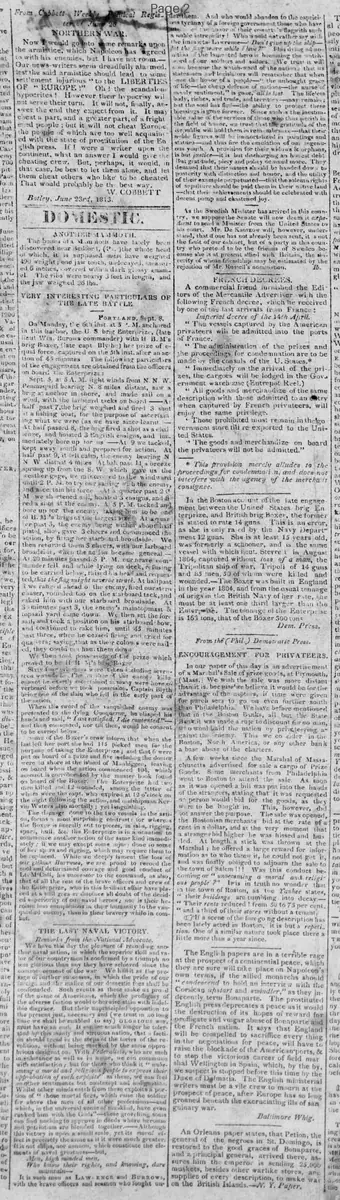
THE LAST NAVAL VICTORY.
Remarks from the National Advocate.
We have this day the pleasure of recording another naval action, in which the superior skill and valor of our countrymen is confirmed by a triumph no less glorious than any they have achieved since the commencement of the war. We hail it as the presage of further successes, in which the pride of our foreign and the malice of our domestic foes shall be confounded. Such events as these make us proud of the name of Americans, which the profligacy of the adverse faction would otherwise stain with indelible disgrace. But their unprincipled opposition to the present just, necessary and (we trust in no long time we shall be enabled to say) glorious war, must have an end. It can survive much longer be tolerated in a manly and virtuous nation, that a faction should tread in the steps of the tories of the revolution, without being marked by the same opprobrious designation. With Federalists, who are such in substance as well as in name, we can commune with satisfaction; but for those who think it "unbecoming a moral and religious people to express their approbation of such exploits" as these, we can feel no other sentiments but contempt and indignation. Whilst other minds catch from these exploits a portion of "those mortal fires, which raise the soldier far above the men of all other professions—and which, in the universal sense of mankind, have even ranked him with the Gods"—these groveling souls can find nothing to approve in deeds where heroism and patriotism are blended together.—Although this victory is upon a small scale, yet its moral effect is precisely the same as if it were much greater. It is not ships, nor cannon, which constitute the elements of naval greatness—but,
Men, high minded men.
Who know their rights, and knowing, dare maintain—
It is such men as Lawrence, Jones and Burrows, with the brave officers and seamen who fought under them. And who would abandon to the capricious tyranny of a foreign government those who have sustained the honor of their country's flag with such a noble intrepidity? Who would not rather say with the immortal Lawrence—'Don't give up the ship—let the flag wave while I live?' This dying admonition of the lamented hero is becoming the watch-word of our soldiers and sailors. We trust it will soon become the watch-word of the nation: that our statesmen and legislators will remember that when the honor of a people—the unbought grace of life—the cheap defence of nations—the nurse of manly sentiment," is gone, all is lost. The lifeless body, riches, and trade, and territory—may remain; but the soul has fled—the ability to protect these blessings is gone forever. Since such is the inestimable value of the services of those who thus perish in the field of honor, we trust that the gratitude of the republic will hold them in remembrance—that their noble figures will be immortalized in paintings and statues—and thus fire the emulation of our ingenious youth. A provision for their widows & orphans, is but justice—it is but discharging an honest debt. But gratitude, piety and policy demand more. They demand that their names should be handed down to posterity with distinction and honor, and the utility of their example perpetuated—that the solemn rites of sepulture should be paid them in their native land—that their achievements should be celebrated with decent pomp and chastened joy.
Remarks from the National Advocate.
We have this day the pleasure of recording another naval action, in which the superior skill and valor of our countrymen is confirmed by a triumph no less glorious than any they have achieved since the commencement of the war. We hail it as the presage of further successes, in which the pride of our foreign and the malice of our domestic foes shall be confounded. Such events as these make us proud of the name of Americans, which the profligacy of the adverse faction would otherwise stain with indelible disgrace. But their unprincipled opposition to the present just, necessary and (we trust in no long time we shall be enabled to say) glorious war, must have an end. It can survive much longer be tolerated in a manly and virtuous nation, that a faction should tread in the steps of the tories of the revolution, without being marked by the same opprobrious designation. With Federalists, who are such in substance as well as in name, we can commune with satisfaction; but for those who think it "unbecoming a moral and religious people to express their approbation of such exploits" as these, we can feel no other sentiments but contempt and indignation. Whilst other minds catch from these exploits a portion of "those mortal fires, which raise the soldier far above the men of all other professions—and which, in the universal sense of mankind, have even ranked him with the Gods"—these groveling souls can find nothing to approve in deeds where heroism and patriotism are blended together.—Although this victory is upon a small scale, yet its moral effect is precisely the same as if it were much greater. It is not ships, nor cannon, which constitute the elements of naval greatness—but,
Men, high minded men.
Who know their rights, and knowing, dare maintain—
It is such men as Lawrence, Jones and Burrows, with the brave officers and seamen who fought under them. And who would abandon to the capricious tyranny of a foreign government those who have sustained the honor of their country's flag with such a noble intrepidity? Who would not rather say with the immortal Lawrence—'Don't give up the ship—let the flag wave while I live?' This dying admonition of the lamented hero is becoming the watch-word of our soldiers and sailors. We trust it will soon become the watch-word of the nation: that our statesmen and legislators will remember that when the honor of a people—the unbought grace of life—the cheap defence of nations—the nurse of manly sentiment," is gone, all is lost. The lifeless body, riches, and trade, and territory—may remain; but the soul has fled—the ability to protect these blessings is gone forever. Since such is the inestimable value of the services of those who thus perish in the field of honor, we trust that the gratitude of the republic will hold them in remembrance—that their noble figures will be immortalized in paintings and statues—and thus fire the emulation of our ingenious youth. A provision for their widows & orphans, is but justice—it is but discharging an honest debt. But gratitude, piety and policy demand more. They demand that their names should be handed down to posterity with distinction and honor, and the utility of their example perpetuated—that the solemn rites of sepulture should be paid them in their native land—that their achievements should be celebrated with decent pomp and chastened joy.
What sub-type of article is it?
War Or Peace
Partisan Politics
Military Affairs
What keywords are associated?
Naval Victory
American Heroism
War Opposition
Federalists
Patriotic Duty
National Honor
Military Remembrance
What entities or persons were involved?
Lawrence
Jones
Burrows
Federalists
Tories Of The Revolution
Editorial Details
Primary Topic
Celebration Of Recent Naval Victory And Criticism Of War Opposition
Stance / Tone
Patriotic Exaltation And Contempt For Federalist Opposition
Key Figures
Lawrence
Jones
Burrows
Federalists
Tories Of The Revolution
Key Arguments
Superior American Naval Skill And Valor Confirmed By Recent Triumph
Opposition To The Just War Akin To Tory Treason, Deserving Contempt
Naval Greatness Stems From High Minded Men Who Defend Rights
Honor And Flag Must Be Upheld As National Soul
Gratitude Demands Remembrance, Provisions For Families, And Perpetuation Of Heroes' Examples