Thank you for visiting SNEWPapers!
Sign up free
The New Hampshire Gazette And General Advertiser
Portsmouth, Exeter, Rockingham County, New Hampshire
What is this article about?
An essay reflecting on the historical adoration and oppression of women across cultures and ages, from savage societies to civilized nations, highlighting their vulnerabilities, societal roles, and arguing for public recognition of their virtues and contributions beyond domestic spheres.
Merged-components note: This is a continuation of the literary essay 'On the UNIVERSAL MAGAZINE: THE FEMALE SEX' from page 1 to page 2; the text flows directly without interruption, changing the label from 'letter_to_editor' to 'literary' for the overall piece.
Clippings
1 of 2
OCR Quality
Full Text
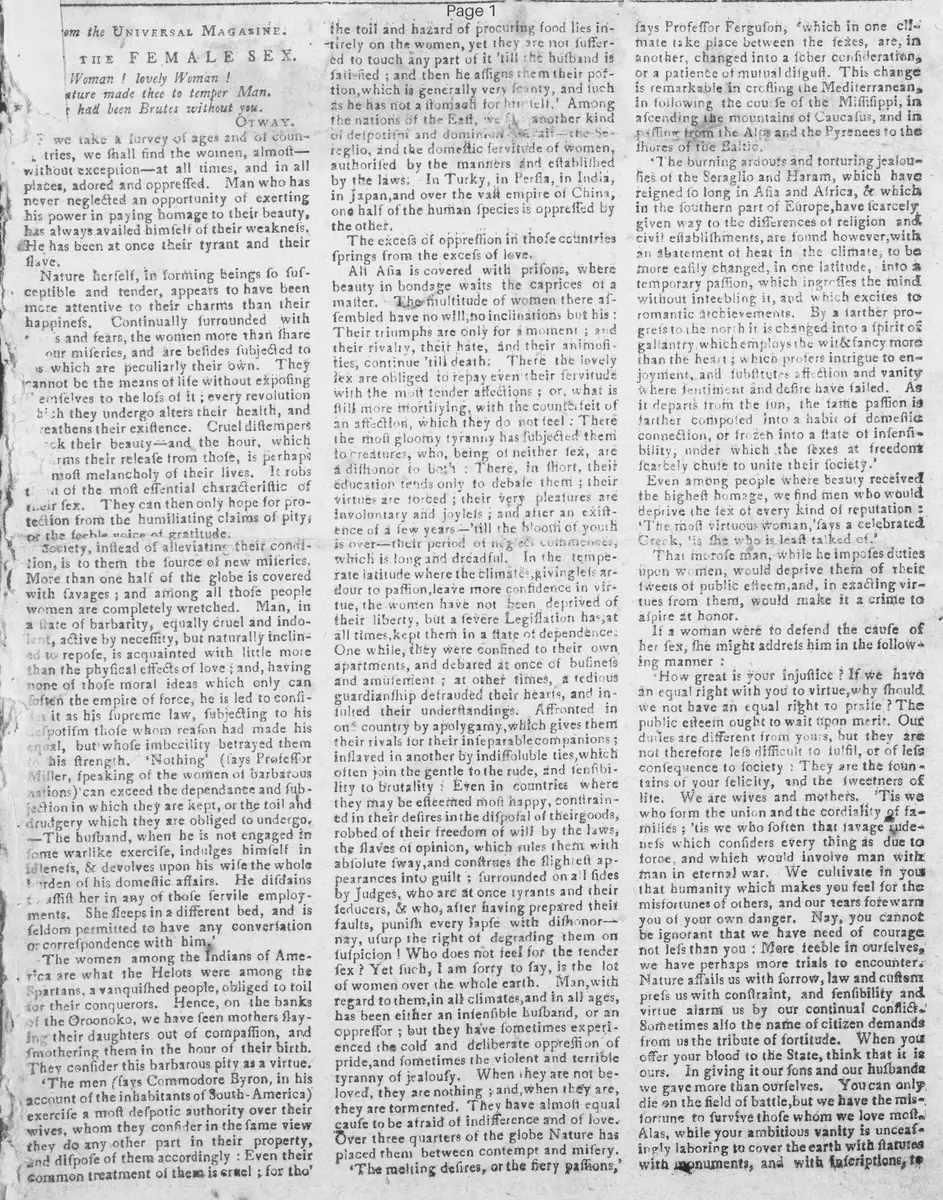
THE FEMALE SEX.
Woman! lovely Woman!
Nature's allure made thee to temper Man.
We had been Brutes without you.
STRAY.
When we take a survey of ages and of countries, we shall find the women almost without exception—at all times, and in all places, adored and oppressed. Man who has never neglected an opportunity of exerting his power in paying homage to their beauty, has always availed himself of their weakness. He has been at once their tyrant and their slave.
Nature herself, in forming beings of susceptible and tender, appears to have been more attentive to their charms than their happiness. Continually surrounded with dangers and fears: the women more than share our miseries, and are besides subjected to ills which are peculiarly their own. They cannot be the means of life without exposing themselves to the loss of it: every revolution which they undergo alters their health, and threatens their existence. Cruel distempers attack their beauty—and the hour, which brings their release from those, is perhaps most melancholy of their lives. It robs them of the most essential characteristic of their sex. They can then only hope for protection from the humiliating claims of pity, or the feeble voice of gratitude.
Society, instead of alleviating their condition, is to them the source of new miseries. More than one half of the globe is covered with savages: and among all those people women are completely wretched. Man, in a state of barbarity, equally cruel and indolent, active by necessity, but naturally inclined to repose, is acquainted with little more than the physical effects of love; and, having none of those moral ideas which only can soften the empire of force, he is led to consider it as his supreme law, subjecting to his despotism those whom reason had made his equal, but whose imbecility betrayed them into his strength. Nothing (says Professor Miller, speaking of the women of barbarous nations) can exceed the dependence and subjection in which they are kept, or the toil and drudgery which they are obliged to undergo. The husband, when he is not engaged in some warlike exercise, indulges himself in idleness, & devolves upon his wife the whole burden of his domestic affairs. He disdains to aid her in any of those servile employments. She sleeps in a different bed, and is seldom permitted to have any conversation or correspondence with him.
The women among the Indians of America are what the Helots were among the Spartans, a vanquished people, obliged to toil for their conquerors. Hence, on the banks of the Oronooko, we have seen mothers slaying their daughters out of compassion, and smothering them in the hour of their birth. They consider this barbarous pity as a virtue. The men (says Commodore Byron, in his account of the inhabitants of South-America) exercise a most despotic authority over their wives, whom they consider in the same view they do any other part in their property, and dispose of them accordingly: Even their common treatment of them is cruel; for tho' the toil and hazard of procuring food lies entirely on the women, yet they are not suffered to touch any part of it till the husband is satisfied; and then he assigns them their portion, which is generally very scanty, and such as he has no stomach for himself. Among the nations of the East, we see another kind of despotism and dominion gain—the Seraglio, and the domestic servitude of women, authorised by the manners and established by the laws: In Turkey, in Persia, in India, in Japan, and over the vast empire of China, one half of the human species is oppressed by the other.
The excess of oppression in those countries springs from the excess of love. All Asia is covered with prisons, where beauty in bondage waits the caprices of a master. The multitude of women there assembled have no will; no inclinations but his: Their triumphs are only for a moment; and their rivalries, their hate, and their animosities continue till death: There the lovely sex are obliged to repay even their servitude with the most tender affections: or, what is still more mortifying, with the counterfeit of an affection, which they do not feel: There the most gloomy tyranny has subjected them to creatures, who, being of neither sex, are a dishonor to both: There, in short, their education tends only to debase them: their virtues are forced: their very pleasures are involuntary and joyless; and after an existence of a few years—till the bloom of youth is over—their period of neglect commences, which is long and dreadful. In the temperate latitudes where the climate, giving less ardour to passion, leaves more confidence in virtue, the women have not been deprived of their liberty, but a severe Legislation has; at all times, kept them in a state of dependence. One while, they were confined to their own apartments, and debarred at once of business and amusement; at other times, a tedious guardianship defrauded their hearts, and insulted their understandings. Affronted in one country by polygamy, which gives them their rivals for their inseparable companions; enslaved in another by indissoluble ties, which often join the gentle to the rude, and sensibility to brutality: Even in countries where they may be deemed most happy, confined in their desires in the disposal of their goods, robbed of their freedom of will by the laws, the slaves of opinion, which rules them with absolute sway, and construes the lightest appearances into guilt: surrounded on all sides by Judges, who are at once tyrants and their seducers, & who, after having prepared their faults, punish every lapse with dishonor—nay, usurp the right of degrading them on suspicion! Who does not feel for the tender sex? Yet such, I am sorry to say, is the lot of women over the whole earth. Man, with regard to them, in all climates, and in all ages, has been either an insensible husband, or an oppressor; but they have sometimes experienced the cold and deliberate oppression of pride, and sometimes the violent and terrible tyranny of jealousy. When they are not beloved, they are nothing; and, when they are, they are tormented. They have almost equal cause to be afraid of indifference and of love. Over three quarters of the globe Nature has placed them between contempt and misery. The melting desires, or the fiery passions,
says Professor Ferguson, which in one climate take place between the sexes, are, in another, changed into a sober consideration, or a patience of mutual disgust. This change is remarkable in crossing the Mediterranean, in following the course of the Mississippi, in ascending the mountains of Caucasus, and in passing from the Alps and the Pyrenees to the shores of the Baltic.
The burning ardours and torturing jealousies of the Seraglio and Harem, which have reigned so long in Asia and Africa, & which in the southern part of Europe, have scarcely given way to the differences of religion and civil establishments, are found however, with an abatement of heat in the climate, to be more easily changed, in one latitude, into a temporary passion, which engrosses the mind without enfeebling it, and which excites to romantic achievements. By a farther progress to the north it is changed into a spirit of gallantry which employs the wit & fancy more than the heart: which prefers intrigue to enjoyment, and substitutes affection and vanity where sentiment and desire have failed. As it departs from the sun, the same passion is farther composed into a habit of domestic connection, or frozen into a state of insensibility, under which the sexes at freedom scarcely choose to unite their society.
Even among people where beauty received the highest homage, we find men who would deprive the sex of every kind of reputation: 'The most virtuous woman,' says a celebrated Greek, 'is she who is least talked of.' That morose man, while he imposes duties upon women, would deprive them of their sweets of public esteem, and, in exacting virtues from them, would make it a crime to aspire at honor.
If a woman were to defend the cause of her sex, she might address him in the following manner:
How great is your injustice? If we have an equal right with you to virtue, why should we not have an equal right to praise? The public esteem ought to wait upon merit. Our duties are different from yours, but they are not therefore less difficult to fulfil, or of less consequence to society: They are the fountains of your felicity, and the sweeteners of life. We are wives and mothers. 'Tis we who form the union and the cordiality of families: 'tis we who often soften that savage rudeness which considers every thing as due to force, and which would involve man with man in eternal war. We cultivate in your breasts that humanity which makes you feel for the misfortunes of others, and our tears forewarn you of your own danger. Nay, you cannot be ignorant that we have need of courage not less than you: More feeble in ourselves, we have perhaps more trials to encounter. Nature assails us with sorrow, law and custom press us with constraint, and sensibility and virtue alarm us by our continual conflict. Sometimes also the name of citizen demands from us the tribute of fortitude. When you offer your blood to the State, think that it is ours. In giving it our sons and our husbands we gave more than ourselves. You can only die on the field of battle, but we have the misfortune to survive those whom we love most. Alas, while your ambitious vanity is unceasingly laboring to cover the earth with temples with monuments, and with inscriptions, to Eternize, if possible, your names, and give yourselves an existence, when this body is no more. Why must we be condemned to live and to die unknown? Would that the grave and eternal forgetfulness should be our lot. Be not our tyrants in all: Permit our names to be sometimes pronounced beyond the narrow circle in which we live: Permit friendship, or at least love, to inscribe its emblems on the tomb where our ashes repose; and deny us not that public esteem, which after the esteem of one's self, is the sweetest reward of well-doing.
All men, however, it must be owned, have not been equally unjust to their fair companions. In some countries public honors have been paid to women. Art has erected them monuments, Eloquence has celebrated their virtues, and History has collected whatever could adorn their characters.
I shall perhaps hereafter trouble you with some more reflections upon this agreeable subject, and am, with great respect, &c.
What sub-type of article is it?
What themes does it cover?
What keywords are associated?
What entities or persons were involved?
Literary Details
Title
The Female Sex.
Author
Stray.
Subject
On The Condition And Oppression Of Women Across Ages And Countries
Key Lines