Thank you for visiting SNEWPapers!
Sign up free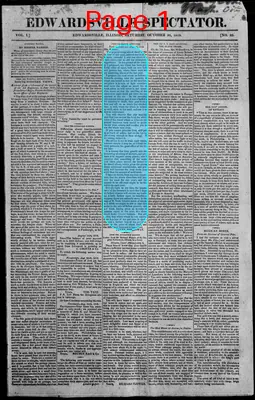
Letter to Editor
October 30, 1819
Edwardsville Spectator
Edwardsville, Madison County, Illinois
What is this article about?
Peter Holloway writes to Mr. Ripley from York, Genesee Co., on Aug. 16, 1819, sharing his method for preventing smut in wheat using lye from wood ashes and slacked lime on seed wheat. He reports success on his farm and estimates statewide economic benefits, including yield increases and reduced losses.
Clipping
OCR Quality
98%
Excellent
Full Text
York, Genesee Co. Aug. 16, 1819
MR. RIPLEY,
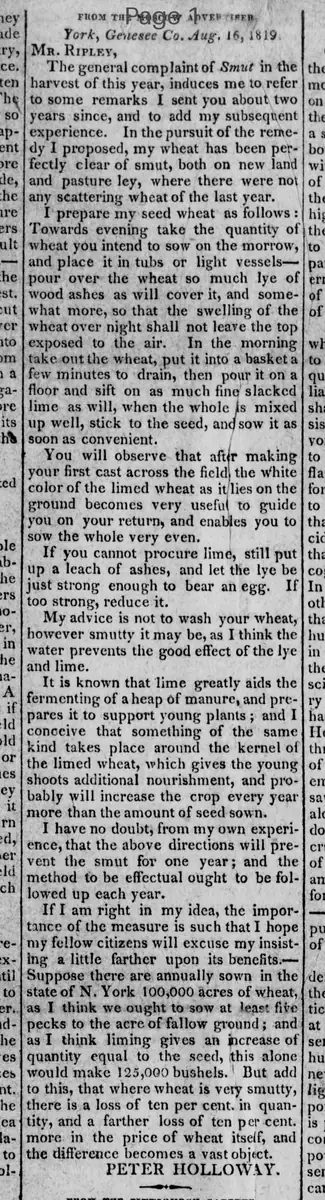
The general complaint of Smut in the harvest of this year, induces me to refer to some remarks I sent you about two years since, and to add my subsequent experience. In the pursuit of the remedy I proposed, my wheat has been perfectly clear of smut, both on new land and pasture ley, where there were not any scattering wheat of the last year. I prepare my seed wheat as follows:
Towards evening take the quantity of wheat you intend to sow on the morrow, and place it in tubs or light vessels—pour over the wheat so much lye of wood ashes as will cover it, and somewhat more, so that the swelling of the wheat over night shall not leave the top exposed to the air. In the morning take out the wheat, put it into a basket a few minutes to drain, then pour it on a floor and sift on as much fine slacked lime as will, when the whole is mixed up well, stick to the seed, and sow it as soon as convenient.
You will observe that after making your first cast across the field the white color of the limed wheat as it lies on the ground becomes very useful to guide you on your return, and enables you to sow the whole very even.
If you cannot procure lime, still put up a leach of ashes, and let the lye be just strong enough to bear an egg. If too strong, reduce it.
My advice is not to wash your wheat, however smutty it may be, as I think the water prevents the good effect of the lye and lime.
It is known that lime greatly aids the fermenting of a heap of manure, and prepares it to support young plants; and I conceive that something of the same kind takes place around the kernel of the limed wheat, which gives the young shoots additional nourishment, and probably will increase the crop every year more than the amount of seed sown.
I have no doubt, from my own experience, that the above directions will prevent the smut for one year; and the method to be effectual ought to be followed up each year.
If I am right in my idea, the importance of the measure is such that I hope my fellow citizens will excuse my insisting a little farther upon its benefits. Suppose there are annually sown in the state of N. York 100,000 acres of wheat, as I think we ought to sow at least five pecks to the acre of fallow ground; and as I think liming gives an increase of quantity equal to the seed, this alone would make 125,000 bushels. But add to this, that where wheat is very smutty, there is a loss of ten per cent. in quantity, and a farther loss of ten per cent. more in the price of wheat itself, and the difference becomes a vast object.
PETER HOLLOWAY.
MR. RIPLEY,
The general complaint of Smut in the harvest of this year, induces me to refer to some remarks I sent you about two years since, and to add my subsequent experience. In the pursuit of the remedy I proposed, my wheat has been perfectly clear of smut, both on new land and pasture ley, where there were not any scattering wheat of the last year. I prepare my seed wheat as follows:
Towards evening take the quantity of wheat you intend to sow on the morrow, and place it in tubs or light vessels—pour over the wheat so much lye of wood ashes as will cover it, and somewhat more, so that the swelling of the wheat over night shall not leave the top exposed to the air. In the morning take out the wheat, put it into a basket a few minutes to drain, then pour it on a floor and sift on as much fine slacked lime as will, when the whole is mixed up well, stick to the seed, and sow it as soon as convenient.
You will observe that after making your first cast across the field the white color of the limed wheat as it lies on the ground becomes very useful to guide you on your return, and enables you to sow the whole very even.
If you cannot procure lime, still put up a leach of ashes, and let the lye be just strong enough to bear an egg. If too strong, reduce it.
My advice is not to wash your wheat, however smutty it may be, as I think the water prevents the good effect of the lye and lime.
It is known that lime greatly aids the fermenting of a heap of manure, and prepares it to support young plants; and I conceive that something of the same kind takes place around the kernel of the limed wheat, which gives the young shoots additional nourishment, and probably will increase the crop every year more than the amount of seed sown.
I have no doubt, from my own experience, that the above directions will prevent the smut for one year; and the method to be effectual ought to be followed up each year.
If I am right in my idea, the importance of the measure is such that I hope my fellow citizens will excuse my insisting a little farther upon its benefits. Suppose there are annually sown in the state of N. York 100,000 acres of wheat, as I think we ought to sow at least five pecks to the acre of fallow ground; and as I think liming gives an increase of quantity equal to the seed, this alone would make 125,000 bushels. But add to this, that where wheat is very smutty, there is a loss of ten per cent. in quantity, and a farther loss of ten per cent. more in the price of wheat itself, and the difference becomes a vast object.
PETER HOLLOWAY.
What sub-type of article is it?
Informative
Persuasive
What themes does it cover?
Agriculture
What keywords are associated?
Wheat Smut
Seed Treatment
Lye Preparation
Slacked Lime
Agricultural Remedy
Crop Yield
New York Farming
What entities or persons were involved?
Peter Holloway
Mr. Ripley
Letter to Editor Details
Author
Peter Holloway
Recipient
Mr. Ripley
Main Argument
treating seed wheat with lye from wood ashes and slacked lime prevents smut, improves even sowing, and increases crop yield equivalent to the seed amount, with significant statewide economic benefits in new york by reducing losses from smut.
Notable Details
Refers To Previous Remarks Sent Two Years Ago
Specific Preparation: Soak In Lye Overnight, Drain, Mix With Lime
Lye Strength: Just Enough To Bear An Egg
Advises Against Washing Smutty Wheat
Estimates 100,000 Acres Sown Annually In N. York, Potential 125,000 Bushel Increase Plus 20% Loss Avoidance