Thank you for visiting SNEWPapers!
Sign up free
Letter to Editor
October 14, 1826
Phenix Gazette
Alexandria, Virginia
What is this article about?
In Letter IV, 'B. C.' defends Catholicism by critiquing Rev. Joseph Blanco White's credibility, accusing him of hypocrisy, imposture, and fabricating family affection to justify his apostasy and continued ministry despite disbelief in core doctrines like hell.
Clipping
OCR Quality
98%
Excellent
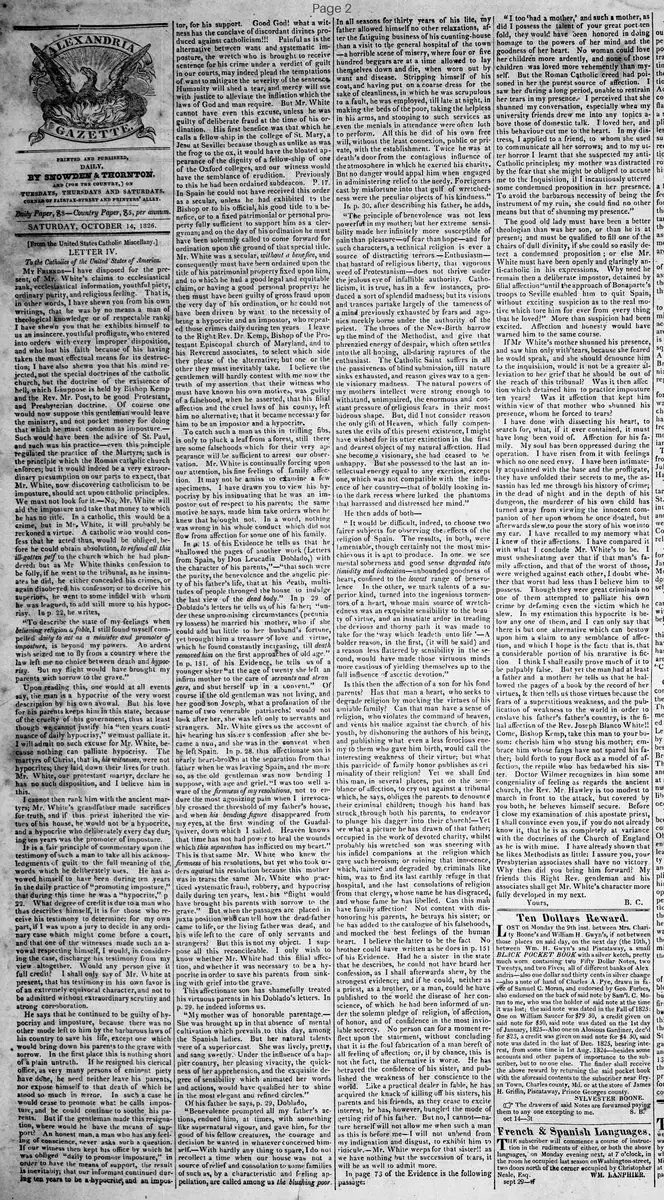
Full Text
[From the United States Catholic Miscellany.]
LETTER IV.
To the Catholics of the United States of America.
My Friends—I have disposed for the present, of Mr. White's claims to ecclesiastical rank, ecclesiastical information, youthful piety, ordinary purity, and religious feeling. That is, in other words, I have shewn you from his own writings, that he was by no means a man of theological knowledge or of respectable rank; I have shewn you that he exhibits himself to us an insincere, youthful profligate, who entered into orders with every improper disposition, and who lost his faith because of his having taken the most effectual means for its destruction; I have also shewn you that his mind rejected, not the special doctrines of the catholic church, but the doctrine of the existence of hell, which I suppose is held by Bishop Kemp and the Rev. Mr. Post, to be good Protestant, and Presbyterian doctrine. Of course one would now suppose this gentleman would leave the ministry, and not pocket money for doing that which he must condemn as imposture.—
Such would have been the advice of St. Paul, and such was his practice—even this principle regulated the practice of the Martyrs; such is the principle which the Roman catholic church enforces; but it would indeed be a very extraordinary presumption on our parts to expect, that Mr. White, now discovering catholicism to be imposture, should act upon catholic principles. We must not look for it.—No, Mr. White will aid the imposture and take that money to which he has no title. In a catholic, this would be a crime, but in Mr. White, it will probably be reckoned a virtue. A catholic who would confess that he acted thus, would be obliged, before he could obtain absolution, to refund all this ill-gotten pelf to the church which he had plundered: but as Mr. White thinks confession to be folly, if he went to the tribunal, as he insinuates he did, he either concealed his crimes, or again disobeyed his confessor; or to deceive his superiors, he went to some infidel with whom he was leagued, to add still more to his hypocrisy. In p. 22, he writes,
"To describe the state of my feelings when believing religion a fable, I still found myself compelled daily to act as a minister and promoter of imposture, is beyond my powers. An ardent wish seized me to fly from a country where the law left me no choice between death and hypocrisy. But my flight would have brought my parents with sorrow to the grave."
Upon reading this, one would at all events say, the man is a hypocrite of the very worst description by his own avowal. But his love for his parents keeps him in this state, because of the cruelty of his government, thus at least though we cannot justify his "ten years continuance of daily hypocrisy," we must palliate it.
I will admit no such excuse for Mr. White, because nothing can palliate hypocrisy. The martyrs of Christ, that is, his witnesses, were not hypocrites; they laid down their lives for truth. Mr. White, our protestant martyr, declares he has no such disposition, and I believe him in this.
I cannot then rank him with the ancient martyrs; Mr. White's grandfather made sacrifices for truth, and if this priest inherited the virtues of his house, he would not be a hypocrite, and a hypocrite who deliberately every day during ten years was the promoter of imposture.
It is a fair principle of commentary upon the testimony of such a man to take all his acknowledgments of guilt to the full meaning of the words which he deliberately uses. He has avowed himself to have been during ten years in the daily practice of "promoting imposture," that during this time he was a "hypocrite," p. 22. What degree of credit is due to a man who thus describes himself, it is for those who receive his testimony to determine: for my own part, if I was upon a jury to decide in any ordinary case which might come before a court, and that one of the witnesses made such an avowal respecting himself, I would, in considering the case, discharge his testimony from my view altogether. Would any person give it full credit? I shall only say of Mr. White at present, that his testimony in his own favor is of an extremely equivocal character, and not to be admitted without extraordinary scrutiny and strong corroboration.
He says that he continued to be guilty of hypocrisy and imposture, because there was no other mode left to him by the barbarous laws of his country to save his life, except one which would bring down his parents to the grave with sorrow. In the first place this is nothing short of a plain untruth. If he resigned his clerical office, as very many persons of eminent piety have done, he need neither leave his parents, nor expose himself to that death of which he stood so much in terror. In such a case he would cease to promote what he calls imposture, and he could continue to soothe his parents. But if the gentleman made this resignation, where would he have the means of support? An honest man, a man who has any feeling of conscience, never asks such a question.
If our witness then kept his office by which he was obliged "daily to promote imposture," in order to have the means of support, the result is inevitably, that our informant continued during ten years to be a hypocrite, and an impostor, for his support. Good God! what a witness has the conclave of discordant divines produced against catholicism!!! Painful as is the alternative between want and systematic imposture, the wretch who is brought to receive sentence for his crime under a verdict of guilty in our courts, may indeed plead the temptations of want to mitigate the severity of the sentence. Humanity will shed a tear, and mercy will sue with justice to alleviate the infliction which the laws of God and man require. But Mr. White cannot have even this excuse, unless he was guilty of deliberate fraud at the time of his ordination. His first benefice was that which he calls a fellow-ship in the college of St. Mary, a Jesu at Seville: because though as unlike as was the frog to the ox, it would have the bloated appearance of the dignity of a fellow-ship of one of the Oxford colleges, and our witness would have the semblance of erudition. Previously to this he had been ordained subdeacon. p. 17. In Spain he could not have received this order as a secular, unless he had exhibited to the Bishop or to his official, his good title to a benefice, or to a fixed patrimonial or personal property fully sufficient to support him as a clergyman; and on the day of his ordination he must have been solemnly called forward for ordination upon the ground of that special title. Mr. White was a secular, without a benefice, and consequently must have been ordained upon the title of his patrimonial property fixed upon him, and to which he had a good legal and equitable claim, or having a good personal property: he then must have been guilty of gross fraud upon the very day of his ordination, or he could not have been driven by want to the necessity of being a hypocrite and an impostor, who repeated those crimes daily during ten years. I leave to the Right Rev. Dr. Kemp, Bishop of the Protestant Episcopal church of Maryland, and to his Reverend associates, to select which side they please of the alternative; but one or the other they must inevitably take. I believe the gentlemen will hardly contest with me now the truth of my assertion that their witness who must have known his own motives, was guilty of a falsehood, when he asserted, that his filial affection and the cruel laws of his country, left him no alternative; that it became necessary for him to be an impostor and a hypocrite.
To catch such a man as this in trifling fibs, is only to pluck a leaf from a forest, still there are some falsehoods which for their very appearance will be sufficient to arrest our observation. Mr. White is continually forcing upon our attention, his fine feelings of family affection. It may not be amiss to examine a few specimens. I have drawn you to view his hypocrisy by his insinuating that he was an impostor out of respect to his parents; the same motive he says, made him take orders when he knew that he ought not. In a word, nothing was wrong in his whole conduct which did not flow from affection for some one of his family. In p. 15. of his Evidence he tells us that he "hallowed the pages of another work (Letters from Spain, by Don Leucadio Doblado,) with the character of his parents," "that such were the purity, the benevolence and the angelic piety of his father's life, that at his death, multitudes of people thronged the house to indulge the last view of the dead body." In p 29 of Doblado's letters he tells us of his father; "under these unpromising circumstances (pecuniary losses) he married his mother, who if she could add but little to her husband's fortune yet brought him a treasure of love and virtue, which he found constantly increasing, till death removed him on the first approaches of old age." In p. 151. of his Evidence, he tells us of a younger sister "at the age of twenty she left an infirm mother to the care of servants and strangers, and shut herself up in a convent." Of course if the old gentleman was not living, and her good son Joseph, what a profanation of the name of two venerable patriarchs! would not look after her, she was left only to servants and strangers. Mr. White gives us the account of his hearing his sister's confession after she became a nun, and she was in the convent when he left Spain. In p. 28. this affectionate son is nearly heart-broken at the separation from that father when he was leaving Spain, and the more so, as the old gentleman was now bending I suppose, with age and grief. "I was too well aware of the firmness of my resolutions, not to endure the most agonizing pain when I irrevocably crossed the threshold of my father's house, and when his bending figure disappeared from my eyes, at the first winding of the Guadalquivir, down which I sailed. Heaven knows that time has not had power to heal the wounds which this separation has inflicted on my heart."
This is that same Mr. White who knew the firmness of his resolutions, but yet who took orders against his resolution because this mother was in tears: the same Mr. White who practiced systematic fraud, robbery, and hypocrisy daily during ten years, lest his "flight would have brought his parents with sorrow to the grave." But when the passages are placed in juxtaposition who can tell how the dead father came to life, or the living father was dead, and his wife left to the care of only servants and strangers? But this is not my object. I suppose all this reconcileable. I only wish to know whether Mr. White had this filial affection, and whether it was necessary to be a hypocrite in order to save his parents from sinking with grief into the grave.
This affectionate son has shamefully treated his virtuous parents in his Doblado's letters. In p. 29. he indeed informs us.
"My mother was of honorable parentage.— She was brought up in that absence of mental cultivation which prevails to this day, among the Spanish ladies. But her natural talents were of a superior cast. She was lively, pretty, and sang sweetly. Under the influence of a happier country, her pleasing vivacity, the quickness of her apprehension, and the exquisite degree of sensibility which animated her words and actions, would have qualified her to shine in the most elegant and refined circles."
Of his father he says, p. 29, Doblado,
"Benevolence prompted all my father's actions, endued him, at times, with something like supernatural vigour, and gave him, for the good of his fellow creatures, the courage and decision he wanted in whatever concerned himself.—With hardly any thing to spare, I do not recollect a time when our house was not a source of relief and consolation to some families of such as, by a characteristic and feeling appellation, are called among us the blushing poor.
In all seasons for thirty years of his life, my father allowed himself no other relaxations, after the fatiguing business of his counting-house than a visit to the general hospital of the town --a horrible scene of misery, where four or five hundred beggars are at a time allowed to lay themselves down and die, when worn out by want and disease. Stripping himself of his coat, and having put on a coarse dress for the sake of cleanliness, in which he was scrupulous to a fault, he was employed, till late at night, in making the beds of the poor, taking the helpless in his arms, and stooping to such services as even the menials in attendance were often loth to perform. All this he did of his own free will, without the least connexion, public or private, with the establishment. Twice he was at death's door from the contagious influence of the atmosphere in which he exerted his charity. But no danger would appal him when engaged in administering relief to the needy. Foreigners cast by misfortune into that gulf of wretchedness were the peculiar objects of his kindness."
In p. 30. after describing his father, he adds,
"The principle of benevolence was not less powerful in my mother; but her extreme sensibility made her infinitely more susceptible of pain than pleasure—of fear than hope—and for such characters, a technical religion is ever a source of distracting terrors—Enthusiasm— that bastard of religious liberty, that vigorous weed of Protestantism—does not thrive under the jealous eye of infallible authority. Catholicism, it is true, has in a few instances, produced a sort of splendid madness; but its visions and trances partake largely of the tameness of a mind previously exhausted by fears and agonies meekly borne under the authority of the priest. The throes of the New-Birth harrow up the mind of the Methodist, and give that phrenzied energy of despair, which often settles into the all-boxing, all-daring raptures of the enthusiast. The Catholic Saint suffers in all the passiveness of blind submission, till nature sinks exhausted, and reason gives way to a gentle visionary madness. The natural powers of my mother's intellect were strong enough to withstand, unimpaired, the enormous and constant pressure of religious fears in their most hideous shape. But, did I not consider reason the only gift of Heaven, which fully compensates the evils of this present existence, I might have wished for its utter extinction in the first and dearest object of my natural affection. Had she become a visionary, she had ceased to be unhappy. But she possessed to the last an intellectual energy equal to any exertion, except one, which was not compatible with the influence of her country—that of boldly looking into the dark recess where lurked the phantoms that harassed and distressed her mind."
He then adds of both—
"It would be difficult, indeed, to choose two fairer subjects for observing the effects of the religion of Spain. The results, in both, were lamentable, though certainly not the most mischievous it is apt to produce. In one, we see mental soberness and good sense degraded into timidity and indecision—unbounded goodness of heart, confined to the lowest range of benevolence. In the other, we mark talents of a superior kind, turned into the ingenious tormentors of a heart, whose main source of wretchedness was an exquisite sensibility to the beauty of virtue, and an insatiate ardor in treading the devious and thorny path it was made to take for the 'way which leadeth unto life.'—A bolder reason, in the first, (it will be said) and a reason less flattered by sensibility in the second, would have made those virtuous minds more cautious of yielding themselves up to the full influence of ascetic devotion."
Is this then the affection of a son for his fond parents? Has that man a heart, who seeks to degrade religion by mocking the virtues of his amiable family? Can that man have a sense of religion, who violates the command of heaven, and vents his malice against the church, of his youth, by dishonoring the authors of his being, and publishing what even a less ferocious enemy to them who gave him birth, would call the interesting weakness of their virtue; but what this parricide of family honor publishes as criminality of their religion? Yet we shall find this man, in several places, put on the semblance of affection, to cry out against a tribunal which, he says, obliges the parents to denounce their criminal children; though his hand has struck through both his parents, to endeavor to plunge his dagger into their church! Yet see what a picture he has drawn of that father; occupied in the work of devoted charity, whilst probably his wretched son was sneering with his infidel companions at the religion which gave such heroism; or ruining that innocence, which, tainted and degraded by criminals like him, was to find its last earthly refuge in that hospital, and the last consolations of religion from that clergy, whose name he has disgraced, and whose fame he has libelled. Can this man have family affection? Not content with dishonoring his parents, he betrays his sister; or he has added to the catalogue of his falsehoods, and mocked the best feelings of the human heart. I believe the latter to be the fact. No brother could have written as he does in p. 151 of his Evidence. Had he a sister in the state that he describes, he could not have heard her confession, as I shall afterwards shew, by the strongest evidence; and if he could, neither as a priest, as a brother, or a man, could he have published to the world the disease of her conscience, of which he had been informed under the solemn pledge of religion, of affection, of honor, and of confidence in the most inviolable secrecy. No person can for a moment reflect upon the statement, without concluding that it is the foul fabrication of a man bereft of all feeling of affection; or, if by chance, this is not the fact, the alternative is worse. He has betrayed the confidence of his sister, and published the weakness of her conscience to the world. Like a practical dealer in fable, he has acquired the knack of killing off his sisters, his parents and his friends, as they cease to excite interest; he has, however, bungled the mode of getting rid of his father. But no, I cannot—nature herself will not allow me when such a man as this is before me—I will not unbend from my indignation and disgust, to exhibit him to ridicule.—Mr. White weeps for that sister!! as we have nothing but the succession of tears, it will be as well to admit more.
In page 73 of the Evidence is the following passage:
"I too 'had a mother.' and such a mother, as did I possess the talent of your great poet ten fold, they would have been honored in doing homage to the powers of her mind and the goodness of her heart. No woman could love her children more ardently, and none of those children was loved more vehemently than myself. But the Roman Catholic creed had poisoned in her the purest source of affection. I saw her during a long period, unable to restrain her tears in my presence.—I perceived that she shunned my conversation, especially when my university friends drew me into any topics above those of domestic talk. I loved her, and this behaviour cut me to the heart. In my distress, I applied to a friend, to whom she used to communicate all her sorrows; and to my utter horror I learnt that she suspected my anti-Catholic principles; my mother was distracted by the fear that she might be obliged to accuse me to the Inquisition, if I incautiously uttered some condemned proposition in her presence. To avoid the barbarous necessity of being the instrument of my ruin, she could find no other means but that of shunning my presence.'
The good old lady must have been a better theologian than was her son, or than he is at present; and must be qualified to fill one of the chairs of dull divinity, if she could so easily detect a condemned proposition; or else Mr. White must have been openly and glaringly anti-catholic in his expressions. Why need he remain then a deliberate impostor, detained by filial affection "until the approach of Bonaparte's troops to Seville enabled him to quit Spain, without exciting suspicion as to the real motive which tore him for ever from every thing that he loved?" More than suspicion had been excited. Affection and honesty would have warned him to the same course.
If Mr. White's mother shunned his presence, and saw him only with tears, because she feared he would speak, and she should denounce him to the inquisition, would it not be a greater alleviation to her grief that he should be out of the reach of this tribunal? Was it then affection which detained him to practice imposture ten years? Was it affection that kept him within view of that mother who shunned his presence, whom he forced to tears?
I have done with dissecting his heart, to search for, what, if it ever contained, it must have long been void of. Affection for his family. My soul has been oppressed during the operation. I have risen from it with feelings which no one need envy. I have been intimately acquainted with the base and the profligate, they have unfolded their secrets to me, the assassin has led me through his history of crime: in the dead of night and in the depth of his dungeon. the murderer of his own child has turned away from viewing the innocent companion of her upon whom he once doated, but afterwards slew, to pour the story of his woe into my ear. I have recalled to my memory what I knew of their affections. I have compared it with what I conclude Mr. White's to be. I must unhesitatingly aver that if that man's family affection, and that of the worst of those, were weighed against each other, I doubt whether that worst had less than I believe him to possess. Though they were great criminals no one of them attempted to palliate his own crime by defaming even the victim which he slew. In my estimation this hypocrite is below any one of them, and I can only say that there is but one alternative which can bestow upon him a claim to any semblance of affection, and which I hope is the fact: that is, that a considerable portion of his narrative is fiction. I think I shall easily prove much of it to be palpably false. But yet the man had at least a father and a mother: he tells us that he hallowed the pages of a book by the record of her virtues, & then tells us those virtues because the fears of a superstitious weakness, and the publication of weakness to the world in order to enslave his father's father's country, is the filial affection of the Rev. Joseph Blanco White!!
Come, Bishop Kemp, take this man to your bosom: cherish him who stung his mother; embrace him whose fangs have not spared his father; hold forth to your flock as a model of affection, the reptile who has bedawbed his sister. Doctor Wilmer recognizes in him some congeniality of feeling as regards the ancient church, the Rev. Mr. Hawley is too modest to march in front to the attack, but covered by you both, he believes himself secure. Before I close my examination of this apostate priest, I shall convince even you, if you do not already know it, that he is as completely at variance with the doctrines of the Church of England as he is with mine. I have already shown that he likes Methodists as little: I assure you, your Presbyterian associates shall have no victory. Why then did you bring him forward? My friends this Right Rev. gentleman and his associates shall get Mr. White's character more fully developed in my next.
Yours,
B. C.
LETTER IV.
To the Catholics of the United States of America.
My Friends—I have disposed for the present, of Mr. White's claims to ecclesiastical rank, ecclesiastical information, youthful piety, ordinary purity, and religious feeling. That is, in other words, I have shewn you from his own writings, that he was by no means a man of theological knowledge or of respectable rank; I have shewn you that he exhibits himself to us an insincere, youthful profligate, who entered into orders with every improper disposition, and who lost his faith because of his having taken the most effectual means for its destruction; I have also shewn you that his mind rejected, not the special doctrines of the catholic church, but the doctrine of the existence of hell, which I suppose is held by Bishop Kemp and the Rev. Mr. Post, to be good Protestant, and Presbyterian doctrine. Of course one would now suppose this gentleman would leave the ministry, and not pocket money for doing that which he must condemn as imposture.—
Such would have been the advice of St. Paul, and such was his practice—even this principle regulated the practice of the Martyrs; such is the principle which the Roman catholic church enforces; but it would indeed be a very extraordinary presumption on our parts to expect, that Mr. White, now discovering catholicism to be imposture, should act upon catholic principles. We must not look for it.—No, Mr. White will aid the imposture and take that money to which he has no title. In a catholic, this would be a crime, but in Mr. White, it will probably be reckoned a virtue. A catholic who would confess that he acted thus, would be obliged, before he could obtain absolution, to refund all this ill-gotten pelf to the church which he had plundered: but as Mr. White thinks confession to be folly, if he went to the tribunal, as he insinuates he did, he either concealed his crimes, or again disobeyed his confessor; or to deceive his superiors, he went to some infidel with whom he was leagued, to add still more to his hypocrisy. In p. 22, he writes,
"To describe the state of my feelings when believing religion a fable, I still found myself compelled daily to act as a minister and promoter of imposture, is beyond my powers. An ardent wish seized me to fly from a country where the law left me no choice between death and hypocrisy. But my flight would have brought my parents with sorrow to the grave."
Upon reading this, one would at all events say, the man is a hypocrite of the very worst description by his own avowal. But his love for his parents keeps him in this state, because of the cruelty of his government, thus at least though we cannot justify his "ten years continuance of daily hypocrisy," we must palliate it.
I will admit no such excuse for Mr. White, because nothing can palliate hypocrisy. The martyrs of Christ, that is, his witnesses, were not hypocrites; they laid down their lives for truth. Mr. White, our protestant martyr, declares he has no such disposition, and I believe him in this.
I cannot then rank him with the ancient martyrs; Mr. White's grandfather made sacrifices for truth, and if this priest inherited the virtues of his house, he would not be a hypocrite, and a hypocrite who deliberately every day during ten years was the promoter of imposture.
It is a fair principle of commentary upon the testimony of such a man to take all his acknowledgments of guilt to the full meaning of the words which he deliberately uses. He has avowed himself to have been during ten years in the daily practice of "promoting imposture," that during this time he was a "hypocrite," p. 22. What degree of credit is due to a man who thus describes himself, it is for those who receive his testimony to determine: for my own part, if I was upon a jury to decide in any ordinary case which might come before a court, and that one of the witnesses made such an avowal respecting himself, I would, in considering the case, discharge his testimony from my view altogether. Would any person give it full credit? I shall only say of Mr. White at present, that his testimony in his own favor is of an extremely equivocal character, and not to be admitted without extraordinary scrutiny and strong corroboration.
He says that he continued to be guilty of hypocrisy and imposture, because there was no other mode left to him by the barbarous laws of his country to save his life, except one which would bring down his parents to the grave with sorrow. In the first place this is nothing short of a plain untruth. If he resigned his clerical office, as very many persons of eminent piety have done, he need neither leave his parents, nor expose himself to that death of which he stood so much in terror. In such a case he would cease to promote what he calls imposture, and he could continue to soothe his parents. But if the gentleman made this resignation, where would he have the means of support? An honest man, a man who has any feeling of conscience, never asks such a question.
If our witness then kept his office by which he was obliged "daily to promote imposture," in order to have the means of support, the result is inevitably, that our informant continued during ten years to be a hypocrite, and an impostor, for his support. Good God! what a witness has the conclave of discordant divines produced against catholicism!!! Painful as is the alternative between want and systematic imposture, the wretch who is brought to receive sentence for his crime under a verdict of guilty in our courts, may indeed plead the temptations of want to mitigate the severity of the sentence. Humanity will shed a tear, and mercy will sue with justice to alleviate the infliction which the laws of God and man require. But Mr. White cannot have even this excuse, unless he was guilty of deliberate fraud at the time of his ordination. His first benefice was that which he calls a fellow-ship in the college of St. Mary, a Jesu at Seville: because though as unlike as was the frog to the ox, it would have the bloated appearance of the dignity of a fellow-ship of one of the Oxford colleges, and our witness would have the semblance of erudition. Previously to this he had been ordained subdeacon. p. 17. In Spain he could not have received this order as a secular, unless he had exhibited to the Bishop or to his official, his good title to a benefice, or to a fixed patrimonial or personal property fully sufficient to support him as a clergyman; and on the day of his ordination he must have been solemnly called forward for ordination upon the ground of that special title. Mr. White was a secular, without a benefice, and consequently must have been ordained upon the title of his patrimonial property fixed upon him, and to which he had a good legal and equitable claim, or having a good personal property: he then must have been guilty of gross fraud upon the very day of his ordination, or he could not have been driven by want to the necessity of being a hypocrite and an impostor, who repeated those crimes daily during ten years. I leave to the Right Rev. Dr. Kemp, Bishop of the Protestant Episcopal church of Maryland, and to his Reverend associates, to select which side they please of the alternative; but one or the other they must inevitably take. I believe the gentlemen will hardly contest with me now the truth of my assertion that their witness who must have known his own motives, was guilty of a falsehood, when he asserted, that his filial affection and the cruel laws of his country, left him no alternative; that it became necessary for him to be an impostor and a hypocrite.
To catch such a man as this in trifling fibs, is only to pluck a leaf from a forest, still there are some falsehoods which for their very appearance will be sufficient to arrest our observation. Mr. White is continually forcing upon our attention, his fine feelings of family affection. It may not be amiss to examine a few specimens. I have drawn you to view his hypocrisy by his insinuating that he was an impostor out of respect to his parents; the same motive he says, made him take orders when he knew that he ought not. In a word, nothing was wrong in his whole conduct which did not flow from affection for some one of his family. In p. 15. of his Evidence he tells us that he "hallowed the pages of another work (Letters from Spain, by Don Leucadio Doblado,) with the character of his parents," "that such were the purity, the benevolence and the angelic piety of his father's life, that at his death, multitudes of people thronged the house to indulge the last view of the dead body." In p 29 of Doblado's letters he tells us of his father; "under these unpromising circumstances (pecuniary losses) he married his mother, who if she could add but little to her husband's fortune yet brought him a treasure of love and virtue, which he found constantly increasing, till death removed him on the first approaches of old age." In p. 151. of his Evidence, he tells us of a younger sister "at the age of twenty she left an infirm mother to the care of servants and strangers, and shut herself up in a convent." Of course if the old gentleman was not living, and her good son Joseph, what a profanation of the name of two venerable patriarchs! would not look after her, she was left only to servants and strangers. Mr. White gives us the account of his hearing his sister's confession after she became a nun, and she was in the convent when he left Spain. In p. 28. this affectionate son is nearly heart-broken at the separation from that father when he was leaving Spain, and the more so, as the old gentleman was now bending I suppose, with age and grief. "I was too well aware of the firmness of my resolutions, not to endure the most agonizing pain when I irrevocably crossed the threshold of my father's house, and when his bending figure disappeared from my eyes, at the first winding of the Guadalquivir, down which I sailed. Heaven knows that time has not had power to heal the wounds which this separation has inflicted on my heart."
This is that same Mr. White who knew the firmness of his resolutions, but yet who took orders against his resolution because this mother was in tears: the same Mr. White who practiced systematic fraud, robbery, and hypocrisy daily during ten years, lest his "flight would have brought his parents with sorrow to the grave." But when the passages are placed in juxtaposition who can tell how the dead father came to life, or the living father was dead, and his wife left to the care of only servants and strangers? But this is not my object. I suppose all this reconcileable. I only wish to know whether Mr. White had this filial affection, and whether it was necessary to be a hypocrite in order to save his parents from sinking with grief into the grave.
This affectionate son has shamefully treated his virtuous parents in his Doblado's letters. In p. 29. he indeed informs us.
"My mother was of honorable parentage.— She was brought up in that absence of mental cultivation which prevails to this day, among the Spanish ladies. But her natural talents were of a superior cast. She was lively, pretty, and sang sweetly. Under the influence of a happier country, her pleasing vivacity, the quickness of her apprehension, and the exquisite degree of sensibility which animated her words and actions, would have qualified her to shine in the most elegant and refined circles."
Of his father he says, p. 29, Doblado,
"Benevolence prompted all my father's actions, endued him, at times, with something like supernatural vigour, and gave him, for the good of his fellow creatures, the courage and decision he wanted in whatever concerned himself.—With hardly any thing to spare, I do not recollect a time when our house was not a source of relief and consolation to some families of such as, by a characteristic and feeling appellation, are called among us the blushing poor.
In all seasons for thirty years of his life, my father allowed himself no other relaxations, after the fatiguing business of his counting-house than a visit to the general hospital of the town --a horrible scene of misery, where four or five hundred beggars are at a time allowed to lay themselves down and die, when worn out by want and disease. Stripping himself of his coat, and having put on a coarse dress for the sake of cleanliness, in which he was scrupulous to a fault, he was employed, till late at night, in making the beds of the poor, taking the helpless in his arms, and stooping to such services as even the menials in attendance were often loth to perform. All this he did of his own free will, without the least connexion, public or private, with the establishment. Twice he was at death's door from the contagious influence of the atmosphere in which he exerted his charity. But no danger would appal him when engaged in administering relief to the needy. Foreigners cast by misfortune into that gulf of wretchedness were the peculiar objects of his kindness."
In p. 30. after describing his father, he adds,
"The principle of benevolence was not less powerful in my mother; but her extreme sensibility made her infinitely more susceptible of pain than pleasure—of fear than hope—and for such characters, a technical religion is ever a source of distracting terrors—Enthusiasm— that bastard of religious liberty, that vigorous weed of Protestantism—does not thrive under the jealous eye of infallible authority. Catholicism, it is true, has in a few instances, produced a sort of splendid madness; but its visions and trances partake largely of the tameness of a mind previously exhausted by fears and agonies meekly borne under the authority of the priest. The throes of the New-Birth harrow up the mind of the Methodist, and give that phrenzied energy of despair, which often settles into the all-boxing, all-daring raptures of the enthusiast. The Catholic Saint suffers in all the passiveness of blind submission, till nature sinks exhausted, and reason gives way to a gentle visionary madness. The natural powers of my mother's intellect were strong enough to withstand, unimpaired, the enormous and constant pressure of religious fears in their most hideous shape. But, did I not consider reason the only gift of Heaven, which fully compensates the evils of this present existence, I might have wished for its utter extinction in the first and dearest object of my natural affection. Had she become a visionary, she had ceased to be unhappy. But she possessed to the last an intellectual energy equal to any exertion, except one, which was not compatible with the influence of her country—that of boldly looking into the dark recess where lurked the phantoms that harassed and distressed her mind."
He then adds of both—
"It would be difficult, indeed, to choose two fairer subjects for observing the effects of the religion of Spain. The results, in both, were lamentable, though certainly not the most mischievous it is apt to produce. In one, we see mental soberness and good sense degraded into timidity and indecision—unbounded goodness of heart, confined to the lowest range of benevolence. In the other, we mark talents of a superior kind, turned into the ingenious tormentors of a heart, whose main source of wretchedness was an exquisite sensibility to the beauty of virtue, and an insatiate ardor in treading the devious and thorny path it was made to take for the 'way which leadeth unto life.'—A bolder reason, in the first, (it will be said) and a reason less flattered by sensibility in the second, would have made those virtuous minds more cautious of yielding themselves up to the full influence of ascetic devotion."
Is this then the affection of a son for his fond parents? Has that man a heart, who seeks to degrade religion by mocking the virtues of his amiable family? Can that man have a sense of religion, who violates the command of heaven, and vents his malice against the church, of his youth, by dishonoring the authors of his being, and publishing what even a less ferocious enemy to them who gave him birth, would call the interesting weakness of their virtue; but what this parricide of family honor publishes as criminality of their religion? Yet we shall find this man, in several places, put on the semblance of affection, to cry out against a tribunal which, he says, obliges the parents to denounce their criminal children; though his hand has struck through both his parents, to endeavor to plunge his dagger into their church! Yet see what a picture he has drawn of that father; occupied in the work of devoted charity, whilst probably his wretched son was sneering with his infidel companions at the religion which gave such heroism; or ruining that innocence, which, tainted and degraded by criminals like him, was to find its last earthly refuge in that hospital, and the last consolations of religion from that clergy, whose name he has disgraced, and whose fame he has libelled. Can this man have family affection? Not content with dishonoring his parents, he betrays his sister; or he has added to the catalogue of his falsehoods, and mocked the best feelings of the human heart. I believe the latter to be the fact. No brother could have written as he does in p. 151 of his Evidence. Had he a sister in the state that he describes, he could not have heard her confession, as I shall afterwards shew, by the strongest evidence; and if he could, neither as a priest, as a brother, or a man, could he have published to the world the disease of her conscience, of which he had been informed under the solemn pledge of religion, of affection, of honor, and of confidence in the most inviolable secrecy. No person can for a moment reflect upon the statement, without concluding that it is the foul fabrication of a man bereft of all feeling of affection; or, if by chance, this is not the fact, the alternative is worse. He has betrayed the confidence of his sister, and published the weakness of her conscience to the world. Like a practical dealer in fable, he has acquired the knack of killing off his sisters, his parents and his friends, as they cease to excite interest; he has, however, bungled the mode of getting rid of his father. But no, I cannot—nature herself will not allow me when such a man as this is before me—I will not unbend from my indignation and disgust, to exhibit him to ridicule.—Mr. White weeps for that sister!! as we have nothing but the succession of tears, it will be as well to admit more.
In page 73 of the Evidence is the following passage:
"I too 'had a mother.' and such a mother, as did I possess the talent of your great poet ten fold, they would have been honored in doing homage to the powers of her mind and the goodness of her heart. No woman could love her children more ardently, and none of those children was loved more vehemently than myself. But the Roman Catholic creed had poisoned in her the purest source of affection. I saw her during a long period, unable to restrain her tears in my presence.—I perceived that she shunned my conversation, especially when my university friends drew me into any topics above those of domestic talk. I loved her, and this behaviour cut me to the heart. In my distress, I applied to a friend, to whom she used to communicate all her sorrows; and to my utter horror I learnt that she suspected my anti-Catholic principles; my mother was distracted by the fear that she might be obliged to accuse me to the Inquisition, if I incautiously uttered some condemned proposition in her presence. To avoid the barbarous necessity of being the instrument of my ruin, she could find no other means but that of shunning my presence.'
The good old lady must have been a better theologian than was her son, or than he is at present; and must be qualified to fill one of the chairs of dull divinity, if she could so easily detect a condemned proposition; or else Mr. White must have been openly and glaringly anti-catholic in his expressions. Why need he remain then a deliberate impostor, detained by filial affection "until the approach of Bonaparte's troops to Seville enabled him to quit Spain, without exciting suspicion as to the real motive which tore him for ever from every thing that he loved?" More than suspicion had been excited. Affection and honesty would have warned him to the same course.
If Mr. White's mother shunned his presence, and saw him only with tears, because she feared he would speak, and she should denounce him to the inquisition, would it not be a greater alleviation to her grief that he should be out of the reach of this tribunal? Was it then affection which detained him to practice imposture ten years? Was it affection that kept him within view of that mother who shunned his presence, whom he forced to tears?
I have done with dissecting his heart, to search for, what, if it ever contained, it must have long been void of. Affection for his family. My soul has been oppressed during the operation. I have risen from it with feelings which no one need envy. I have been intimately acquainted with the base and the profligate, they have unfolded their secrets to me, the assassin has led me through his history of crime: in the dead of night and in the depth of his dungeon. the murderer of his own child has turned away from viewing the innocent companion of her upon whom he once doated, but afterwards slew, to pour the story of his woe into my ear. I have recalled to my memory what I knew of their affections. I have compared it with what I conclude Mr. White's to be. I must unhesitatingly aver that if that man's family affection, and that of the worst of those, were weighed against each other, I doubt whether that worst had less than I believe him to possess. Though they were great criminals no one of them attempted to palliate his own crime by defaming even the victim which he slew. In my estimation this hypocrite is below any one of them, and I can only say that there is but one alternative which can bestow upon him a claim to any semblance of affection, and which I hope is the fact: that is, that a considerable portion of his narrative is fiction. I think I shall easily prove much of it to be palpably false. But yet the man had at least a father and a mother: he tells us that he hallowed the pages of a book by the record of her virtues, & then tells us those virtues because the fears of a superstitious weakness, and the publication of weakness to the world in order to enslave his father's father's country, is the filial affection of the Rev. Joseph Blanco White!!
Come, Bishop Kemp, take this man to your bosom: cherish him who stung his mother; embrace him whose fangs have not spared his father; hold forth to your flock as a model of affection, the reptile who has bedawbed his sister. Doctor Wilmer recognizes in him some congeniality of feeling as regards the ancient church, the Rev. Mr. Hawley is too modest to march in front to the attack, but covered by you both, he believes himself secure. Before I close my examination of this apostate priest, I shall convince even you, if you do not already know it, that he is as completely at variance with the doctrines of the Church of England as he is with mine. I have already shown that he likes Methodists as little: I assure you, your Presbyterian associates shall have no victory. Why then did you bring him forward? My friends this Right Rev. gentleman and his associates shall get Mr. White's character more fully developed in my next.
Yours,
B. C.
What sub-type of article is it?
Persuasive
Investigative
Religious
What themes does it cover?
Religion
Morality
What keywords are associated?
Joseph Blanco White
Catholic Defense
Hypocrisy
Apostate Priest
Family Affection
Ordination Fraud
Inquisition Fears
What entities or persons were involved?
B. C.
To The Catholics Of The United States Of America
Letter to Editor Details
Author
B. C.
Recipient
To The Catholics Of The United States Of America
Main Argument
the writer discredits rev. joseph blanco white as a hypocritical apostate priest who continued promoting catholicism as imposture for ten years due to self-interest, not family affection, and fabricates inconsistencies in his testimony to attack the church.
Notable Details
Quotes From White's Evidence P.22 On Hypocrisy
References To White's Ordination Fraud In Spain
Critique Of White's Portrayals Of Parents In Doblado's Letters
Comparisons To Martyrs And St. Paul
Accusations Against Bishop Kemp And Associates