Thank you for visiting SNEWPapers!
Sign up free
New Hampshire Statesman And State Journal
Concord, Merrimack County, New Hampshire
What is this article about?
The General Court of Virginia affirmed the validity of John Randolph's wills and codicils from 1819-1831, emancipating about 500 slaves and providing for their settlement. Due to executor Wm. Leigh's renunciation, $150,000 reverts to heirs. An appeal is planned, potentially leading to intestacy. The 1819 will text is included, detailing slave freedom and estate trusts.
Clipping
OCR Quality
Full Text
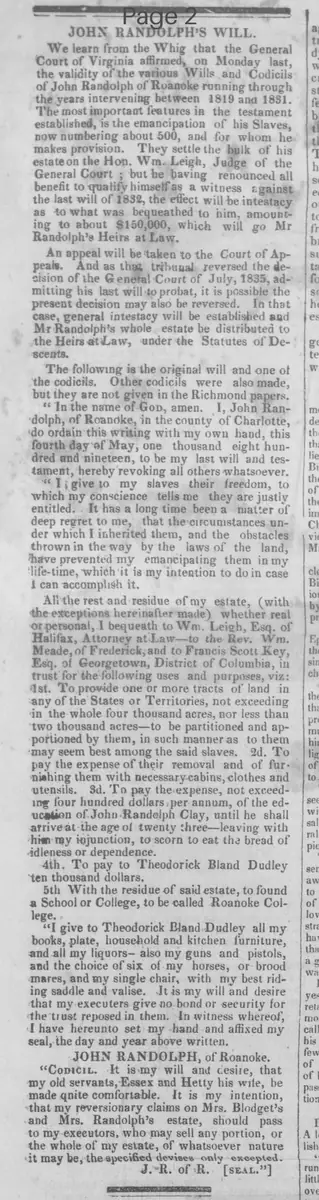
We learn from the Whig that the General Court of Virginia affirmed, on Monday last, the validity of the various Wills and Codicils of John Randolph of Roanoke running through the years intervening between 1819 and 1831.
The most important features in the testament established, is the emancipation of his Slaves, now numbering about 500, and for whom he makes provision. They settle the bulk of his estate on the Hon. Wm. Leigh, Judge of the General Court; but he having renounced all benefit to qualify himself as a witness against the last will of 1832, the effect will be intestacy as to what was bequeathed to him, amounting to about $150,000, which will go Mr Randolph's Heirs at Law.
An appeal will be taken to the Court of Appeals. And as that tribunal reversed the decision of the General Court of July, 1835, admitting his last will to probate, it is possible the present decision may also be reversed. In that case, general intestacy will be established and Mr Randolph's whole estate be distributed to the Heirs at Law, under the Statutes of Descents.
The following is the original will and one of the codicils. Other codicils were also made, but they are not given in the Richmond papers.
"In the name of God, amen. I, John Randolph, of Roanoke, in the county of Charlotte, do ordain this writing with my own hand, this fourth day of May, one thousand eight hundred and nineteen, to be my last will and testament, hereby revoking all others whatsoever.
"I give to my slaves their freedom, to which my conscience tells me they are justly entitled. It has a long time been a matter of deep regret to me, that the circumstances under which I inherited them, and the obstacles thrown in the way by the laws of the land, have prevented my emancipating them in my life-time, which it is my intention to do in case I can accomplish it.
All the rest and residue of my estate, (with the exceptions hereinafter made) whether real or personal, I bequeath to Wm. Leigh, Esq. of Halifax, Attorney at Law—to the Rev. Wm. Meade, of Frederick, and to Francis Scott Key, Esq. of Georgetown, District of Columbia, in trust for the following uses and purposes, viz:
1st. To provide one or more tracts of land in any of the States or Territories, not exceeding in the whole four thousand acres, nor less than two thousand acres—to be partitioned and apportioned by them, in such manner as to them may seem best among the said slaves. 2d. To pay the expense of their removal and of furnishing them with necessary cabins, clothes and utensils. 3d. To pay the expense, not exceeding four hundred dollars per annum, of the education of John Randolph Clay, until he shall arrive at the age of twenty three—leaving with him my injunction, to scorn to eat the bread of idleness or dependence.
4th. To pay to Theodorick Bland Dudley ten thousand dollars.
5th With the residue of said estate, to found a School or College, to be called Roanoke College.
"I give to Theodorick Bland Dudley all my books, plate, household and kitchen furniture, and all my liquors—also my guns and pistols, and the choice of six of my horses, or brood mares, and my single chair, with my best riding saddle and valise. It is my will and desire that my executors give no bond or security for the trust reposed in them. In witness whereof I have hereunto set my hand and affixed my seal, the day and year above written.
JOHN RANDOLPH, of Roanoke.
"Codicil. It is my will and desire, that my old servants, Essex and Hetty his wife, be made quite comfortable. It is my intention, that my reversionary claims on Mrs. Blodget's and Mrs. Randolph's estate, should pass to my executors, who may sell any portion, or the whole of my estate, of whatsoever nature it may be, the specified devises only excepted.
J. R. of R. [SEAL."
What sub-type of article is it?
What themes does it cover?
What keywords are associated?
What entities or persons were involved?
Where did it happen?
Story Details
Key Persons
Location
Roanoke, County Of Charlotte, Virginia
Event Date
Between 1819 And 1831
Story Details
The General Court of Virginia affirmed the validity of John Randolph's wills and codicils from 1819-1831, emancipating his approximately 500 slaves and providing land, removal expenses, and other provisions through trustees. The bulk of the estate was settled on Wm. Leigh, but his renunciation leads to intestacy for $150,000, going to heirs. An appeal to the Court of Appeals is anticipated, which could reverse the decision and establish general intestacy. The 1819 will details slave emancipation, regrets over legal obstacles, bequests for land, education of John Randolph Clay, payment to Theodorick Bland Dudley, founding Roanoke College, and personal items to Dudley. A codicil ensures comfort for old servants Essex and Hetty and handles reversionary claims.