Thank you for visiting SNEWPapers!
Sign up free
New York Daily Tribune
New York, New York County, New York
What is this article about?
In 1857, a New York Tribune correspondent from Quincy, Illinois, highlights severe labor shortages in Illinois and Iowa amid unharvested crops, urging Eastern unemployed to migrate West for farming and domestic jobs at good wages. Notes cheap land sales and a successful farmer's story, while criticizing uncomfortable train travel.
Clipping
OCR Quality
Full Text
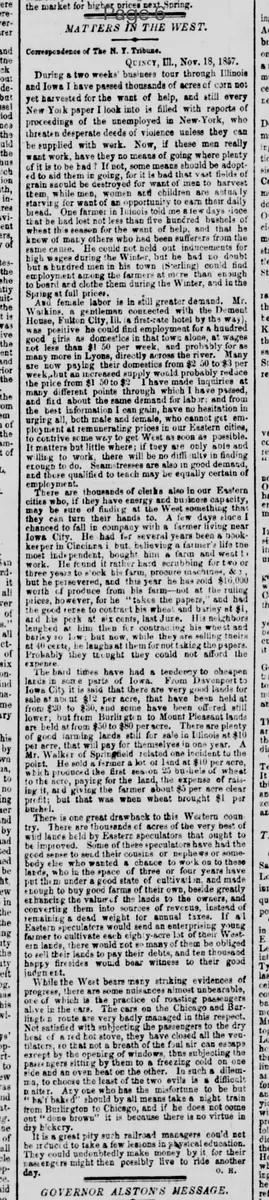
Correspondence of The N. Y. Tribune.
QUINCY, ILL., Nov. 18, 1857.
During a two weeks' business tour through Illinois and Iowa I have passed thousands of acres of corn not yet harvested for the want of help, and still every New York paper I look into is filled with reports of proceedings of the unemployed in New-York, who threaten desperate deeds of violence unless they can be supplied with work. Now, if these men really want work, have they no means of going where plenty of it is to be had? If not, some means should be adopted to aid them in going, for it is bad that vast fields of grain should be destroyed for want of men to harvest them, while men, women and children are actually starving for want of an opportunity to earn their daily bread. One farmer in Illinois told me a few days since that he had lost not less than five hundred bushels of wheat this season for the want of help, and that he knew of many others who had been sufferers from the same cause. He could not hold out inducements for high wages during the Winter, but he had no doubt but a hundred men in his town (Sterling) could find employment among the farmers at more than enough to board and clothe them during the Winter, and in the Spring at full prices.
And female labor is in still greater demand. Mr. Watkins, a gentleman connected with the Dement House, Fulton City, Ill. (a first-rate hotel by the way), was positive he could find employment for a hundred good girls as domestics in that town alone, at wages not less than $1.50 per week, and probably for as many more in Lyons, directly across the river. Many are now paying their domestics from $2.50 to $3 per week, but an increased supply would probably reduce the price from $1.50 to $2. I have made inquiries at many different points through which I have passed, and find about the same demand for labor; and from the best information I can gain, have no hesitation in urging all, both male and female, who cannot get employment at remunerating prices in our Eastern cities, to contrive some way to get West as soon as possible. It matters but little where; if they are only able and willing to work, there will be no difficulty in finding enough to do. Seamstresses are also in good demand, and those qualified to teach may be equally certain of employment.
There are thousands of clerks also in our Eastern cities who, if they have energy and business capacity, may be sure of finding at the West something that they can turn their hands to. A few days since I chanced to fall in company with a farmer living near Iowa City. He had for several years been a book-keeper in Cincinnati; but, believing a farmer's life the most independent, bought him a farm and went to work. He found it rather hard scrubbing for two or three years to stock his farm, procure machines, &c., but he persevered, and this year he has sold $16,000 worth of produce from his farm—not at the ruling prices, however, for he 'takes the papers,' and had the good sense to contract his wheat and barley at $1, and his pork at six cents, last June. His neighbors laughed at him then for contracting his wheat and barley so low; but now, while they are selling theirs at 40 cents, he laughs at them for not taking the papers. Probably they thought they could not afford the expense.
The hard times have had a tendency to cheapen lands in some parts of Iowa. From Davenport to Iowa City it is said that there are very good lands for sale at about $12 per acre, that have been held at from $20 to $30, and some have been offered still lower; but from Burlington to Mount Pleasant lands are held at from $50 to $80 per acre. There are plenty of good farming lands still for sale in Illinois at $10 per acre, that will pay for themselves in one year. A Mr. Walker of Springfield related one incident to the point. He sold a farmer a lot of land at $10 per acre, which produced the first season 25 bushels of wheat to the acre, paying for the land, the expense of raising it, and giving the farmer about $5 per acre clear profit; but that was when wheat brought $1 per bushel.
There is one great drawback to this Western country. There are thousands of acres of the very best of wild lands held by Eastern speculators that ought to be improved. Some of these speculators have had the good sense to sell their cousins or nephews or somebody else who wanted a chance to work on to these lands, who in the space of three or four years have put them under a good state of cultivation, and made enough to buy good farms of their own, beside greatly enhancing the value of the lands to the owners, and converting them into sources of revenue, instead of remaining a dead weight for annual taxes. If all Eastern speculators would send an enterprising young farmer to cultivate each eighty-acre lot of their Western lands, there would not so many of them be obliged to sell their lands to pay their debts, and ten thousand happy firesides would bear witness to their good judgment.
While the West bears many striking evidences of progress, there are some nuisances almost unbearable, one of which is the practice of roasting passengers alive in the cars. The cars on the Chicago and Burlington route are very badly managed in this respect. Not satisfied with subjecting the passengers to the dry heat of a red hot stove, they have closed all the ventilators, so that not a breath of the foul air can escape except by the opening of windows, thus subjecting the passengers sitting by them to a freezing cold on one side and an oven heat on the other. In such a dilemma, to choose the least of the two evils is a difficult matter. Any one who has the misfortune to be but 'half baked' should by all means take a night train from Burlington to Chicago, and if he does not come out 'done brown' it is because there is no virtue in dry hickory.
It is a great pity such railroad managers could not be induced to take a few lessons in physical education. They could undoubtedly make money by it for their passengers might then possibly live to ride another day.
o. H.
What sub-type of article is it?
What keywords are associated?
What entities or persons were involved?
Where did it happen?
Domestic News Details
Primary Location
Illinois And Iowa
Event Date
Nov. 18, 1857
Key Persons
Outcome
abundant employment opportunities for men, women, and seamstresses in farming and domestic work at wages from $1.50 to $3 per week; good lands available at $10-$12 per acre in parts of illinois and iowa, down from higher prices due to hard times.
Event Details
Correspondent reports labor shortages causing unharvested crops in Illinois and Iowa, with thousands of acres of corn and losses of wheat; urges Eastern unemployed to migrate West for plentiful work among farmers at sufficient wages; notes high demand for female domestics and seamstresses; describes a former book-keeper's success as a farmer selling $16,000 in produce; mentions cheapening land prices and speculators' holdings; complains of poor ventilation and heat in Chicago and Burlington route trains.