Thank you for visiting SNEWPapers!
Sign up free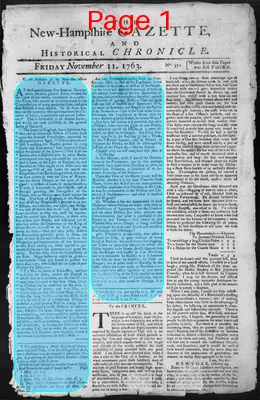
The New Hampshire Gazette And Historical Chronicle
Portsmouth, Greenland, Rockingham County, New Hampshire
What is this article about?
A letter to the New-Hampshire Gazette discusses the limitations of general laws, praising English common law but highlighting its severity in cases like debtors' prisons. It argues for legislative relief for poor prisoners in the colonies, similar to English statutes, questioning the humanity of current prison conditions.
Clipping
OCR Quality
Full Text
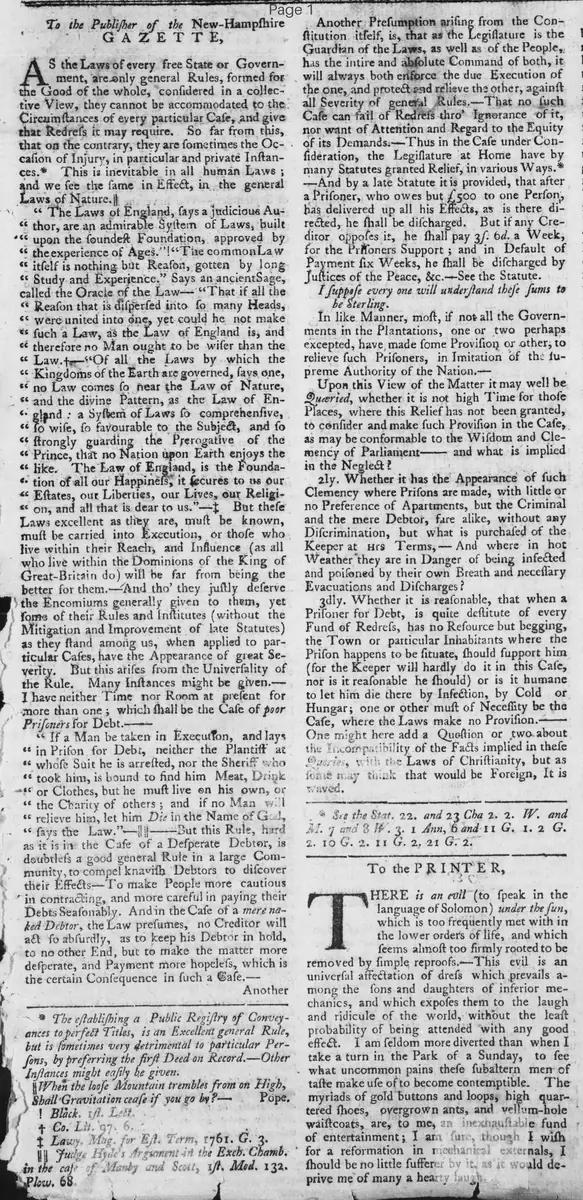
As the Laws of every free State or Government, are only general Rules, formed for the Good of the whole, considered in a collective View, they cannot be accommodated to the Circumstances of every particular Case, and give that Redress it may require. So far from this, that on the contrary, they are sometimes the Occasion of Injury, in particular and private Instances.* This is inevitable in all human Laws; and we see the same in Effect, in the general Laws of Nature.
The Laws of England, says a judicious Author, are an admirable System of Laws, built upon the soundest Foundation, approved by the Experience of Ages. The common Law itself is nothing but Reason, gotten by long Study and Experience. Says an ancient Sage, called the Oracle of the Law—That if all the Reason that is dispersed into so many Heads, were united into one, yet could he not make such a Law, as the Law of England is, and therefore no Man ought to be wiser than the Law.—Of all the Laws by which these Kingdoms of the Earth are governed, says one, no Law comes so near the Law of Nature, and the divine Pattern, as the Law of England: a System of Laws so comprehensive, so wise, so favourable to the Subject, and so strongly guarding the Prerogative of the Prince, that no Nation upon Earth enjoys the like. The Law of England, is the Foundation of all our Happiness, it secures to us our Estates, our Liberties, our Lives, our Religion, and all that is dear to us.— But these Laws excellent as they are, must be known, must be carried into Execution, or those who live within their Reach, and Influence (as all who live within the Dominions of the King of Great-Britain do) will be far from being the better for them.—And tho' they justly deserve the Encomiums generally given to them, yet Some of their Rules and Institutes (without the Mitigation and Improvement of late Statutes) as they stand among us, when applied to particular Cases, have the Appearance of great Severity. But this arises from the Universality of the Rule. Many Instances might be given.—
I have neither Time nor Room at present for more than one; which shall be the Case of poor Prisoners for Debt.—
If a Man be taken in Execution, and lies in Prison for Debt, neither the Plaintiff at whose Suit he is arrested, nor the Sheriff who took him, is bound to find him Meat, Drink or Clothes, but he must live on his own, or the Charity of others: and if no Man will relieve him, let him Die in the Name of God, says the Law.—But this Rule, hard as it is in the Case of a Desperate Debtor, is doubtless a good general Rule in a large Community, to compel knavish Debtors to discover their Effects—To make People more cautious in contracting, and more careful in paying their Debts Seasonably. And in the Case of a mere naked Debtor, the Law presumes, no Creditor will act so absurdly, as to keep his Debtor in hold, to no other End, but to make the matter more desperate, and Payment more hopeless, which is the certain Consequence in such a Case.—
Another
—* The establishing a Public Registry of Conveyances to perfect Titles, is an Excellent general Rule, but is sometimes very detrimental to particular Persons, by preferring the first Deed on Record.—Other Instances might easily be given.
When the loose Mountain trembles from on High,
Shall Gravitation cease if you go by?—
Pope.
Black. Inst. Leet.
4 Co: Lit. 07. b. 6.
Lawyer. Mag. for East. Term; 1761. G: z.
Full Justice Hyde's Argument in the Exch: Chamb. in the case of Manby. and Scarit, 1st. Mod. 132.
Plaw. 68. xii.
Another Presumption arising from the Constitution itself, is, that as the Legislature is the Guardian of the Laws, as well as of the People, has the intire and absolute Command of both, it will always both enforce the due Execution of the One, and protect and relieve the other, against all Severity of general Rules.—That no such Case can fail of Redress thro' Ignorance of it, nor want of Attention and Regard to the Equity of its Demands:—Thus in the Case under Consideration, the Legislature at Home have by many Statutes granted Relief, in various Ways.* —And by a late Statute it is provided, that after a Prisoner, who owes but £50 to one Person, has delivered up all his Effects, as is there directed, he shall be discharged. But if any Creditor opposes it, he shall pay 3s. 6d. a Week, for the Prisoner's Support; and in Default of Payment six Weeks, he shall be discharged by Justices of the Peace, &c.—See the Statute.
I suppose every one will understand these sums to be Sterling.
In like Manner, most, if not all the Governments in the Plantations, one or two perhaps excepted, have made some Provision or other, to relieve such Prisoners, in Imitation of the supreme Authority of the Nation.—
Upon this View of the Matter it may well be Queried, whether it is not high Time for those Places, where this Relief has not been granted, to consider and make such Provision in the Case, as may be conformable to the Wisdom and Clemency of Parliament— and what is implied in the Neglect ?
2ly. Whether it has the Appearance of such Clemency where Prisons are made, with little or no Preference of Apartments, but the Criminal and the mere Debtor, fare alike, without any Discrimination, but what is purchased of the Keeper at his Terms,— And where in hot Weather they are in Danger of being infected and poisoned by their own Breath and necessary Evacuations and Discharges?
3dly. Whether it is reasonable, that when a Prisoner for Debt, is quite destitute of every Fund of Redress, has no Resource but begging, the Town or particular Inhabitants where the Prison happens to be situate, should support him (for the Keeper will hardly do it in this Case, nor is it reasonable he should) or is it humane to let him die there by Infection, by Cold or Hunger; one or other must of Necessity be the Case, where the Laws make no Provision..—
One might here add a Question or two about the Incompatibility of the Facts implied in these Queries, with the Laws of Christianity, but as some may think that would be Foreign, It is waved.
* See the Stat. 22. and 23 Cha 2. 2. W. and M. 7 and 8 W. 3. 1 Ann, 6 and 11 G. 1. 2 G. 2. 10 G. 2. 11 G. 2. 21 G. 2.
What sub-type of article is it?
What themes does it cover?
What keywords are associated?
What entities or persons were involved?
Letter to Editor Details
Recipient
To The Publisher Of The New Hampshire Gazette
Main Argument
while english laws are excellent in general, they can be severe in particular cases like debtors' imprisonment without provision for sustenance; the author urges colonial legislatures to enact relief measures similar to those in england to provide humane treatment and discharge for poor debtors.
Notable Details