Thank you for visiting SNEWPapers!
Sign up free
Editorial
January 10, 1922
Atlanta Tri Weekly Journal
Atlanta, Fulton County, Georgia
What is this article about?
Editorial advises spiritual self-inventory mirroring business stock-taking, urging honest evaluation of abilities to avoid self-conceit-induced failures and pursue fitting vocations for happiness and success.
Clipping
OCR Quality
98%
Excellent
Full Text
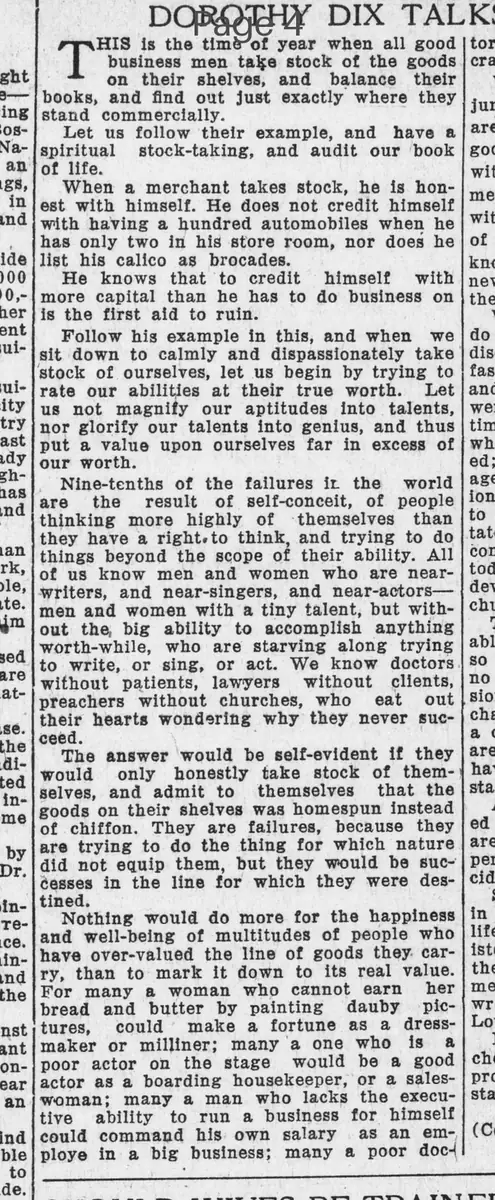
This is the time of year when all good business men take stock of the goods on their shelves, and balance their books, and find out just exactly where they stand commercially.
Let us follow their example, and have a spiritual stock-taking, and audit our book of life.
When a merchant takes stock, he is honest with himself. He does not credit himself with having a hundred automobiles when he has only two in his store room, nor does he list his calico as brocades.
He knows that to credit himself with more capital than he has to do business on is the first aid to ruin.
Follow his example in this, and when we sit down to calmly and dispassionately take stock of ourselves, let us begin by trying to rate our abilities at their true worth. Let us not magnify our aptitudes into talents, nor glorify our talents into genius, and thus put a value upon ourselves far in excess of our worth.
Nine-tenths of the failures in the world are the result of self-conceit, of people thinking more highly of themselves than they have a right to think, and trying to do things beyond the scope of their ability. All of us know men and women who are near-writers, and near-singers, and near-actors-- men and women with a tiny talent, but without the big ability to accomplish anything worth-while, who are starving along trying to write, or sing, or act. We know doctors without patients, lawyers without clients, preachers without churches, who eat out their hearts wondering why they never succeed.
The answer would be self-evident if they would only honestly take stock of themselves, and admit to themselves that the goods on their shelves was homespun instead of chiffon. They are failures, because they are trying to do the thing for which nature did not equip them, but they would be successes in the line for which they were destined.
Nothing would do more for the happiness and well-being of multitudes of people who have over-valued the line of goods they carry, than to mark it down to its real value.
For many a woman who cannot earn her bread and butter by painting dauby pictures, could make a fortune as a dress-maker or milliner; many a one who is a poor actor on the stage would be a good actor as a boarding housekeeper, or a sales-woman; many a man who lacks the executive ability to run a business for himself could command his own salary as an employee in a big business; many a poor doctor
Let us follow their example, and have a spiritual stock-taking, and audit our book of life.
When a merchant takes stock, he is honest with himself. He does not credit himself with having a hundred automobiles when he has only two in his store room, nor does he list his calico as brocades.
He knows that to credit himself with more capital than he has to do business on is the first aid to ruin.
Follow his example in this, and when we sit down to calmly and dispassionately take stock of ourselves, let us begin by trying to rate our abilities at their true worth. Let us not magnify our aptitudes into talents, nor glorify our talents into genius, and thus put a value upon ourselves far in excess of our worth.
Nine-tenths of the failures in the world are the result of self-conceit, of people thinking more highly of themselves than they have a right to think, and trying to do things beyond the scope of their ability. All of us know men and women who are near-writers, and near-singers, and near-actors-- men and women with a tiny talent, but without the big ability to accomplish anything worth-while, who are starving along trying to write, or sing, or act. We know doctors without patients, lawyers without clients, preachers without churches, who eat out their hearts wondering why they never succeed.
The answer would be self-evident if they would only honestly take stock of themselves, and admit to themselves that the goods on their shelves was homespun instead of chiffon. They are failures, because they are trying to do the thing for which nature did not equip them, but they would be successes in the line for which they were destined.
Nothing would do more for the happiness and well-being of multitudes of people who have over-valued the line of goods they carry, than to mark it down to its real value.
For many a woman who cannot earn her bread and butter by painting dauby pictures, could make a fortune as a dress-maker or milliner; many a one who is a poor actor on the stage would be a good actor as a boarding housekeeper, or a sales-woman; many a man who lacks the executive ability to run a business for himself could command his own salary as an employee in a big business; many a poor doctor
What sub-type of article is it?
Moral Or Religious
Social Reform
What keywords are associated?
Spiritual Stock Taking
Self Assessment
Self Conceit
Personal Failure
Vocational Success
Editorial Details
Primary Topic
Spiritual Stock Taking And Honest Self Assessment
Stance / Tone
Advisory And Exhortative Promoting Humility
Key Arguments
Conduct Honest Self Assessment Like A Merchant's Inventory
Avoid Magnifying Abilities Beyond True Worth To Prevent Ruin
Self Conceit Causes Most Failures By Leading To Unsuitable Pursuits
Recognize And Pursue Vocations For Which One Is Naturally Equipped
Adjust Self Valuation For Greater Happiness And Success