Thank you for visiting SNEWPapers!
Sign up free
The Oakwood Press (Oakwood
Oakwood, Montgomery County, Ohio
What is this article about?
In 1953, Dayton and Oakwood, Ohio, residents face 15-25% higher real estate tax bills due to a state-mandated 17% property valuation increase, keeping Dayton's rate at $26.80/$1000 but raising Oakwood's to $28/$1000 with new school levies.
Merged-components note: Continuation of the 'Dayton Tax Bills Increase' article from page 1 to page 6.
Clippings
1 of 2
OCR Quality
Full Text
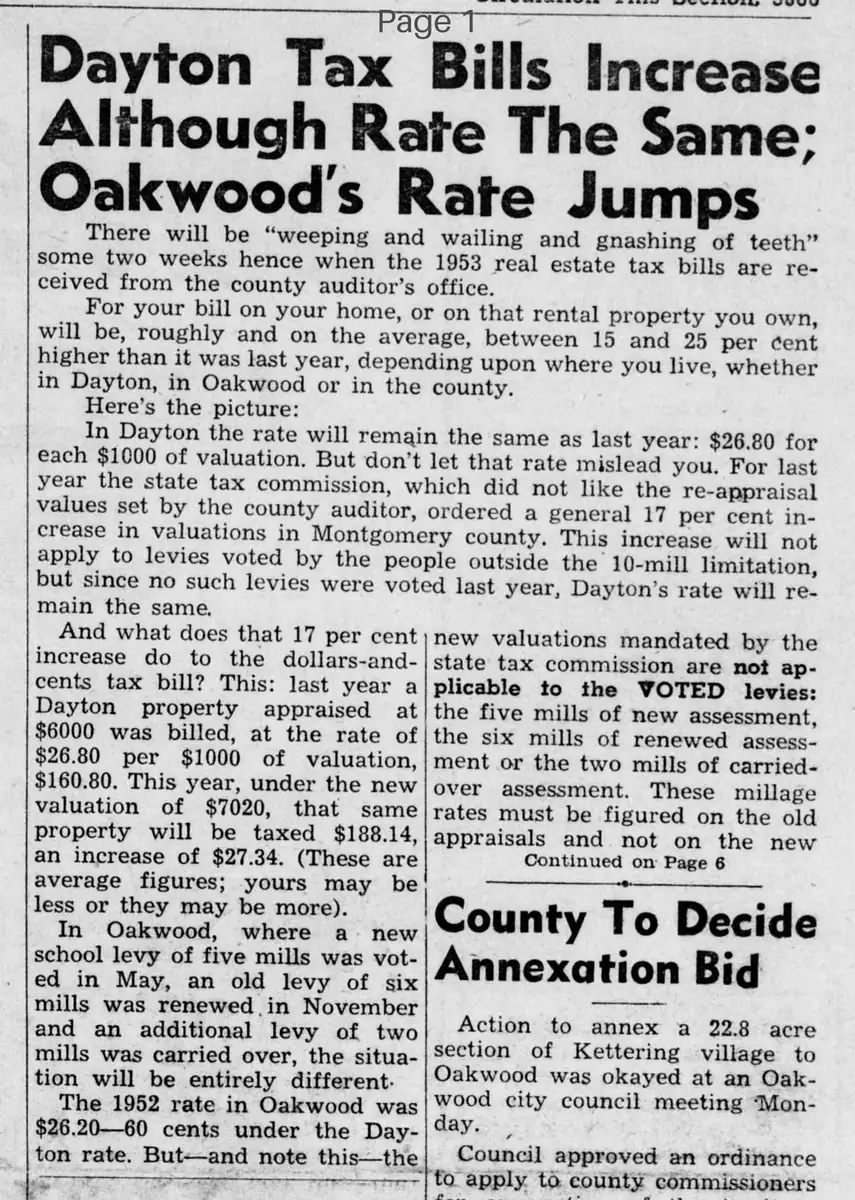
There will be "weeping and wailing and gnashing of teeth" some two weeks hence when the 1953 real estate tax bills are received from the county auditor's office.
For your bill on your home, or on that rental property you own, will be, roughly and on the average, between 15 and 25 per cent higher than it was last year, depending upon where you live, whether in Dayton, in Oakwood or in the county.
Here's the picture:
In Dayton the rate will remain the same as last year: $26.80 for each $1000 of valuation. But don't let that rate mislead you. For last year the state tax commission, which did not like the re-appraisal values set by the county auditor, ordered a general 17 per cent increase in valuations in Montgomery county. This increase will not apply to levies voted by the people outside the 10-mill limitation, but since no such levies were voted last year, Dayton's rate will remain the same.
And what does that 17 per cent increase do to the dollars-and-cents tax bill? This: last year a Dayton property appraised at $6000 was billed, at the rate of $26.80 per $1000 of valuation, $160.80. This year, under the new valuation of $7020, that same property will be taxed $188.14, an increase of $27.34. (These are average figures; yours may be less or they may be more).
In Oakwood, where a new school levy of five mills was voted in May, an old levy of six mills was renewed in November and an additional levy of two mills was carried over, the situation will be entirely different.
The 1952 rate in Oakwood was $26.20--60 cents under the Dayton rate. But--and note this--the new valuations mandated by the state tax commission are not applicable to the VOTED levies: the five mills of new assessment, the six mills of renewed assessment or the two mills of carried-over assessment. These millage rates must be figured on the old appraisals and not on the new.
Continued on Page 6
Tax Bill Up--
(Continued from Page 1)
appraisals which are, on the average, 17 per cent higher. That means, then, that the five-mill levy on the old valuation becomes 4.28 mills on the new valuation; that the old six mills becomes 5.14 mills and the two mills becomes 1.71 mills. But even when these lower levy rates are applied, the over-all tax rate jumps from $26.20 to $28.
Now look at the picture:
Last year a property appraised at $6000 was taxed for $157.20. With the new five-mill school levy the rate would have been $31.20 and the tax $187.20, but for the 17 per cent increase in valuations. Now the picture is this: new valuation will be $7020 and the new tax $196.56—an increase of $39.36.
In all fairness it must be pointed out that had not the NEW school levy of five mills (really only 4.28 mills under the new valuation) been submitted and approved, Oakwood's new rate would be $23.72 and the tax on that erstwhile $6000 home, now valued at $7020, would be $166.51, as compared with last year's tax of $157.20.
For a break-down of the $28 rate The Press consulted City Manager A. C. Bergman. And here's the picture as he paints it:
Of the $28 from each $1000 of valuation the schools will receive $17.40; the city, $7.40; the county, $2.90 and the state of Ohio, $.30.
Last year, out of the $26.20 rate the schools received $14.60; the city, $8.20; the county, $3.00 and the state, $.40. In other words, this year the schools will receive $2.80 more of the $28 than they received last year of the $26.20; the city will receive 80 cents less; the county, 10 cents less and the state, 10 cents less.
Or to put it another way: what becomes of each tax dollar you pay on your Oakwood home? The answer:
In 1952, 56 cents of each tax dollar went to the schools; in 1953 they will get 62.14 cents, an increase of 6.14 cents.
In 1952, the city received 31 cents of each tax dollar; in 1953 it will get 26.42 cents, a decrease of 4.58 cents.
In 1952, the county received 11.5 cents; in 1953 it will receive 10.35 cents, a decrease of 1.15 cents.
In 1952, the state received 1.5 cents; in 1953 it will receive 1.09 cents, a decrease of .41 cents.
Add them up: the city, county and state will receive 6.14 cents less; the schools will receive 6.14 cents more of your tax dollar in 1953 than in 1952.
The answer must be obvious: if you have any protest on your new tax bill, don't blame the city government, the county government, nor the state government.
And, in the final analysis, don't blame the schools, for YOU voted that additional five mills for the schools because you wanted GOOD schools.
What sub-type of article is it?
What keywords are associated?
What entities or persons were involved?
Where did it happen?
Domestic News Details
Primary Location
Dayton And Oakwood, Montgomery County, Ohio
Event Date
1953
Key Persons
Outcome
tax bills increase 15-25% on average; dayton example: $6000 property from $160.80 to $188.14; oakwood example: $6000 property from $157.20 to $196.56
Event Details
Real estate tax bills for 1953 will be higher due to a 17% increase in valuations ordered by the state tax commission, despite Dayton's rate remaining $26.80 per $1000. Oakwood's rate rises to $28 per $1000 due to new and renewed school levies, with allocations: schools $17.40, city $7.40, county $2.90, state $0.30.