Thank you for visiting SNEWPapers!
Sign up free
Editorial
September 13, 1796
Gazette Of The United States, & Philadelphia Daily Advertiser
Philadelphia, Philadelphia County, Pennsylvania
What is this article about?
The Lay Preacher expounds on St. Paul's biblical advice to the Thessalonians to 'study to be quiet and mind your own business,' critiquing rural villagers' propensity for gossip and meddling due to limited distractions, contrasting it with busier city life, and urging focus on personal duties over prying into neighbors' affairs.
Clipping
OCR Quality
98%
Excellent
Full Text
THE WEEKLY JOURNAL
"Study to be quiet, and to do your own business."
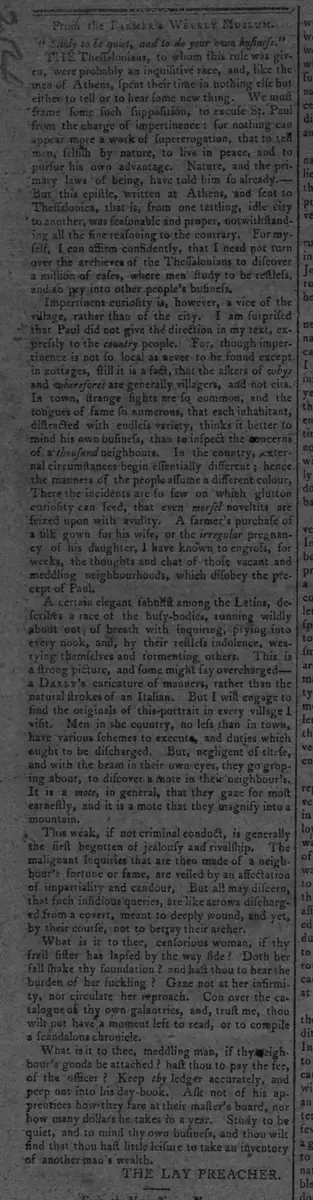
THE Thessalonians, to whom this rule was given, were probably an inquisitive race, and, like the men of Athens, spent their time in nothing else but either to tell or to hear some new thing. We must frame some such supposition, to excuse St. Paul from the charge of impertinence: for nothing can appear more a work of supererogation, than to teach men, selfish by nature, to live in peace, and to pursue his own advantage. Nature, and the primary laws of being, have told him so already.
But this epistle, written at Athens, and sent to Thessalonica, that is, from one tattling, idle city to another, was seasonable and proper, notwithstanding all the fine reasoning to the contrary. For myself, I can affirm confidently, that I need not turn over the archives of the Thessalonians to discover a million of cases, where men study to be restless and to pry into other people's business.
Impertinent curiosity is, however, a vice of the village, rather than of the city. I am surprised that Paul did not give the direction in my text, expressly to the country people. For, though impertinence is not so local as never to be found except in cottages, still it is a fact, that the askers of whys and wherefores are generally villagers, and not citizens.
In town, strange sights are so common, and the tongues of fame so numerous, that each inhabitant, distracted with endless variety, thinks it better to mind his own business, than to inspect the concerns of a thousand neighbours. In the country, external circumstances being essentially different; hence the manners of the people assume a different colour.
There the incidents are so few on which glutton curiosity can feed, that even morel novelties are seized upon with avidity. A farmer's purchase of a silk gown for his wife, or the irregular pregnancy of his daughter, I have known to engross, for weeks, the thoughts and chat of those vacant and meddling neighbourhoods, which disobey the precept of Paul.
A certain elegant satirist among the Latins, describes a race of the busy-bodies, running wildly about out of breath with inquiring, prying into every nook, and, by their restless indolence, wearying themselves and tormenting, others. This is a strong picture, and some might say overcharged—a Darly's caricature of manners, rather than the natural strokes of an Italian. But I will engage to find the originals of this portrait in every village I visit. Men in the country, no less than in town, have various schemes to execute, and duties which ought to be discharged. But, negligent of these, and with the beam in their own eyes, they go groping about, to discover a mote in their neighbour's.
It is a mote, in general, that they gaze for most earnestly, and it is a mote that they magnify into a mountain.
This weak, if not criminal conduct, is generally the first begotten of jealousy and rivalry. The malignant inquiries that are then made of a neighbour's fortune or fame, are veiled by an affectation of impartiality and candour. But all may discern, that such insidious queries, are like arrows discharged from a covert, meant to deeply wound, and yet, by their course, not to betray their archer.
What is it to thee, censorious woman, if thy frail sister has lapsed by the way side? Doth her fall shake thy foundation? and hast thou to bear the burden of her suckling? Gaze not at her infirmity, nor circulate her reproach. Con over the catalogue of thy own gallantries, and, trust me, thou wilt not have a moment left to read, or to compile a scandalous chronicle.
What is it to thee, meddling man, if thy neighbour's goods be attached? Hast thou to pay the fee, of the officer? Keep thy ledger accurately, and peep not into his day-book. Ask not of his apprentices how they fare at their master's board, nor how many dollars he takes in a year. Study to be quiet, and to mind thy own business, and thou wilt find that thou hast little leisure to take an inventory of another man's wealth.
THE LAY PREACHER.
"Study to be quiet, and to do your own business."
THE Thessalonians, to whom this rule was given, were probably an inquisitive race, and, like the men of Athens, spent their time in nothing else but either to tell or to hear some new thing. We must frame some such supposition, to excuse St. Paul from the charge of impertinence: for nothing can appear more a work of supererogation, than to teach men, selfish by nature, to live in peace, and to pursue his own advantage. Nature, and the primary laws of being, have told him so already.
But this epistle, written at Athens, and sent to Thessalonica, that is, from one tattling, idle city to another, was seasonable and proper, notwithstanding all the fine reasoning to the contrary. For myself, I can affirm confidently, that I need not turn over the archives of the Thessalonians to discover a million of cases, where men study to be restless and to pry into other people's business.
Impertinent curiosity is, however, a vice of the village, rather than of the city. I am surprised that Paul did not give the direction in my text, expressly to the country people. For, though impertinence is not so local as never to be found except in cottages, still it is a fact, that the askers of whys and wherefores are generally villagers, and not citizens.
In town, strange sights are so common, and the tongues of fame so numerous, that each inhabitant, distracted with endless variety, thinks it better to mind his own business, than to inspect the concerns of a thousand neighbours. In the country, external circumstances being essentially different; hence the manners of the people assume a different colour.
There the incidents are so few on which glutton curiosity can feed, that even morel novelties are seized upon with avidity. A farmer's purchase of a silk gown for his wife, or the irregular pregnancy of his daughter, I have known to engross, for weeks, the thoughts and chat of those vacant and meddling neighbourhoods, which disobey the precept of Paul.
A certain elegant satirist among the Latins, describes a race of the busy-bodies, running wildly about out of breath with inquiring, prying into every nook, and, by their restless indolence, wearying themselves and tormenting, others. This is a strong picture, and some might say overcharged—a Darly's caricature of manners, rather than the natural strokes of an Italian. But I will engage to find the originals of this portrait in every village I visit. Men in the country, no less than in town, have various schemes to execute, and duties which ought to be discharged. But, negligent of these, and with the beam in their own eyes, they go groping about, to discover a mote in their neighbour's.
It is a mote, in general, that they gaze for most earnestly, and it is a mote that they magnify into a mountain.
This weak, if not criminal conduct, is generally the first begotten of jealousy and rivalry. The malignant inquiries that are then made of a neighbour's fortune or fame, are veiled by an affectation of impartiality and candour. But all may discern, that such insidious queries, are like arrows discharged from a covert, meant to deeply wound, and yet, by their course, not to betray their archer.
What is it to thee, censorious woman, if thy frail sister has lapsed by the way side? Doth her fall shake thy foundation? and hast thou to bear the burden of her suckling? Gaze not at her infirmity, nor circulate her reproach. Con over the catalogue of thy own gallantries, and, trust me, thou wilt not have a moment left to read, or to compile a scandalous chronicle.
What is it to thee, meddling man, if thy neighbour's goods be attached? Hast thou to pay the fee, of the officer? Keep thy ledger accurately, and peep not into his day-book. Ask not of his apprentices how they fare at their master's board, nor how many dollars he takes in a year. Study to be quiet, and to mind thy own business, and thou wilt find that thou hast little leisure to take an inventory of another man's wealth.
THE LAY PREACHER.
What sub-type of article is it?
Moral Or Religious
Social Reform
What keywords are associated?
Gossip
Meddling
Rural Vice
Biblical Precept
Social Curiosity
Impertinence
What entities or persons were involved?
St. Paul
Thessalonians
The Lay Preacher
Editorial Details
Primary Topic
Critique Of Gossip And Meddling In Rural Communities
Stance / Tone
Moral Exhortation Against Impertinent Curiosity
Key Figures
St. Paul
Thessalonians
The Lay Preacher
Key Arguments
Biblical Advice To Mind One's Own Business Is Especially Needed In Rural Areas
Villagers Gossip Due To Fewer Novelties And Distractions Compared To City Life
Gossip Often Stems From Jealousy And Rivalry, Magnifying Minor Faults
People Should Focus On Their Own Duties And Flaws Rather Than Neighbors' Affairs