Thank you for visiting SNEWPapers!
Sign up free
Literary
April 16, 1840
Watchman Of The South
Richmond, Virginia
What is this article about?
Account of Mr. Inglis, a blind infidel converted to Christianity in 1790 by hearing the Bible read aloud. Describes his gentle transformation, visions of scriptures and the crucifixion, devout life under Rev. Tennent, and reflections on his steadfast faith despite later decline in old age. Emphasizes Bible's power over skepticism.
Clipping
OCR Quality
98%
Excellent
Full Text
For the Watchman of the South.
RELIGIOUS EXPERIENCE.
NO. XVIII.
Conversion of a Blind Infidel by Hearing the Bible Read.
[Concluded.]
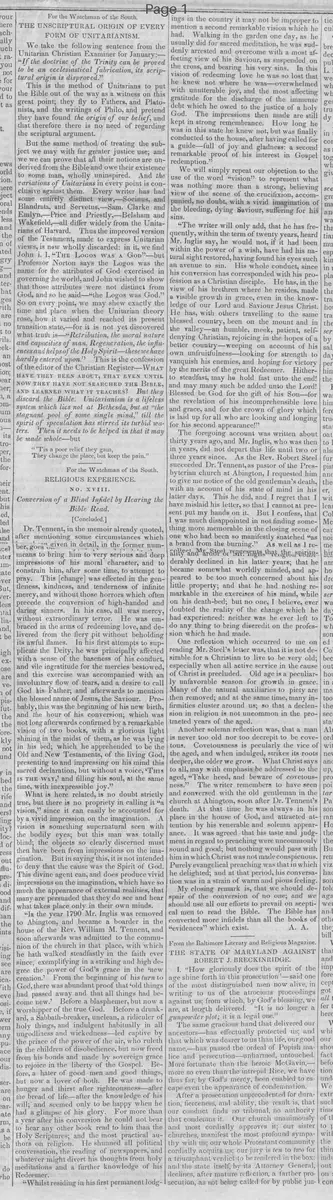
Dr. Tennent, in the memoir already quoted, after mentioning some circumstances which do not require to be given in detail, in the former number, goes on to say, that the means used to bring him to very serious and deep impressions of his moral character, and to constrain him, after some time, to attempt to pray. This [change] was effected in the gentleness, kindness, and tenderness of infinite mercy, and without those horrors which often precede the conversion of high-handed and daring sinners. In his case, all was mercy, without extraordinary terror. He was embraced in the arms of redeeming love, and delivered from the fiery pit without beholding its awful flames. In his first attempts to supplicate the Deity, he was principally affected with a sense of the baseness of his conduct, and vile ingratitude for the mercies bestowed, and this exercise was accompanied with an involuntary flow of tears, and a desire to call God his Father; and afterwards to mention the blessed name of Jesus, the Saviour. Probably, this was the beginning of his new birth, and the hour of his conversion; which was not long afterwards confirmed by a remarkable vision of two books, with a glorious light shining in the midst of them, as he was lying in his bed; which he apprehended to be the Old and New Testaments, of the living God, presenting to and impressing on his mind this sacred declaration, but without a voice, 'THIS Is THE way,' and filling his soul, at the same time, with inexpressible joy."
What is here related, is no doubt strictly true, but there is no propriety in calling it "a vision," since it can easily be accounted for by a vivid impression on the imagination. A vision is something supernatural seen with the bodily eyes; but this man was totally blind; the objects so clearly discerned must then have been from impressions on the imagination. But in saying this, it is not intended to deny that the cause was the Spirit of God. This divine agent can, and does produce vivid impressions on the imagination, which have so much the appearance of external realities, that many are persuaded that they do see and hear what takes place only in their own minds.
"In the year 1790 Mr. Inglis was removed to Abington, and became a boarder in the house of the Rev. William M. Tennent, and soon afterwards was admitted to the communion of the church in that place, with which he hath walked steadfastly in the faith ever since; exemplifying in a striking and high degree the power of God's grace in the new creation.'" From the beginning of his turn to God, there was abundant proof that 'old things had passed away and that all things had become new.' Before a blasphemer, but now a worshipper of the true God. Before a drunkard, a Sabbath-breaker, unclean, a ridiculer of holy things, and indulgent habitually in all ungodliness and wickedness—led captive by the prince of the power of the air, who ruleth in the children of disobedience, but now freed from his bonds and made by sovereign grace to rejoice in the liberty of the Gospel. Before, a hater of good men and good things, but now a lover of both. He was made to hunger and thirst after righteousness—after the bread of life—after the knowledge of his will; and seemed only to be happy when he had a glimpse of his glory. For more than a year after his conversion he could not bear to hear any other book read to him than the Holy Scriptures; and the most practical authors on religion. He shunned all political conversation, the reading of newspapers, and whatever might divert his thoughts from holy meditations and a further knowledge of his Redeemer.
"Whilst residing in his first permanent lodgings in the country it may not be improper to mention a second remarkable vision which he had. Walking in the garden one day, as he usually did for sacred meditation, he was suddenly arrested and overcome with a most affecting view of his Saviour, as suspended on the cross, and bearing his very sins. In this vision of redeeming love he was so lost that he knew not where he was overwhelmed with unutterable joy, and the most affecting gratitude for the discharge of the immense debt which he owed to the justice of a holy God. The impressions then made are still kept in strong remembrance. How long he was in this state he knew not, but was finally conducted to the house, after having called for a guide—full of joy and gladness: a second remarkable proof of his interest in Gospel redemption."
We will simply repeat our objection to the use of the word "vision" to represent what was nothing more than a strong, believing view of the scene of the crucifixion, accompanied, no doubt, with a vivid imagination of the bleeding, dying Saviour, suffering for his sins.
"The writer will only add, that he has frequently, within the term of twenty years, heard Mr. Inglis say, he would not, if it had been within the power of a wish, have had his natural sight restored, having found his eyes such an avenue to sin. His whole conduct, since his conversion has corresponded with his profession as a Christian disciple. He has, in the view of his brethren where he resides, made a visible growth in grace, even in the knowledge of our Lord and Saviour Jesus Christ. He has, with others travelling to the same blessed country, been on the mount and in the valley—an humble, meek, patient, self-denying Christian, rejoicing in the hopes of a better country—weeping on account of his own unfruitfulness—looking for strength to vanquish his enemies, and hoping for victory by the merits of the great Redeemer. Hitherto steadfast, may he hold fast unto the end! and may many such be added unto the Lord!
Blessed be God for the gift of his Son—for the revelation of his incomprehensible love and grace, and for the crown of glory which is laid up for all who are looking and longing for his second appearance!"
The foregoing account was written about thirty years ago, and Mr. Inglis, who was then in years, did not depart this life until two or three years since. As the Rev. Robert Steel succeeded Dr. Tennent, as pastor of the Presbyterian church at Abington, I requested him to give me notice of the old gentleman's death, with an account of his state of mind in his latter days. This he did, and I regret that I have mislaid his letter, so that I cannot at present put my hands on it. But I confess, that I was much disappointed in not finding something more memorable in the closing scene of one who had been so manifestly snatched "as a brand from the burning." As well as I remember, Mr. Steel represents, that the spiritual powers considerably declined in his latter years; that he became somewhat worldly minded, and appeared to be too much concerned about his little property; and that he had nothing remarkable in the exercises of his mind, while on his death-bed; but no one, I believe, ever doubted the reality of the change which he had experienced: neither was he ever left to do any thing to bring discredit on the profession which he had made.
One reflection which occurred to me on reading Mr. Steel's letter was, that it is not desirable for a Christian to live to be very old; especially when all active service in the cause of Christ is precluded. Old age is a peculiarly unfavorable season for growth in grace. Many of the natural auxiliaries to piety are then removed; and at the same time, many infirmities cluster around us; so that a declension in religion is not uncommon in the protracted years of the aged.
Another solemn reflection was, that a man is never too old nor too decrepit to be covetous. Covetousness is peculiarly the vice of the aged, and when indulged, strikes its roots deeper, the older we grow. What Christ says to all, may with emphasis be addressed to the aged, "Take heed, and beware of covetousness."
The writer remembers to have seen and conversed with the old gentleman in the church at Abington, soon after Dr. Tennent's death. At that time he was always in his place in the house of God, and attracted attention by his venerable and solemn appearance. It was agreed that his taste and judgment in regard to preaching were uncommonly sound and good; but nothing would pass with him in which Christ was not made conspicuous. Purely evangelical preaching was that in which he delighted; and at that period, his conversation was in a strain of warm and pious feeling.
My closing remark is, that we should despair of the conversion of no one; and we should use all our efforts to prevail on sceptical men to read the Bible. The Bible has converted more infidels than all the books of "evidences" which exist.
A. A.
RELIGIOUS EXPERIENCE.
NO. XVIII.
Conversion of a Blind Infidel by Hearing the Bible Read.
[Concluded.]
Dr. Tennent, in the memoir already quoted, after mentioning some circumstances which do not require to be given in detail, in the former number, goes on to say, that the means used to bring him to very serious and deep impressions of his moral character, and to constrain him, after some time, to attempt to pray. This [change] was effected in the gentleness, kindness, and tenderness of infinite mercy, and without those horrors which often precede the conversion of high-handed and daring sinners. In his case, all was mercy, without extraordinary terror. He was embraced in the arms of redeeming love, and delivered from the fiery pit without beholding its awful flames. In his first attempts to supplicate the Deity, he was principally affected with a sense of the baseness of his conduct, and vile ingratitude for the mercies bestowed, and this exercise was accompanied with an involuntary flow of tears, and a desire to call God his Father; and afterwards to mention the blessed name of Jesus, the Saviour. Probably, this was the beginning of his new birth, and the hour of his conversion; which was not long afterwards confirmed by a remarkable vision of two books, with a glorious light shining in the midst of them, as he was lying in his bed; which he apprehended to be the Old and New Testaments, of the living God, presenting to and impressing on his mind this sacred declaration, but without a voice, 'THIS Is THE way,' and filling his soul, at the same time, with inexpressible joy."
What is here related, is no doubt strictly true, but there is no propriety in calling it "a vision," since it can easily be accounted for by a vivid impression on the imagination. A vision is something supernatural seen with the bodily eyes; but this man was totally blind; the objects so clearly discerned must then have been from impressions on the imagination. But in saying this, it is not intended to deny that the cause was the Spirit of God. This divine agent can, and does produce vivid impressions on the imagination, which have so much the appearance of external realities, that many are persuaded that they do see and hear what takes place only in their own minds.
"In the year 1790 Mr. Inglis was removed to Abington, and became a boarder in the house of the Rev. William M. Tennent, and soon afterwards was admitted to the communion of the church in that place, with which he hath walked steadfastly in the faith ever since; exemplifying in a striking and high degree the power of God's grace in the new creation.'" From the beginning of his turn to God, there was abundant proof that 'old things had passed away and that all things had become new.' Before a blasphemer, but now a worshipper of the true God. Before a drunkard, a Sabbath-breaker, unclean, a ridiculer of holy things, and indulgent habitually in all ungodliness and wickedness—led captive by the prince of the power of the air, who ruleth in the children of disobedience, but now freed from his bonds and made by sovereign grace to rejoice in the liberty of the Gospel. Before, a hater of good men and good things, but now a lover of both. He was made to hunger and thirst after righteousness—after the bread of life—after the knowledge of his will; and seemed only to be happy when he had a glimpse of his glory. For more than a year after his conversion he could not bear to hear any other book read to him than the Holy Scriptures; and the most practical authors on religion. He shunned all political conversation, the reading of newspapers, and whatever might divert his thoughts from holy meditations and a further knowledge of his Redeemer.
"Whilst residing in his first permanent lodgings in the country it may not be improper to mention a second remarkable vision which he had. Walking in the garden one day, as he usually did for sacred meditation, he was suddenly arrested and overcome with a most affecting view of his Saviour, as suspended on the cross, and bearing his very sins. In this vision of redeeming love he was so lost that he knew not where he was overwhelmed with unutterable joy, and the most affecting gratitude for the discharge of the immense debt which he owed to the justice of a holy God. The impressions then made are still kept in strong remembrance. How long he was in this state he knew not, but was finally conducted to the house, after having called for a guide—full of joy and gladness: a second remarkable proof of his interest in Gospel redemption."
We will simply repeat our objection to the use of the word "vision" to represent what was nothing more than a strong, believing view of the scene of the crucifixion, accompanied, no doubt, with a vivid imagination of the bleeding, dying Saviour, suffering for his sins.
"The writer will only add, that he has frequently, within the term of twenty years, heard Mr. Inglis say, he would not, if it had been within the power of a wish, have had his natural sight restored, having found his eyes such an avenue to sin. His whole conduct, since his conversion has corresponded with his profession as a Christian disciple. He has, in the view of his brethren where he resides, made a visible growth in grace, even in the knowledge of our Lord and Saviour Jesus Christ. He has, with others travelling to the same blessed country, been on the mount and in the valley—an humble, meek, patient, self-denying Christian, rejoicing in the hopes of a better country—weeping on account of his own unfruitfulness—looking for strength to vanquish his enemies, and hoping for victory by the merits of the great Redeemer. Hitherto steadfast, may he hold fast unto the end! and may many such be added unto the Lord!
Blessed be God for the gift of his Son—for the revelation of his incomprehensible love and grace, and for the crown of glory which is laid up for all who are looking and longing for his second appearance!"
The foregoing account was written about thirty years ago, and Mr. Inglis, who was then in years, did not depart this life until two or three years since. As the Rev. Robert Steel succeeded Dr. Tennent, as pastor of the Presbyterian church at Abington, I requested him to give me notice of the old gentleman's death, with an account of his state of mind in his latter days. This he did, and I regret that I have mislaid his letter, so that I cannot at present put my hands on it. But I confess, that I was much disappointed in not finding something more memorable in the closing scene of one who had been so manifestly snatched "as a brand from the burning." As well as I remember, Mr. Steel represents, that the spiritual powers considerably declined in his latter years; that he became somewhat worldly minded, and appeared to be too much concerned about his little property; and that he had nothing remarkable in the exercises of his mind, while on his death-bed; but no one, I believe, ever doubted the reality of the change which he had experienced: neither was he ever left to do any thing to bring discredit on the profession which he had made.
One reflection which occurred to me on reading Mr. Steel's letter was, that it is not desirable for a Christian to live to be very old; especially when all active service in the cause of Christ is precluded. Old age is a peculiarly unfavorable season for growth in grace. Many of the natural auxiliaries to piety are then removed; and at the same time, many infirmities cluster around us; so that a declension in religion is not uncommon in the protracted years of the aged.
Another solemn reflection was, that a man is never too old nor too decrepit to be covetous. Covetousness is peculiarly the vice of the aged, and when indulged, strikes its roots deeper, the older we grow. What Christ says to all, may with emphasis be addressed to the aged, "Take heed, and beware of covetousness."
The writer remembers to have seen and conversed with the old gentleman in the church at Abington, soon after Dr. Tennent's death. At that time he was always in his place in the house of God, and attracted attention by his venerable and solemn appearance. It was agreed that his taste and judgment in regard to preaching were uncommonly sound and good; but nothing would pass with him in which Christ was not made conspicuous. Purely evangelical preaching was that in which he delighted; and at that period, his conversation was in a strain of warm and pious feeling.
My closing remark is, that we should despair of the conversion of no one; and we should use all our efforts to prevail on sceptical men to read the Bible. The Bible has converted more infidels than all the books of "evidences" which exist.
A. A.
What sub-type of article is it?
Essay
What themes does it cover?
Religious
Moral Virtue
What keywords are associated?
Religious Conversion
Blind Infidel
Bible Reading
Spiritual Vision
Christian Testimony
Redemption
Grace
Infidelity To Faith
What entities or persons were involved?
A. A.
Literary Details
Title
Religious Experience. No. Xviii. Conversion Of A Blind Infidel By Hearing The Bible Read. [Concluded.]
Author
A. A.
Subject
Conversion Of Mr. Inglis
Key Lines
This [Change] Was Effected In The Gentleness, Kindness, And Tenderness Of Infinite Mercy, And Without Those Horrors Which Often Precede The Conversion Of High Handed And Daring Sinners.
Which Was Not Long Afterwards Confirmed By A Remarkable Vision Of Two Books, With A Glorious Light Shining In The Midst Of Them... 'This Is The Way,'
He Was Suddenly Arrested And Overcome With A Most Affecting View Of His Saviour, As Suspended On The Cross, And Bearing His Very Sins.
He Would Not, If It Had Been Within The Power Of A Wish, Have Had His Natural Sight Restored, Having Found His Eyes Such An Avenue To Sin.
The Bible Has Converted More Infidels Than All The Books Of "Evidences" Which Exist.