Thank you for visiting SNEWPapers!
Sign up free
The Representative
Saint Paul, Minneapolis, Ramsey County, Hennepin County, Minnesota
What is this article about?
William Goebel, awarded Kentucky's governorship in a disputed election, was shot and critically wounded by an unknown assassin near the Frankfort capitol on Jan. 31. Suspect Harland Whittaker arrested but evidence lacking. Political tensions high with Republican Gov. Taylor in power.
Clipping
OCR Quality
Full Text
IS SHOT
Democratic Contestant in Kentucky Gubernatorial Case
Fatally Wounded by Unknown Assassin.
ONE SUSPECT TAKEN
Canvassing Board Makes Report Favorable to Seating
Dying Man and Adverse
to Taylor Faction.
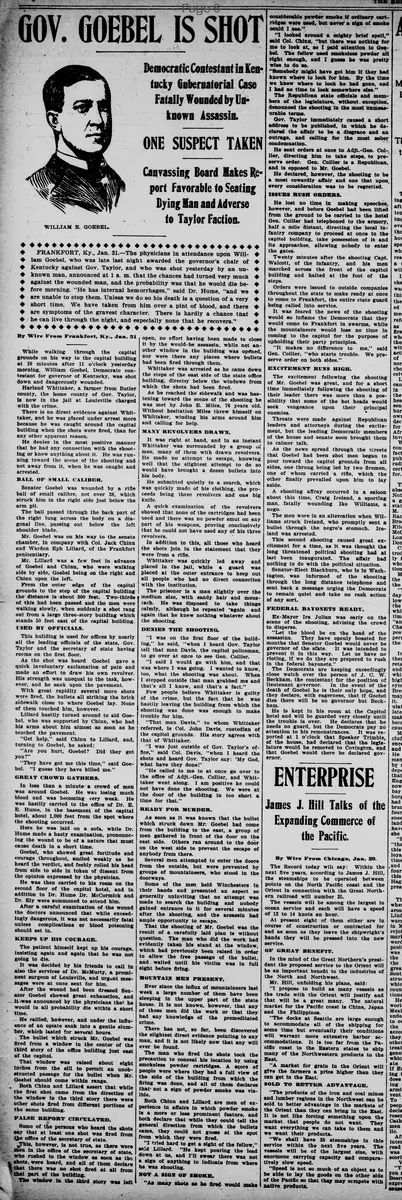
WILLIAM E. GOEBEL.
FRANKFORT, Ky., Jan. 31.—The physicians in attendance upon William Goebel, who was late last night awarded the governor's chair of Kentucky against Gov. Taylor, and who was shot yesterday by an unknown man, announced at 1 a. m. that the chances had turned very much against the wounded man, and the probability was that he would die before morning. "He has internal hemorrhages," said Dr. Hume, "and we are unable to stop them. Unless we do so his death is a question of a very short time. We have taken from him over a pint of blood, and there are symptoms of the gravest character. There is hardly a chance that he can live through the night, and especially none that he recovers."
By Wire From Frankfort, Ky., Jan. 31
While walking through the capital grounds on his way to the capital building at 10 minutes after 11 o'clock yesterday morning, William Goebel, Democratic contestant for governor of Kentucky, was shot down and dangerously wounded. Harland Whittaker, a farmer from Butler county, the home county of Gov. Taylor, is now in the jail at Louisville charged with the crime.
There is no direct evidence against Whittaker, and he was placed under arrest more because he was caught around the capital building when the shots were fired, than for any other apparent reason. He denies in the most positive manner that he had any connection with the shooting or knew anything about it. He was running toward the scene of the shooting and not away from it, when he was caught and arrested.
BALL OF SMALL CALIBER.
Senator Goebel was wounded by a rifle ball of small calibre, not over .38, which struck him in the right side just below the arm pit. The ball passed through the back part of the right lung across the body on a diagonal line, passing out below the left shoulder blade.
Mr. Goebel was on his way to the senate chamber, in company with Col. Jack Chinn and Warden Eph Lillard, of the Frankfort penitentiary. Mr. Lillard was a few feet in advance of Goebel and Chinn, who were walking side by side, Goebel being on the right and Chinn upon the left.
From the outer edge of the capital grounds to the step of the capital building the distance is about 300 feet. Two-thirds of this had been passed and the men were walking slowly, when suddenly a shot rang out from a large three-story building which stands 50 feet east of the capital building.
USED BY OFFICIALS.
This building is used for offices by nearly all the leading officials of the state, Gov. Taylor and the secretary of state having rooms on the first floor.
As the shot was heard Goebel gave a quick involuntary exclamation of pain and made an effort to draw his own revolver. His strength was unequal to the task, however, and he sank upon the pavement. With great rapidity several more shots were fired, the bullets all striking the brick sidewalk close to where Goebel lay. None of them touched him, however.
Lillard hastily turned around to aid Goebel, who was supported by Chinn, who had his arms about him almost as soon as he touched the pavement.
"Get help," said Chinn to Lillard, and, turning to Goebel, he asked:
"Are you hurt, Goebel? Did they get you?"
"They have got me this time," said Goebel.
"I guess they have killed me."
GREAT CROWD GATHERS.
In less than a minute a crowd of men was around Goebel. He was losing much blood and was becoming very weak. He was hastily carried to the office of Dr. E. E. Hume, in the basement of the capital hotel, about 1,000 feet from the spot where the shooting occurred.
Here he was laid on a sofa, while Dr. Hume made a hasty examination, pronouncing the wound to be of a nature that must cause death in a short time.
Goebel, who showed great fortitude and courage throughout, smiled weakly as he heard the verdict, and feebly rolled his head from side to side in token of dissent from the opinion expressed by the physician.
He was then carried to his room on the second floor of the capitol hotel, and in addition to Dr. Hume Dr. McCormick and Dr. Ely were summoned to attend him.
After a careful examination of the wound the doctors announced that while exceedingly dangerous, it was not necessarily fatal unless complications or blood poisoning should set in.
KEEPS UP HIS COURAGE.
The patient himself kept up his courage, insisting again and again that he was not going to die.
It was decided by his friends to call in also the services of Dr. McMurtry, a prominent surgeon of Louisville, and urgent messages were at once sent for him.
After the wound had been dressed Senator Goebel showed great exhaustion, and it was announced by the physicians that he would in all probability die within a short time.
He rallied, however, and under the influence of an opiate sank into a gentle slumber, which lasted for several hours.
The bullet which struck Mr. Goebel was fired from a window in the center of the third story of the office building just east of the capitol. That window was raised about eight inches from the sill to permit an unobstructed passage for the bullet when Mr. Goebel should come within range.
Both Chinn and Lillard assert that while the first shot came from the direction of the window in the third story there were other shots fired from different portions of the same building.
FALSE REPORT CIRCULATED.
Some of the persons who heard the shots say that at least one shot was fired from the office of the secretary of state. This, however, is not true, as there were men in the office of the secretary of state, who rushed to the window as soon as the shots were heard, and all of them declare that there was no shot fired at all from that part of the building.
The window in the third story was left open, no effort having been made to close it by the would-be assassin, while not another window in the building was opened, nor were there any places where bullets had been fired through them.
Whittaker was arrested as he came down the steps of the east side of the state office building, directly below the windows from which the shots had been fired.
As he reached the sidewalk and was hastening toward the scene of the shooting he was met by John E. Miles, 76 years old. Without hesitation Miles threw himself on Whittaker, winding his arms around him and calling for help.
MANY REVOLVERS DRAWN.
It was right at hand, and in an instant Whittaker was surrounded by a group of men, many of them with drawn revolvers.
He made no attempt to escape, knowing well that the slightest attempt to do so would have brought a dozen bullets into his body.
He submitted quietly to a search, which was quickly made of his clothing, the proceeds being three revolvers and one big knife.
A quick examination of the revolvers showed that none of the cartridges had been used and there was no powder smut on any part of his weapons, proving conclusively that he could not have used any of his three revolvers.
In addition to this, all those who heard the shots join in the statement that they were from a rifle.
Whittaker was quickly led away and placed in the jail, while a guard was placed at the outer entrance to keep out all people who had no direct connection with the institution.
The prisoner is a man slightly over the medium size, with sandy hair and mustache. He was disposed to take things calmly, although he repeated again and again that he knew nothing whatever about the shooting.
DENIES THE SHOOTING
"I was on the first floor of the building," he said, "when I heard Gov. Taylor tell that man Davis, the capitol policeman, to go over at once to see Gen. Collier.
"I said I would go with him, and that was where I was going. I wanted to know, too, what the shooting was about. When I stepped outside that man grabbed me and that's all I know, and that's a fact."
Few people believe Whittaker is guilty of the crime, but the fact that he was hastily leaving the building from which the shooting was done was enough to make trouble for him.
"That man Davis," to whom Whittaker referred, is Col. John Davis, custodian of the capitol grounds. His story agrees with that of Whittaker.
"I was just outside of Gov. Taylor's office," said Col. Davis, "when I heard the shots and heard Gov. Taylor say: 'My God, what have they done!'
"He called to me to at once go over to the office of Adjt.-Gen. Collier, and Whittaker went along. I am positive he could not have done the shooting. We were at the door of the building in too short a time for that."
READY FOR MURDER.
As soon as it was known that the bullet which struck down Mr. Goebel had come from the building to the east, a group of men gathered in front of the door on the east side. Others ran around to the door on the west side to prevent the escape of anybody from there.
Several men attempted to enter the doors from the outside, but were prevented by groups of mountaineers, who stood in the doorways. Some of the men held Winchesters in their hands and presented an aspect so generally uninviting that no attempt was made to search the building and nobody gained entrance to it for several minutes after the shooting, and the assassin had ample opportunity to escape.
That the shooting of Mr. Goebel was the result of a carefully laid plan is without question. The man who did the work had evidently taken his stand at the window, which had previously been raised in order to allow the free passage of the bullet, and waited until his victim was in full sight before firing.
MOUNTAIN MEN PRESENT.
Ever since the influx of mountaineers last week a large number of them have been sleeping in the upper part of the state house. It is not known, however, that any of these men did the work or that they had any knowledge of the premeditated crime.
There has not, so far, been discovered the slightest direct evidence pointing to any man, and it is not likely now that any will ever be found.
The man who fired the shots took the precaution to conceal his location by using smokeless powder cartridges. A score of people were where they had a full view of the side of the building from which the firing was done, and all of them declare that not a sign of powder smoke was visible.
Both Chinn and Lillard are men of experience in affairs in which powder smoke is a more or less prominent feature, and both declare that while they could tell the general direction from which the bullets came, they could not guess at the spot from which they were fired.
"I tried hard to get a sight of the fellow," said Lillard. "He kept pouring the lead down at us, and I'll swear there was not a sign of anything to indicate from where he was shooting."
NOT A SIGN OF SMOKE.
"As many shots as he fired would make considerable powder smoke if ordinary cartridges were used, but never a sign of smoke could I see."
"I looked around a mighty brief spell," said Col. Chinn, "but there was nothing for me to look at, so I paid attention to Goebel. The fellow used smokeless powder all right enough, and I guess he was pretty wise to do so.
"Somebody might have got him if they had known where to look for him. By the time we knew where to look he had gone, and I had no time to look somewhere else."
The Republican state officials and members of the legislature, without exception, denounced the shooting in the most unmeasurable terms.
Gov. Taylor immediately caused a short address to be published, in which he declared the affair to be a disgrace and an outrage, and calling for the most sober condemnation.
He sent orders at once to Adjt.-Gen. Collier, directing him to take steps to preserve order. Gen. Collier is a Republican, and is opposed to Mr. Goebel.
He declared, however, the shooting to be a most cowardly affair and one that upon every consideration was to be regretted.
ISSUES RUSH ORDERS.
He lost no time in making speeches however, and before Goebel had been lifted from the ground to be carried to the hotel Gen. Collier had telephoned to the armory, half a mile distant, directing the local infantry company to proceed at once to the capitol building, take possession of it and its approaches, allowing nobody to enter the gates.
Twenty minutes after the shooting Capt. Walcott, of the infantry, and his men marched across the front of the capitol building and halted at the foot of the steps.
Orders were issued to outside companies throughout the state to make ready at once to come to Frankfort, the entire state guard being called into service.
It was feared the news of the shooting would so inflame the Democrats that they would come to Frankfort in swarms, while the mountaineers would lose no time in coming to the capitol for the purpose of upholding their party principles.
"It makes no difference to me," said Gen. Collier, "who starts trouble. We preserve order on both sides."
EXCITEMENT RUNS HIGH,
The excitement following the shooting of Mr. Goebel was great, and for a short time immediately following the shooting of their leader there was more than a possibility that some of the hot heads would seek vengeance upon their principal enemies.
Threats were made against Republican leaders and attorneys during the excitement, but the leading Democratic members of the house and senate soon brought them to calmer talk.
As the news spread through the streets that Goebel had been shot men began to pour toward the capitol grounds from all sides, one throng being led by two firemen, one of whom carried a rifle, which the other finally prevailed upon him to lay aside.
A shooting affray occurred in a saloon about this time, Craig Ireland, a sporting man, fatally wounding Ike Williams, a negro.
The men were in an altercation when Williams struck Ireland, who promptly sent a bullet through the negro's stomach. Ireland was arrested.
This second shooting caused great excitement for a time, as it was thought the long threatened political shooting had at last been inaugurated. The affair had nothing to do with the political situation.
Senator-Elect Blackburn, who is in Washington, was informed of the shooting through the long distance telephone and sent back a message urging the Democrats to remain quiet and take no rash action of any sort.
FEDERAL BAYONETS READY.
Ex-Mayor Ira Julian was early on the scene of the shooting, advising the crowd to disperse.
"Let the blood be on the head of the assassins. They have openly boasted for months that Senator Goebel would never be governor of the state. It was intended to prevent it in this way. Let us have no rioting, if we do they are prepared to rush in the federal bayonets."
The Democrats are keeping exceedingly close watch over the person of J. C. W. Beckham, the contestant for the position of lieutenant governor. In the event of the death of Goebel he is their only hope, and they declare, with eagerness, that if Goebel dies there will be no governor but Beckham.
He is kept in his room at the Capitol hotel and will be guarded very closely until the trouble is over. He declares that he needs no guard, but the Democrats pay no attention to his remonstrances. It was reported at 1 o'clock that Speaker Trimble, of the house, had declared that the legislature would be removed to Covington, and that Goebel would there be declared governor.
What sub-type of article is it?
What themes does it cover?
What keywords are associated?
What entities or persons were involved?
Where did it happen?
Story Details
Key Persons
Location
Frankfort, Ky.
Event Date
Jan. 31
Story Details
William Goebel, Democratic contestant for Kentucky governor, was shot and fatally wounded by an unknown assassin while approaching the capitol building. Harland Whittaker was arrested but denied involvement. The shooting occurred amid a disputed election, with Goebel recently awarded the governorship.