Thank you for visiting SNEWPapers!
Sign up free
Literary
June 20, 1844
Litchfield Enquirer
Litchfield, Litchfield County, Connecticut
What is this article about?
In autumn 1843, a traveler rests at a New England inn and converses with companions, including a seemingly rustic Vermont backwoodsman who astounds him with profound legal insights, revealing himself as the renowned jurist Leman Church Esq. The piece vividly describes Church's unassuming appearance and formidable intellectual prowess as an advocate.
Clipping
OCR Quality
92%
Excellent
Full Text
From the Norwich News.
THE TOURIST.
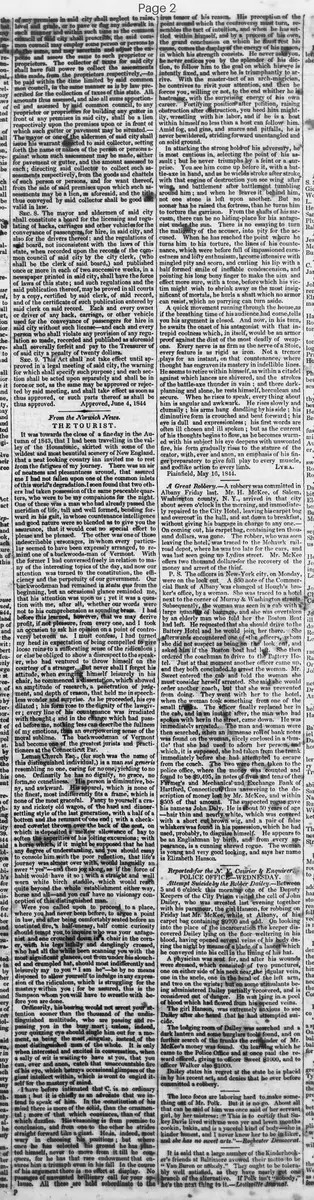
It was towards the close of a fine day in the Autumn of 1843, that I had been travelling in the valley of the Housatonic, skirted with some of the wildest and most beautiful scenery of New England. that a neat looking country inn invited me to rest from the fatigues of my journey. There was an air of neatness and pleasantness around, that assured me I had not fallen upon one of the common inlets of this world's degradation. I soon found that two others had taken possession of the same peaceable quarters, who were to be my companions for the night. One of these was a man who had already passed the meridian of life, tall and well formed, bending forward in his gait, in whose countenance intelligence and good nature were so blended as to give you the assurance, that it would cost no special effort to please and be pleased. The other was one of those indescribable personages, in whom every particular seemed to have been expressly arranged, to remind one of a backwoods-man of Vermont. With the former I had conversed freely in relation to many of the interesting topics of the day, and now our attention was turned to the constitution, the efficiency and the perpetuity of our government. Our backwoodsman had remained in statu quo from the beginning, but an occasional glance reminded me, that his attention was upon us; yet it was a question with me, after all, whether our words were not to his comprehension as sounding brass. I had before this learned, however, that we may derive profit, if not pleasure, from every one, and I took an occasion to ask his opinion on a point of controversy between us. I must confess, I had turned my head in expectation of being compelled to give loose reins to a suffocating sense of the ridiculous; or else be obliged to show a disrespect to the speaker, who had ventured to throw himself on the courtesy of a stranger. But never shall I forget his attitude, when swinging himself leisurely in his chair, he commenced a dissertation, which showed an amplitude of research, a penetration of judgment, and depth of reason, that held me in speechless wonder and surprise. As he proceeded, his eye dilated; his form rose to the dignity of the lawgiver; every line of his countenance was irradiated with thought; and in the change which had passed before me, nothing less can describe the fullness of my emotions, than an overpowering sense of the moral sublime. The backwoodsman of Vermont had become one of the greatest jurists and practitioners at the Connecticut Bar.
Leman Church Esq., (for such was the name of this distinguished individual,) is a man sui generis resembling no one, caring for no one, yielding to no one. Ordinarily he has no dignity, no grace, no form, no comeliness. His person is diminutive, bony, and awkward. His apparel, which is none of the finest, most indifferently fits a frame, which is none of the most graceful. Fancy to yourself a crazy and rickety old wagon, of the hard and dinner-settling style of the last generation, with a half of a bottom and the remnant of one end; with a checkered coverlet thrown over the back of the seat, on which is deposited a meagre allowance of hay to soften the asperities of his jolting excursions; with a horse which, if it might be supposed that he had any degree of understanding, and you should essay to console him with the poor reflection, that life's journey was almost over with, would languidly answer 'yes' and then jog along, as if the force of habit would have it so; with a straight and well worn white birch staddle, which would reach quite beyond the whole establishment either way, horse and all—and you can have no visionary conception of this distinguished man.
Were you called upon to proceed to a place, where you had never been before, to argue a point in law, and after being comfortably seated before an unlighted fire, a half-uneasy, half comic curiosity should tempt you to inquire who was your antagonist and one crouched down in a chair in the corner, with his legs lathily and danglingly crossed, who had all the while been scanning you with the most significant glances, out from under his slouched and crumpled hat, should most indifferently and leisurely say to you 'I am he'—be by no means disposed to allow yourself to indulge in any expression of the ridiculous, which is struggling for the mastery within you; for be assured, this is the Sampson who you will have to wrestle with before you are done.
Ordinarily, his bearing would not arrest your attention sooner than the thousand of the undistinguished multitude, who are passing and re-passing you in the busy mart; unless, indeed, your quizzing eye should single him out for a moment, as being the most singular, instead of the most distinguished man of the whole. It is only when interested and excited in conversation, when a sally of wit is waiting to have at you, that you can, ever and anon, catch that unaccountable fire of his eye, which betrays occasional glimpses of the giant intellect within, which is wont to engird itself for the mastery of mind.
I have before intimated that C. is no ordinary man; but it is chiefly as an advocate that we intend to speak of him. In the constitution of his mind there is more of the solid, than the ornamental; more of that which convinces, than of that which dazzles. His reasoning is from premise to conclusion, and from one to the other he strides straightforward like a giant. He is, indeed, most wary in choosing his positions; but where once he has selected his ground he has planted himself, never to move from it till he conquers, for he has that rare endowment that ensures him a triumph even in his all. In the course of his argument there is no effort at display. No passages of unwonted brilliancy call for your applause. All these are held subordinate to the iron tensor of his reason. His perception of the point around which the controversy must turn, resembles the tact of intuition, and when he has settled within himself, and by a process of his own, the grand conclusion on which he must rest his cause, comes the display of the energy of his reason, in which his strength consists. He never asks you, he never entices you by the splendor of his diction, to follow him to the goal on which his eye is intently fixed, and where he is triumphantly to arrive. With the master-tact of an arch-magician, he contrives to rivet your attention, and then he forces you, willing or not, to the end whither he is hastening, with the surprising energy of his own career. Fortifying position after position, raising obstruction after obstruction, you heed him mightily, wrestling with his labor, and if he is a host within himself no less than a host can follow him. Amid fog, and gins, and snares and pitfalls, he is never bewildered, striding forward unentangled and on solid ground.
In attacking the strong hold of his adversary, he is most cautious in selecting the point of his assault; but he never triumphs by a feint or a surprise. You see him come up before it, with a battle-axe in hand, and as he wields stroke after stroke with that engine of destruction you see wing after wing, and battlement after battlement tumbling around him; and when he leaves it behind him, not one stone is left upon another. But no sooner has he raised the fortress, than he turns him to torture the garrison. From the shafts of his sarcasm, there can be no hiding-place for his antagonist under the sun. There is no essaying to turn the malignity of the accuser, into pity for the accused. When he has reached the point where he turns him to his torture, the lines of his countenance, which were before full of impassioned earnestness and lofty enthusiasm, become intensive with mingled pity and scorn, and curling his lip with a half formed smile of ineffable condescension, and pointing his long bony finger to make the aim and effect more sure, with a tone, before which his victim might wish to shrink away as the most insignificant of mortals, he hurls a shaft which no armor can resist, which no parrying can turn aside.
A quick movement running through the house, as if the breathing time of his audience had come, tells you his argument is closed. And now, in his turn, he awaits the onset of his antagonist with that intrepid coolness which, in itself, would be an armor proof against the dint of the most deadly of weapons. Every nerve is as firm as the nerve of a Stoic, every feature is as rigid as iron. Not a tremor plays for an instant, on that countenance, where thought has engraven its mastery in indelible lines. He seems to retire within himself, as within a citadel against which lances are shivered, and the strokes of the battle-axe thunder in vain; and there dark planning and alone, he rests himself, herculean and secure.
When he rises to speak, every thing about him is angular and awkward. He rises slowly and clumsily; his arms hang dandling by his side; his diminutive form is crouched and bent forward; his eye is dull and expressionless; his first words are often ill chosen and ill spoken; but as the current of his thoughts begins to flow, as he becomes warmed with his subject his eye deepens with unwonted fire, his form gradually rises to the stature of the orator, with, ever and anon, an emphasis of his finger preparatory to give full play to every muscle, and godlike action to every limb.
LYRA.
Plainfield, May 16, 1844.
THE TOURIST.
It was towards the close of a fine day in the Autumn of 1843, that I had been travelling in the valley of the Housatonic, skirted with some of the wildest and most beautiful scenery of New England. that a neat looking country inn invited me to rest from the fatigues of my journey. There was an air of neatness and pleasantness around, that assured me I had not fallen upon one of the common inlets of this world's degradation. I soon found that two others had taken possession of the same peaceable quarters, who were to be my companions for the night. One of these was a man who had already passed the meridian of life, tall and well formed, bending forward in his gait, in whose countenance intelligence and good nature were so blended as to give you the assurance, that it would cost no special effort to please and be pleased. The other was one of those indescribable personages, in whom every particular seemed to have been expressly arranged, to remind one of a backwoods-man of Vermont. With the former I had conversed freely in relation to many of the interesting topics of the day, and now our attention was turned to the constitution, the efficiency and the perpetuity of our government. Our backwoodsman had remained in statu quo from the beginning, but an occasional glance reminded me, that his attention was upon us; yet it was a question with me, after all, whether our words were not to his comprehension as sounding brass. I had before this learned, however, that we may derive profit, if not pleasure, from every one, and I took an occasion to ask his opinion on a point of controversy between us. I must confess, I had turned my head in expectation of being compelled to give loose reins to a suffocating sense of the ridiculous; or else be obliged to show a disrespect to the speaker, who had ventured to throw himself on the courtesy of a stranger. But never shall I forget his attitude, when swinging himself leisurely in his chair, he commenced a dissertation, which showed an amplitude of research, a penetration of judgment, and depth of reason, that held me in speechless wonder and surprise. As he proceeded, his eye dilated; his form rose to the dignity of the lawgiver; every line of his countenance was irradiated with thought; and in the change which had passed before me, nothing less can describe the fullness of my emotions, than an overpowering sense of the moral sublime. The backwoodsman of Vermont had become one of the greatest jurists and practitioners at the Connecticut Bar.
Leman Church Esq., (for such was the name of this distinguished individual,) is a man sui generis resembling no one, caring for no one, yielding to no one. Ordinarily he has no dignity, no grace, no form, no comeliness. His person is diminutive, bony, and awkward. His apparel, which is none of the finest, most indifferently fits a frame, which is none of the most graceful. Fancy to yourself a crazy and rickety old wagon, of the hard and dinner-settling style of the last generation, with a half of a bottom and the remnant of one end; with a checkered coverlet thrown over the back of the seat, on which is deposited a meagre allowance of hay to soften the asperities of his jolting excursions; with a horse which, if it might be supposed that he had any degree of understanding, and you should essay to console him with the poor reflection, that life's journey was almost over with, would languidly answer 'yes' and then jog along, as if the force of habit would have it so; with a straight and well worn white birch staddle, which would reach quite beyond the whole establishment either way, horse and all—and you can have no visionary conception of this distinguished man.
Were you called upon to proceed to a place, where you had never been before, to argue a point in law, and after being comfortably seated before an unlighted fire, a half-uneasy, half comic curiosity should tempt you to inquire who was your antagonist and one crouched down in a chair in the corner, with his legs lathily and danglingly crossed, who had all the while been scanning you with the most significant glances, out from under his slouched and crumpled hat, should most indifferently and leisurely say to you 'I am he'—be by no means disposed to allow yourself to indulge in any expression of the ridiculous, which is struggling for the mastery within you; for be assured, this is the Sampson who you will have to wrestle with before you are done.
Ordinarily, his bearing would not arrest your attention sooner than the thousand of the undistinguished multitude, who are passing and re-passing you in the busy mart; unless, indeed, your quizzing eye should single him out for a moment, as being the most singular, instead of the most distinguished man of the whole. It is only when interested and excited in conversation, when a sally of wit is waiting to have at you, that you can, ever and anon, catch that unaccountable fire of his eye, which betrays occasional glimpses of the giant intellect within, which is wont to engird itself for the mastery of mind.
I have before intimated that C. is no ordinary man; but it is chiefly as an advocate that we intend to speak of him. In the constitution of his mind there is more of the solid, than the ornamental; more of that which convinces, than of that which dazzles. His reasoning is from premise to conclusion, and from one to the other he strides straightforward like a giant. He is, indeed, most wary in choosing his positions; but where once he has selected his ground he has planted himself, never to move from it till he conquers, for he has that rare endowment that ensures him a triumph even in his all. In the course of his argument there is no effort at display. No passages of unwonted brilliancy call for your applause. All these are held subordinate to the iron tensor of his reason. His perception of the point around which the controversy must turn, resembles the tact of intuition, and when he has settled within himself, and by a process of his own, the grand conclusion on which he must rest his cause, comes the display of the energy of his reason, in which his strength consists. He never asks you, he never entices you by the splendor of his diction, to follow him to the goal on which his eye is intently fixed, and where he is triumphantly to arrive. With the master-tact of an arch-magician, he contrives to rivet your attention, and then he forces you, willing or not, to the end whither he is hastening, with the surprising energy of his own career. Fortifying position after position, raising obstruction after obstruction, you heed him mightily, wrestling with his labor, and if he is a host within himself no less than a host can follow him. Amid fog, and gins, and snares and pitfalls, he is never bewildered, striding forward unentangled and on solid ground.
In attacking the strong hold of his adversary, he is most cautious in selecting the point of his assault; but he never triumphs by a feint or a surprise. You see him come up before it, with a battle-axe in hand, and as he wields stroke after stroke with that engine of destruction you see wing after wing, and battlement after battlement tumbling around him; and when he leaves it behind him, not one stone is left upon another. But no sooner has he raised the fortress, than he turns him to torture the garrison. From the shafts of his sarcasm, there can be no hiding-place for his antagonist under the sun. There is no essaying to turn the malignity of the accuser, into pity for the accused. When he has reached the point where he turns him to his torture, the lines of his countenance, which were before full of impassioned earnestness and lofty enthusiasm, become intensive with mingled pity and scorn, and curling his lip with a half formed smile of ineffable condescension, and pointing his long bony finger to make the aim and effect more sure, with a tone, before which his victim might wish to shrink away as the most insignificant of mortals, he hurls a shaft which no armor can resist, which no parrying can turn aside.
A quick movement running through the house, as if the breathing time of his audience had come, tells you his argument is closed. And now, in his turn, he awaits the onset of his antagonist with that intrepid coolness which, in itself, would be an armor proof against the dint of the most deadly of weapons. Every nerve is as firm as the nerve of a Stoic, every feature is as rigid as iron. Not a tremor plays for an instant, on that countenance, where thought has engraven its mastery in indelible lines. He seems to retire within himself, as within a citadel against which lances are shivered, and the strokes of the battle-axe thunder in vain; and there dark planning and alone, he rests himself, herculean and secure.
When he rises to speak, every thing about him is angular and awkward. He rises slowly and clumsily; his arms hang dandling by his side; his diminutive form is crouched and bent forward; his eye is dull and expressionless; his first words are often ill chosen and ill spoken; but as the current of his thoughts begins to flow, as he becomes warmed with his subject his eye deepens with unwonted fire, his form gradually rises to the stature of the orator, with, ever and anon, an emphasis of his finger preparatory to give full play to every muscle, and godlike action to every limb.
LYRA.
Plainfield, May 16, 1844.
What sub-type of article is it?
Prose Fiction
Essay
What themes does it cover?
Political
Moral Virtue
What keywords are associated?
Tourist Narrative
Jurist Portrait
Vermont Backwoodsman
Legal Advocacy
Intellectual Surprise
What entities or persons were involved?
Lyra.
Literary Details
Title
The Tourist.
Author
Lyra.
Subject
Encounter With Jurist Leman Church Esq.
Key Lines
But Never Shall I Forget His Attitude, When Swinging Himself Leisurely In His Chair, He Commenced A Dissertation, Which Showed An Amplitude Of Research, A Penetration Of Judgment, And Depth Of Reason, That Held Me In Speechless Wonder And Surprise.
The Backwoodsman Of Vermont Had Become One Of The Greatest Jurists And Practitioners At The Connecticut Bar.
Leman Church Esq., (For Such Was The Name Of This Distinguished Individual,) Is A Man Sui Generis Resembling No One, Caring For No One, Yielding To No One.