Thank you for visiting SNEWPapers!
Sign up free
Literary
November 30, 1801
The National Intelligencer And Washington Advertiser
Washington, District Of Columbia
What is this article about?
In an excerpt from the Duke de Liancourt's travels, the author visits the elderly Jesuit priest Mr. Dixe in England. The 90-year-old priest vehemently blames the French Revolution on the suppression of the Jesuits, seeing it as God's punishment for France's atheism and sins, while praising French literature ironically.
Clipping
OCR Quality
95%
Excellent
Full Text
FROM THE DUKE DE LIANCOURT'S TRAVELS.
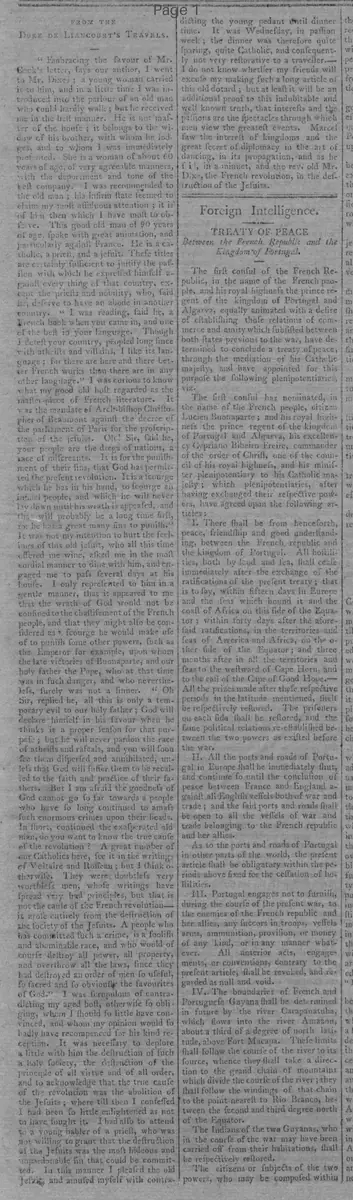
Embracing the favour of Mr. Cock's letter, says our author, I went to Mr. Dixes; a young woman carried it to him, and in a little time I was introduced into the parlour of an old man who could hardly walk; but he received me in the best manner. He is not master of the house; it belongs to the widow of his brother, with whom he lodges, and to whom I was immediately presented. She is a woman of about 60 years of age, of very agreeable manners, with the deportment and tone of the best company. I was recommended to the old man; his infirm state seemed to claim my most assiduous attention; it is of him then which I have most to observe. This good old man of 90 years of age, spoke with great animation, and particularly against France. He is a Catholic, a priest, and a Jesuit. These titles are certainly sufficient to justify the passion with which he expressed himself against every thing of that country, except the priests and nobility, who, said he, deserve to have an abode in another country. "I was reading," said he, "a French book when you came in, and one of the best in your language. Though I detest your country, peopled long since with atheists and villains, I like its language; for there are here and there better French works than there are in any other language." I was curious to know what my good old host regarded as the master-piece of French literature. It was the mandate of Archbishop Christopher of Beaumont against the decree of the parliament of Paris for the proscription of the Jesuits. "Oh! Sir," said he, "your people are the dregs of nations, a race of miscreants. It is for the punishment of their sins, that God has permitted the present revolution. It is a scourge which He has in his hand, to scourge an infidel people, and which he will never have down until his wrath is appeased, - and that will probably be a long time first, if he has a great many sins to punish."
It was not my intention to hurt the feelings of this old Jesuit, who all this time offered me wine, asked me in the most cordial manner to dine with him, and engaged me to pass several days at his house. I only represented to him in a gentle manner, that it appeared to me that the wrath of God would not be confined to the chastisement of the French people, and that they might also be considered as a scourge he would make use of to punish some other powers, such as the Emperor for example, upon whom the late victories of Buonaparte, and our holy father the Pope, who at that time was in such danger, and nevertheless, surely was not a sinner. "Oh Sir," replied he, "all this is only a temporary evil to our holy father; God will declare himself in his favour when he thinks it a proper season for that purpose; but he will never pardon the race of atheists and rascals, and you will soon see them dispersed and annihilated, unless that God will suffer them to be recalled to the faith and practice of their fathers. But I am afraid the goodness of God cannot go so far towards a people who have so long continued to amass such enormous crimes upon their heads."
In short, continued the exasperated old man, do you want to know the true cause of the revolution? A great number of our Catholics here, see it in the writings of Voltaire and Rousseau; but I think otherwise. They were doubtless very worthless men, whose writings have spread very bad principles, but that is not the cause of the French revolution it arose entirely from the destruction of the society of the Jesuits. A people who has committed such a crime, is a foolish and abominable race, and who would of course destroy all power, all property, and overthrow all the laws, since they had destroyed an order of men so useful, so sacred and so obviously the favourites of God." I was scrupulous of contradicting my aged host, otherwise so obliging, whom I should so little have convinced, and whom my opinion would so badly have recompensed for his kind reception. It was necessary to deplore a little with him the destruction of such a holy society, the destruction of the principle of all virtue and of all order, and to acknowledge that the true cause of the revolution was the abolition of the Jesuits; where till then I confessed I had been so little enlightened as not to have thought it. I had also to attend to a young babbler of a priest, who was not willing to grant that the destruction of the Jesuits was the most hideous and unpardonable in that could be committed. In this manner I pleased the old Jesuit and amused myself with contradicting the young pedant until dinner time. It was Wednesday, in passion week; the dinner was therefore quite sparing, quite Catholic, and consequently not very restorative to a traveller.
I do not know whether my friends will excuse my making such a long article of this old dotard; but at least it will be an additional proof to this indubitable and well known truth, that interests and the passions are the spectacles through which men view the greatest events. Marcel saw the interest of kingdoms and the great secret of diplomacy in the art of dancing, in its propagation, and as he said, in a minuet, and the rev. old Mr. Dixe, the French revolution, in the destruction of the Jesuits.
Embracing the favour of Mr. Cock's letter, says our author, I went to Mr. Dixes; a young woman carried it to him, and in a little time I was introduced into the parlour of an old man who could hardly walk; but he received me in the best manner. He is not master of the house; it belongs to the widow of his brother, with whom he lodges, and to whom I was immediately presented. She is a woman of about 60 years of age, of very agreeable manners, with the deportment and tone of the best company. I was recommended to the old man; his infirm state seemed to claim my most assiduous attention; it is of him then which I have most to observe. This good old man of 90 years of age, spoke with great animation, and particularly against France. He is a Catholic, a priest, and a Jesuit. These titles are certainly sufficient to justify the passion with which he expressed himself against every thing of that country, except the priests and nobility, who, said he, deserve to have an abode in another country. "I was reading," said he, "a French book when you came in, and one of the best in your language. Though I detest your country, peopled long since with atheists and villains, I like its language; for there are here and there better French works than there are in any other language." I was curious to know what my good old host regarded as the master-piece of French literature. It was the mandate of Archbishop Christopher of Beaumont against the decree of the parliament of Paris for the proscription of the Jesuits. "Oh! Sir," said he, "your people are the dregs of nations, a race of miscreants. It is for the punishment of their sins, that God has permitted the present revolution. It is a scourge which He has in his hand, to scourge an infidel people, and which he will never have down until his wrath is appeased, - and that will probably be a long time first, if he has a great many sins to punish."
It was not my intention to hurt the feelings of this old Jesuit, who all this time offered me wine, asked me in the most cordial manner to dine with him, and engaged me to pass several days at his house. I only represented to him in a gentle manner, that it appeared to me that the wrath of God would not be confined to the chastisement of the French people, and that they might also be considered as a scourge he would make use of to punish some other powers, such as the Emperor for example, upon whom the late victories of Buonaparte, and our holy father the Pope, who at that time was in such danger, and nevertheless, surely was not a sinner. "Oh Sir," replied he, "all this is only a temporary evil to our holy father; God will declare himself in his favour when he thinks it a proper season for that purpose; but he will never pardon the race of atheists and rascals, and you will soon see them dispersed and annihilated, unless that God will suffer them to be recalled to the faith and practice of their fathers. But I am afraid the goodness of God cannot go so far towards a people who have so long continued to amass such enormous crimes upon their heads."
In short, continued the exasperated old man, do you want to know the true cause of the revolution? A great number of our Catholics here, see it in the writings of Voltaire and Rousseau; but I think otherwise. They were doubtless very worthless men, whose writings have spread very bad principles, but that is not the cause of the French revolution it arose entirely from the destruction of the society of the Jesuits. A people who has committed such a crime, is a foolish and abominable race, and who would of course destroy all power, all property, and overthrow all the laws, since they had destroyed an order of men so useful, so sacred and so obviously the favourites of God." I was scrupulous of contradicting my aged host, otherwise so obliging, whom I should so little have convinced, and whom my opinion would so badly have recompensed for his kind reception. It was necessary to deplore a little with him the destruction of such a holy society, the destruction of the principle of all virtue and of all order, and to acknowledge that the true cause of the revolution was the abolition of the Jesuits; where till then I confessed I had been so little enlightened as not to have thought it. I had also to attend to a young babbler of a priest, who was not willing to grant that the destruction of the Jesuits was the most hideous and unpardonable in that could be committed. In this manner I pleased the old Jesuit and amused myself with contradicting the young pedant until dinner time. It was Wednesday, in passion week; the dinner was therefore quite sparing, quite Catholic, and consequently not very restorative to a traveller.
I do not know whether my friends will excuse my making such a long article of this old dotard; but at least it will be an additional proof to this indubitable and well known truth, that interests and the passions are the spectacles through which men view the greatest events. Marcel saw the interest of kingdoms and the great secret of diplomacy in the art of dancing, in its propagation, and as he said, in a minuet, and the rev. old Mr. Dixe, the French revolution, in the destruction of the Jesuits.
What sub-type of article is it?
Essay
Dialogue
What themes does it cover?
Political
Religious
Moral Virtue
What keywords are associated?
French Revolution
Jesuits
Catholic Priest
Divine Punishment
Travel Narrative
Voltaire Rousseau
What entities or persons were involved?
Duke De Liancourt
Literary Details
Title
From The Duke De Liancourt's Travels.
Author
Duke De Liancourt
Subject
Visit To Mr. Dixe And Discussion On The French Revolution
Form / Style
Narrative Travel Anecdote With Dialogue
Key Lines
"Oh! Sir," Said He, "Your People Are The Dregs Of Nations, A Race Of Miscreants. It Is For The Punishment Of Their Sins, That God Has Permitted The Present Revolution."
"Do You Want To Know The True Cause Of The Revolution? ... It Arose Entirely From The Destruction Of The Society Of The Jesuits."
Interests And The Passions Are The Spectacles Through Which Men View The Greatest Events.