Thank you for visiting SNEWPapers!
Sign up free
Editorial
December 4, 1937
Atlanta Daily World
Atlanta, Fulton County, Georgia
What is this article about?
Editorial by Sandy McIntyre explains that radio transmits electric waves, not sound, converting vibrations via microphone. It humorously analogizes an old, troublesome radio to an aging cat, advising replacement with a new one.
Clipping
OCR Quality
98%
Excellent
Full Text
SOUND AND MUSIC
By SANDY McINTYRE
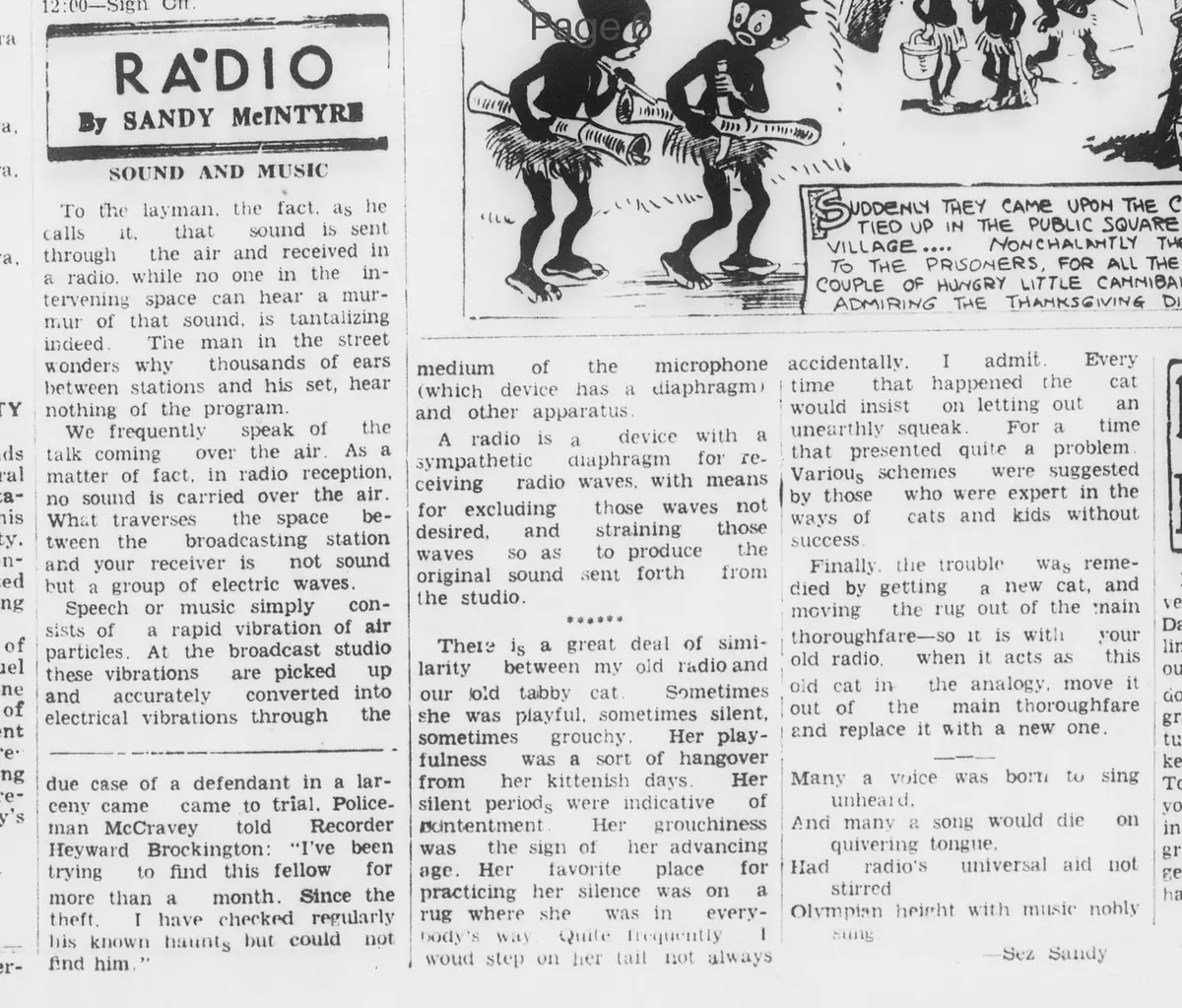
To the layman, the fact, as he calls it, that sound is sent through the air and received in a radio, while no one in the intervening space can hear a murmur of that sound, is tantalizing indeed. The man in the street wonders why thousands of ears between stations and his set, hear nothing of the program. We frequently speak of the talk coming over the air. As a matter of fact, in radio reception, no sound is carried over the air. What traverses the space between the broadcasting station and your receiver is not sound but a group of electric waves. Speech or music simply consists of a rapid vibration of air particles. At the broadcast studio these vibrations are picked up and accurately converted into electrical vibrations through the medium of the microphone (which device has a diaphragm) and other apparatus. A radio is a device with a sympathetic diaphragm for receiving radio waves, with means for excluding those waves not desired, and straining those waves so as to produce the original sound sent forth from the studio.
There is a great deal of similarity between my old radio and our old tabby cat. Sometimes she was playful, sometimes silent, sometimes grouchy. Her playfulness was a sort of hangover from her kittenish days. Her silent periods were indicative of resentment. Her grouchiness was the sign of her advancing age. Her favorite place for practicing her silence was on a rug where she was in everybody's way. Quite frequently Bobby's way would step on her tail not always accidentally. I admit every time that happened the cat would insist on letting out an unearthly squeak. For a time that presented quite a problem. Various schemes were suggested by those who were expert in the ways of cats and kids without success. Finally, the trouble was remedied by getting a new cat, and moving the rug out of the main thoroughfare—so it is with your old radio, when it acts like this old cat in the analogy, move it out of the main thoroughfare and replace it with a new one.
By SANDY McINTYRE
To the layman, the fact, as he calls it, that sound is sent through the air and received in a radio, while no one in the intervening space can hear a murmur of that sound, is tantalizing indeed. The man in the street wonders why thousands of ears between stations and his set, hear nothing of the program. We frequently speak of the talk coming over the air. As a matter of fact, in radio reception, no sound is carried over the air. What traverses the space between the broadcasting station and your receiver is not sound but a group of electric waves. Speech or music simply consists of a rapid vibration of air particles. At the broadcast studio these vibrations are picked up and accurately converted into electrical vibrations through the medium of the microphone (which device has a diaphragm) and other apparatus. A radio is a device with a sympathetic diaphragm for receiving radio waves, with means for excluding those waves not desired, and straining those waves so as to produce the original sound sent forth from the studio.
There is a great deal of similarity between my old radio and our old tabby cat. Sometimes she was playful, sometimes silent, sometimes grouchy. Her playfulness was a sort of hangover from her kittenish days. Her silent periods were indicative of resentment. Her grouchiness was the sign of her advancing age. Her favorite place for practicing her silence was on a rug where she was in everybody's way. Quite frequently Bobby's way would step on her tail not always accidentally. I admit every time that happened the cat would insist on letting out an unearthly squeak. For a time that presented quite a problem. Various schemes were suggested by those who were expert in the ways of cats and kids without success. Finally, the trouble was remedied by getting a new cat, and moving the rug out of the main thoroughfare—so it is with your old radio, when it acts like this old cat in the analogy, move it out of the main thoroughfare and replace it with a new one.
What sub-type of article is it?
Science Or Medicine
What keywords are associated?
Radio Waves
Sound Transmission
Microphone
Electric Vibrations
Old Radio
Cat Analogy
Replacement
What entities or persons were involved?
Sandy Mcintyre
Editorial Details
Primary Topic
Radio Transmission And Replacement Advice
Stance / Tone
Educational And Humorous
Key Figures
Sandy Mcintyre
Key Arguments
Radio Transmits Electric Waves, Not Sound, Through The Air
Microphone Converts Sound Vibrations To Electrical Vibrations
Receiver Reconstructs Original Sound From Waves
Old Radios, Like Aging Cats, Become Troublesome And Should Be Replaced