Thank you for visiting SNEWPapers!
Sign up free
Rhode Island American And Gazette
Providence, Providence County, Rhode Island
What is this article about?
A public dinner at New York's City Hotel honored Rhode Island Congressman Tristam Burges for his congressional exposure of corruption in President Jackson's administration. Burges delivered a lengthy speech criticizing foreign relations, Indian treaty violations, and domestic policies, amid toasts and political sentiments from attendees including Henry Clay and Daniel Webster references.
Clipping
OCR Quality
Full Text
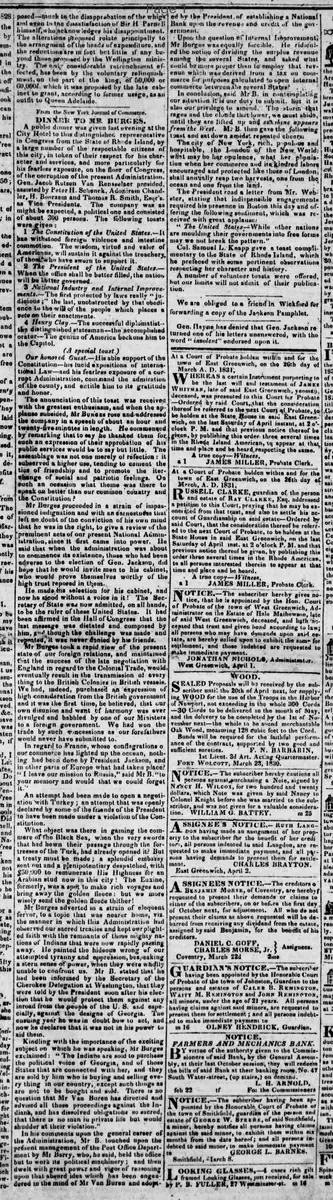
DINNER TO MR. BURGES.
A public dinner was given last evening at the City Hotel to this distinguished representative in Congress from the State of Rhode Island, by a large number of the respectable citizens of this city, in token of their respect for his character and services, and more particularly for his fearless exposure, on the floor of Congress, of the corruption of the present Administration.
Gen. Jacob Rutson Van Rensselaer presided, assisted by Peter H. Schenck, Adoniram Chandler, H. Booraem and Thomas R. Smith, Esqrs. as Vice Presidents. The company was, as might be expected, a political one and consisted of about 300 persons. The following toasts were given:
1. The Constitution of the United States.—It has withstood foreign violence and intestine commotion. The wisdom, virtue and valor of Americans, will sustain it against the treachery of those who have sworn to support it.
2. The President of the United States.—When this office shall be better filled, the nation will be better governed.
3. National Industry and Internal Improvements.—The first protected by laws really 'judicious;' the last, unobstructed by that obedience to the will of the people which places a veto on their enactments.
4. Henry Clay.—The successful diplomatist.—the distinguished statesman—the accomplished orator—The genius of America beckons him to the Capitol.
(A special toast.)
Our honored Guest.—His able support of the Constitution—his lucid expositions of international Law—and his fearless exposure of a corrupt Administration, command the admiration of the country, and entitle him to its gratitude and honor.
The annunciation of this toast was received with the greatest enthusiasm, and when the applause subsided, Mr. Burges rose and addressed the company in a speech of about an hour and twenty-five minutes in length. He commenced by remarking that to say he thanked them for such an expression of their approbation of his public services would be to say but little. The assemblage was not one merely of refection: it subserved a higher use, tending to cement the ties of friendship and to promote the interchange of social and patriotic feelings. On such an occasion what theme was there to speak on better than our common country and the Constitution?
Mr. Burges proceeded in a strain of impassioned indignation and with an earnestness that left no doubt of the conviction of his own mind that he was in the right, to give a review of the prominent acts of our present National Administration, since it first came into power. He said that when the administration was about to commence its existence, those who had been adverse to the election of Gen. Jackson, did hope that he would invite men to his cabinet, who would prove themselves worthy of the high trust reposed in them.
He made this selection for his cabinet, and now he stands without a voice in it! The Secretary of State was now admitted, on all hands, to be the ruler of these United States. It had been affirmed in the Hall of Congress that the last message was dictated and composed by him, and though the challenge was made and repeated, it was never denied by his friends.
Mr. Burges took a rapid view of the present state of our foreign relations, and maintained that the success of the late negotiation with England in regard to the Colonial Trade, would eventually result in the transmission of everything to the British Colonies in British vessels.
We had, indeed, purchased an 'expression of high consideration' from the British government and it was the first time, he believed, that our own disunion and want of harmony was ever divulged and babbled by one of our Ministers to a foreign government. We had won the trade by such concessions as our forefathers would never have submitted to.
In regard to France, whose conflagration of our commerce has lighted up the ocean, nothing had been done by President Jackson, and in other parts of Europe what had taken place?
'I leave our mission to Russia,' said Mr. B. 'to your memory and would that we could forget it.'
An attempt had been made to open a negotiation with Turkey; an attempt that was openly declared by some of the friends of the President to have been made under a violation of the Constitution.
What object was there in gaining the commerce of The Black Sea, when the very swords that had hewn their passage through the fortresses of the Turk, had already opened it? But a treaty must be made; a splendid embassy sent out and a plenipotentiary despatched, with $50,000 to remunerate His Highness for an Arabian stud now in this city! The Euxine, formerly, was a spot to make rich voyages and bring away the golden fleece: but we more wisely send the golden fleece thither!
Mr. Burges adverted in a strain of eloquent fervor, to a topic that was nearer home, viz. the manner in which this Administration had observed our sacred treaties and kept our plighted faith with the remnants of those mighty nations of Indians that were now rapidly passing away. He painted the hideous wrong of our attempted tyranny and oppression, bespeaking a stern sense of power, when they were wholly unable to confront us. Mr. B. stated that he had been informed by the Secretary of the Cherokee Delegation at Washington, that they were told by the President soon after his election that he would protect them against any inroad from the people of the U. S. and especially, against the designs of Georgia. The ensuing year he was in doubt how to act, and now he declares that it was not in his power to aid them.
Kindling with the importance of the exciting subject on which he was speaking, Mr. Burges exclaimed: 'The Indians are said to purchase the political voice of Georgia, and of those States that are connected with her, and they are sold by him who is buying and selling everything in our country, except such things as are not to be bought and sold. There is no question that Mr. Van Buren has directed and advised all those proceedings against the Indian, and has dissolved obligations so sacred, that there is no man in private life but would shudder at their violation.'
In his comments upon the general career of the Administration, Mr. B. touched upon the present management of the Post Office Department by Mr. Barry, who, he said, held the office but to work its political machinery; and then dwelt with great power and vigor of reasoning upon that absurd idea which has been engendered in the mind of Mr. Van Buren and adopted by the President, of establishing a National Bank upon the revenue and credit of the government.
Upon the question Internal Improvement Mr. Burges was equally forcible. He ridiculed the notion of dividing the surplus revenue among the several States, and asked what could be more proper than to employ that revenue which was derived from a tax on commerce for purposes calculated to open internal commerce between the several States?
In conclusion, said Mr. B. in contemplating our situation it is our duty to submit. but, it is also our privilege to amend. The storm that rages and the clouds that lower, we must abide, until they are lifted up and sunshine appears from the West. Mr. B. then gave the following toast and sat down amidst repeated cheers:
The city of New York, rich, populous and hospitable, the London of the New World: what may be her opulence, whatever population when her commerce and its kindred labors encouraged and protected like those of London; shall annually reap two harvests, one from the ocean and one from the land.
The President read a letter from Mr. Webster, stating that indispensable engagements required his presence in Boston this day and offering the following sentiment, which was received with great applause:
'The United States—While other nations are moulding their governments into free forms may we not break the pattern.'
Col. Samuel L. Knapp gave a toast complimentary to the State of Rhode Island, which he prefaced with some pertinent observations respecting her character and history.
A number of volunteer toasts were offered, but our limits will not admit of their publication.
What sub-type of article is it?
What themes does it cover?
What keywords are associated?
What entities or persons were involved?
Where did it happen?
Story Details
Key Persons
Location
City Hotel, New York
Event Date
Last Evening
Story Details
A dinner honored Mr. Burges for exposing administration corruption; he spoke critically on foreign policy, Indian treaties, Post Office, national bank, and internal improvements, proposing toasts and receiving applause.