Thank you for visiting SNEWPapers!
Sign up free
Daily National Intelligencer
Washington, District Of Columbia
What is this article about?
Cobbett's Register reports on the Allied Powers' declaration from Frankfort on December 1, 1813, offering Napoleon peace by recognizing him as Emperor, granting France extensive territories, and supporting its commerce revival, contrasting with past aggressive policies and drawing criticism from pro-Bourbon British press.
Clipping
OCR Quality
Full Text
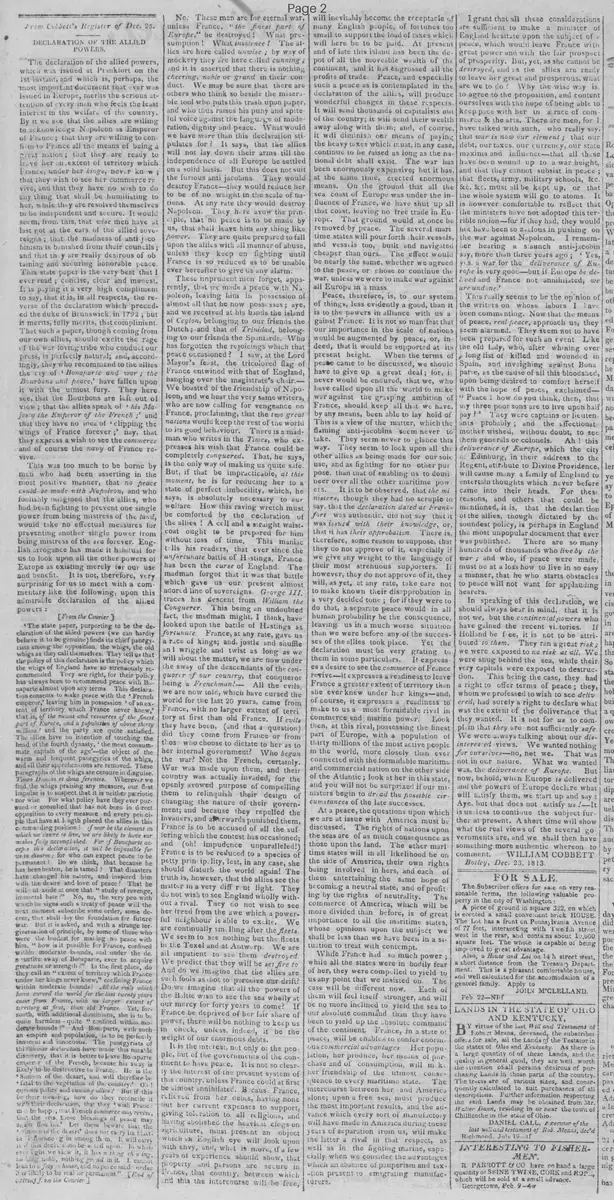
DECLARATION OF THE ALLIED POWERS.
The declaration of the allied powers, which was issued at Frankfort on the 1st instant, and which is, perhaps, the most important document that ever was issued in Europe, merits the serious attention of every man who feels the least interest in the welfare of the country. By it we see that the allies are willing to acknowledge Napoleon as Emperor of France; that they are willing to confirm to France all the means of being a great nation; that they are ready to leave her all extent of territory which France, under her kings, never knew; that they wish to see her commerce revive, and that they have no wish to do any thing that shall be humiliating to her, while they are resolved themselves to be independent and secure. It would seem, from this, that wise men have at last got at the ears of the allied sovereigns; that the madness of anti-jacobinism is banished from their councils; and that they are really desirous of obtaining and securing honorable peace.
This state paper is the very best that I ever read; concise, clear and modest. It is paying it a very high compliment to say, that it is, in all respects, the reverse of the declaration which preceded the duke of Brunswick, in 1792; but it merits, fully merits, that compliment. That such a paper, though coming from our own allies, should excite the rage of the war loving tribe who conduct our press, is perfectly natural; and, accordingly, they who recommend to the allies the cry of 'Bonaparte and war; the Bourbons and peace,' have fallen upon it with the utmost fury. They here see, that the Bourbons are left out of view; that the allies speak of his Majesty the Emperor of the French;' and that they have no idea of clipping the wings of France forever;' nay, that they express a wish to see the commerce and of course the navy of France revive.
This was too much to be borne by men who had been asserting in the most positive manner, that no peace could be made with Napoleon, and who foolishly imagined that the allies, who had been fighting to prevent one single power from being mistress of the land, would take no effectual measures for preventing another single power from being mistress of the sea forever. English arrogance has made it habitual for us to look upon all the other powers of Europe as existing merely for our use and benefit. It is not, therefore, very surprising for us to meet with a commentary like the following, upon this admirable declaration of the allied powers:
[From the Courier]
The state paper, purporting to be the declaration of the allied powers (we can hardly believe it to be genuine) finds its chief panegyrists among the opposition, the whigs, the old whigs as they call themselves. They tell us that the policy of this declaration is the policy which the whigs of England have so strenuously recommended They are right, for their policy has always been to recommend peace with Bonaparte almost upon any terms This declaration consents to make peace with the French emperor,' leaving him in possession 'of an extent of territory which France never knew, that is, of the means and resources of the finest part of Europe, and a population of above thirty millions! and the party are quite satisfied. The allies have no intention of touching the head of the fourth dynasty, 'the most consummate captain of the age'-the object of the warm and frequent panegyrics of the whigs, and all their apprehensions are removed. These paragraphs of the whigs are censure in disguise. Timeo Danaos et dona ferentes. Wherever we find the whigs praising any measure, our first impulse is to suspect that it is neither patriotic nor wise For what policy have they ever pursued or consulted that has not been in direct opposition to every measure and every principle that have at length placed the allies in this commanding position? if war be the element in which we desire to live, we are likely to have our wishes fully accomplished. For if Bonaparte accepts this declaration, it will be impossible for us to disarm; for who can expect peace to be permanent? Do we think, that because he has been beaten, he is tamed! That disasters have changed his nature, and inspired him with the desire and love of peace? That he will put aside at once that "study of revenge, immortal hate?" No, no, the very pen with which he signs such a treaty of peace will the next moment subscribe some order, some decree, that shall lay the foundation for future war. But it is asked, and with a strange tergiversation of principle, by some of those who were the loudest for making no peace with him, "how is it possible for France, confined within moderate bounds, and under the destructive sway of Bonaparte, ever to acquire greatness or strength?" In the first place, do they call an "extent of territory which France under her kings never knew," confining France within moderate bounds? All the evils which have cursed the world for the last twenty years came from France, with no larger extent of territory at first, than old France. Yet, forsooth, with additional dominions, she is to be quite harmless-quite "confined within moderate bounds!" And Bonaparte, with such an empire and population, is to be perfectly innocent and innocuous. The panegyrists of this unwise declaration have made this notable discovery, that it is better to leave Bonaparte emperor of the French, because his sway is likely to be destructive to France. He is the Simoon of the desert, and will therefore be fatal to the vegetation of the country. Oh! curious policy and cunning allies! But if this be their meaning, how do they reconcile it with their declaration, that they 'wish France may be happy, that French commerce may revive, that the rich fruits of peace may again flow in.' Let them beware that the "Simoom of the desert' does not carry its blighting influence among them. It will carry it if this declaration be acted upon. In whatever light we view it, it has nothing cheering, nothing noble, nothing grand in it. It cannot lead to safety or honor, and no peace made under it is likely to be real or permanent."
[End of extract from the Courier]
What sub-type of article is it?
What keywords are associated?
What entities or persons were involved?
Where did it happen?
Foreign News Details
Primary Location
Frankfort
Event Date
1st Instant
Key Persons
Outcome
allies offer to recognize napoleon as emperor, grant france extensive territories beyond historical bounds, support commerce revival, and seek honorable peace while ensuring their own independence.
Event Details
The Allied Powers issued a declaration at Frankfort offering peace to Napoleon, acknowledging him as Emperor of France, confirming her as a great nation with vast territories, wishing for commerce revival without humiliation, contrasting sharply with the 1792 Brunswick declaration; it draws praise for moderation but fury from pro-Bourbon British press like the Courier, which suspects insincerity and fears future war.