Thank you for visiting SNEWPapers!
Sign up free
Virginia Argus
Richmond, Virginia
What is this article about?
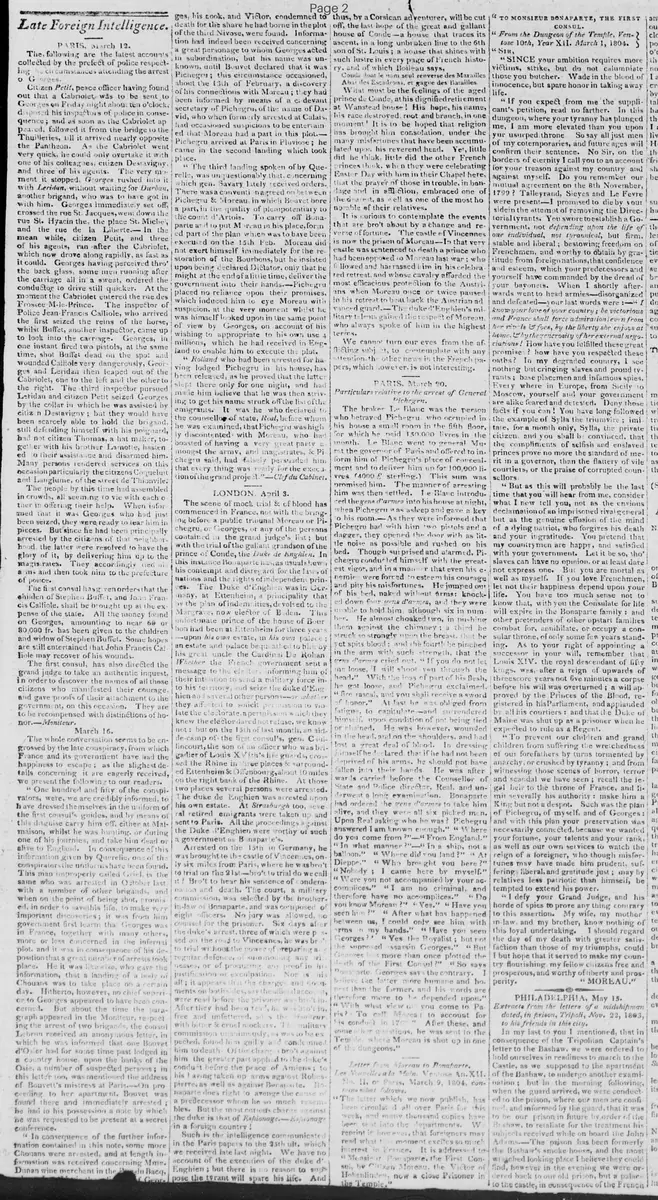
Reports from Paris and London detail the foiled royalist conspiracy against First Consul Bonaparte in March 1804, including the arrest and resistance of Georges Cadoudal, arrests of Pichegru and others, the abduction and execution of Duke d'Enghien from Germany, and Moreau's defiant letter from prison.
Clipping
OCR Quality
Full Text
Paris, March 12.
The following are the latest accounts collected by the prefect of police respecting the circumstances attending the arrest of Georges.
Citizen Petit, peace officer, having found out that a cabriolet was to be sent to Georges on Friday night about ten o'clock, disposed his inspectors of police in consequence; and as soon as the cabriolet appeared, followed it from the bridge to the Thuilleries, until it arrived nearly opposite the Pantheon. As the cabriolet went very quick, he could only overtake it with one of his colleagues, citizen Destavigny, and three of his agents. The very moment it stopped, Georges rushed into it with Leridan, without waiting for Durban, another brigand, who was to have got in with him. Georges immediately set off, crossed the rue St. Jacques, went down the rue St. Hyacinthe, the place St. Michel, and the rue de la Liberté. In the meanwhile, citizen Petit, and three of his agents, ran after the cabriolet, which now drove along rapidly, as fast as it could. Georges having perceived thro' the back glass, some men running after the carriage all in a sweat, ordered the conductor to drive still quicker. At the moment the cabriolet entered the rue des Fossés-le-Prince. The inspector of Police Jean Francis Calliole, who arrived the first, seized the reins of the horse, whilst Buffet, another inspector, came up to look into the carriage. Georges, in one instant fired two pistols, at the same time, shot Buffet dead on the spot and wounded Calliole very dangerously. Georges and Leridan then leaped out of the cabriolet, one to the left and the other to the right. The third inspector pursued Leridan and citizen Petit seized Georges by the collar in which he was assisted by citizen Destavigny; but they would have been scarcely able to hold the brigand, still defending himself with his poignard, had not citizen Thomas, a hat maker, together with his brother Lamotte, hastened to their assistance and disarmed him. Many persons rendered services on this occasion particularly the citizens Coguelin and Langlume, of the street de Thionville. The people by this time had assembled in crowds, all seeming to vie with each other in offering their help. When informed that it was Georges who had just been seized, they were ready to tear him in pieces. But since he had been principally arrested by the citizens of that neighborhood, the latter were resolved to have the glory of it, by delivering him up to the magistrates. They accordingly tied his hands and then took him to the prefecture of police.
The first consul has given orders that the children of Stephen Buffet, and John Francis Calliole, shall be brought up at the expense of the state. All the money found on Georges, amounting to near 60 or 80,000 fr. has been given to the children and widow of Stephen Buffet. Some hopes are still entertained that John Francis Calliole may recover of his wounds.
The first consul, has also directed the grand judge to take an authentic inquest, in order to discover the names of all those citizens who manifested their courage, and gave proofs of their attachment to the government, on this occasion. They are to be recompensed with distinctions of honor.—Moniteur.
March 16.
The whole conversation seems to be engrossed by the late conspiracy, from which France and its government have had the happiness to escape; as the slightest details concerning it are eagerly received, we present the following to our readers.
"One hundred and fifty of the conspirators, were, we are credibly informed, to have dressed themselves in the uniform of the first consul's guides, and by means of this disguise carry him off, either at Malmaison, whilst he was hunting, or during one of his journeys, and take him dead or alive to England. In consequence of this information given by Querelle, one of the conspirators—the uniforms have been found. This man improperly called (frit, is the same who was arrested in October last with a number of other brigands, and when on the point of being shot, promised, in order to save his life, to make very important discoveries; it was from him government first learnt that Georges was in France, together with many others, more or less concerned in the infernal plot, and it was in consequence of his deposition that a great number of arrests took place. He it was likewise, who gave the information, that a landing of a body of Chouans was to take place on a certain day. Hitherto, however, no chief superior to Georges appeared to have been concerned. But about the time the paragraph appeared in the Moniteur, respecting the arrest of two brigands, the consul Lebrun received an anonymous letter, in which he was informed that one Bouvet d'Oslor had for some time past lodged in a country house, upon the banks of the Oise, a number of suspected persons; in this letter too, was mentioned the address of Bouvet's mistress at Paris. On proceeding to her apartment, Bouvet was found there and immediately arrested; he had in his possession a note by which he was requested to be present at a secret conference.
"In consequence of the further information contained in this note, some more Chouans were arrested, and at length information was received concerning Mme. Dunan wine merchant in the Basgu Bacq,
Georges, his cook, and Vicor, condemned to death for the share he had borne in the plot of the third Nivose, were found. Information had indeed been received concerning a great personage to whom Georges acted in subordination, but his name was unknown, until Bouvet declared that it was Pichegru; this circumstance occasioned, about the 18th of February, a discovery of his connections with Moreau; they had been informed by means of a ci-devant secretary of Pichegru, of the name of David, who when formerly arrested at Calais, had occasioned suspicions to be entertained that Moreau had a part in this plot.
Pichegru arrived at Paris in Pluviose; he came in the second landing which took place.
"The third landing spoken of by Querelle, was unquestionably that, concerning which gen. Savary lately received orders. There was a convention agreed on between Pichegru & Moreau, in which Bouvet bore a part, in the quality of plenipotentiary to the count d'Artois. To carry off Bonaparte and to put Moreau in his place, formed part of the plan which was to have been executed on the 15th Feb. Moreau did not exert himself immediately for the restoration of the Bourbons, but he insisted upon being declared Dictator, only that he might at the end of a little time, deliver the government into their hands.—Pichegru placed no reliance upon their promises, which induced him to eye Moreau with suspicion, at the very moment whilst he was himself looked upon in the same point of view by Georges, on account of his wishing to appropriate to his own use 4 millions, which he had received in England to enable him to execute the plot.
"Rolland who had been arrested for having lodged Pichegru in his house, has been released, as he proved that the latter slept there only for one night, and had made him believe that he was then striving to get his name struck off the list of the emigrants. It was he who declared to the counsellor of state, Real, before whom he was examined, that Pichegru was highly discontented with Moreau, who had boasted of having a very great party among the army, and magistrates, & Pichegru said, had falsely persuaded him that every thing was ready for the execution of the grand project." Clef du Cabinet.
LONDON, April 3.
The scene of mock trial & of blood has commenced in France, not with the bringing before a public tribunal Moreau or Pichegru, or Georges, or any of the persons contained in the grand judge's list; but with the trial of the gallant grandson of the prince of Conde, the Duke d'Enghien. In this instance Bonaparte has, as usual, shewn his contempt and disregard for the laws of nations and the rights of independent princes. The Duke d'Enghien was in Germany, at Ettenheim, a principality that by the plan of indemnities, devolved to the Margrave, now elector of Baden. This unfortunate prince of the house of Bourbon had been at Ettenheim for three years—upon his own estate, in his own palace; an estate and palace bequeathed to him by his great uncle the Cardinal de Rohan. Whether the French government sent a message to the elector, informing him of their intention to send a military force into his territory, and seize the duke d'Enghien and several other persons—or whether they affected to solicit permission to violate the electorate, a permission which they knew the elector dared not refuse, we know not: but on the 15th of last month, an aide de-camp of the first consul's, gen. Caulaincourt, the son of an officer who was brigadier of Louis XVIth's life guards, crossed the Rhine in three places & surrounded Ettenheim & Odenbourg, about 10 miles on the right bank of the Rhine. At those two places several persons were arrested. The duke de Enghien was arrested upon his own estate. At Strasburgh too, several retired emigrants were taken up and sent to Paris. All the proceedings against the Duke d'Enghien were worthy of such a government as Bonaparte's.
Arrested on the 15th in Germany, he was brought to the castle of Vincennes, only six miles from Paris, where he was bro't to trial on the 21st—bro't to trial do we call it? Bro't to hear his sentence of condemnation and death. The court, a military commission, was selected by the brother-in-law of Bonaparte, and was composed of eight officers. No jury was allowed, no counsel for the prisoner. Six days after the duke's arrest, three of which were passed on the road to Vincennes, he was bro't to trial without the power of preparing a regular defence, of summoning any witnesses, or of producing any proof in his justification or exculpation. Nor is this all; it appears that the charge and questions on both sides, save the final account, were read before the prisoner was bro't in. After they had been read, he was brought in to, free and unfettered, see the moniteur with bitter & cruel mockery. The military commission unanimously, as was to be expected, found him guilty and condemned him to death. Of the charges bro't against him the greater part applied to the duke's conduct before the peace of Amiens; to his having taken up arms against Republican France, as well as against Bonaparte. How Bonaparte does right to avenge the cause of a predecessor whom he so much resembles. But the most curious charge against the duke is that of Espionage.—Espionage in a foreign country!
Such is the intelligence communicated in the Paris papers to the 25th ult. which we received late last night. We have no account of the execution of the duke d'Enghien; but there is no reason to suppose the tyrant will spare his life. And thus, by a Corsican adventurer, will be cut off, the last hope of the great and gallant house of Conde—a house that traces its ascent, in a long unbroken line to the 6th son of St. Louis: a house that shines with such lustre in every page of French history, and of which Boileau says,
Conde dont le nom seul renverse des Marailles
Abat des Escadrons, et cragye des Batailles.
What must be the feelings of the aged prince de Conde, at his dignified retirement at Wanstead house! His hope, his name, his race destroyed, root and branch, in one moment! It is to be hoped that religion has brought him consolation, under the many misfortunes that have been accumulated upon his reverend head. Yet, little did he think, little did the other French princes think, when they were celebrating Easter Day with him in their Chapel here, that the prayer of those in trouble, in bondage and in action, embraced one of the dauphins, as well as one of the most honorable of their relatives.
It is curious to contemplate the events that are bro't about by a change and reverse of fortune. The castle of Vincennes is now the prison of Moreau—In that very castle was sentenced to death a prince who had been opposed to Moreau last war; who followed and harassed him in his celebrated retreat, and whose cavalry afforded the most efficacious protection to the Austrians when Moreau once or twice paused in his retreat to beat back the Austrian advanced guard.—The duke d'Enghien's military talents gained the respect of Moreau, who always spoke of him in the highest terms.
We cannot turn our eyes from the affecting subject, to contemplate with any attention the other news in the French papers, which however, is not interesting.
PARIS, March 30.
Particulars relative to the arrest of General Pichegru.
The broker Le Blanc was the person who betrayed Pichegru, who occupied in his house a small room in the fifth floor, for which he paid 150,000 livres in the month. Le Blanc went to general Murat the governor of Paris and offered to inform him of Pichegru's place of concealment and to deliver him up for 100,000 livres (4000£ sterling.) This sum was promised him. The manner of arresting him was then settled. Le Blanc introduced the gens d'armes into his house at night, when Pichegru was asleep and gave a key to his room.—As they were informed that Pichegru had with him two pistols and a dagger, they opened the door with as little noise as possible and rushed on his bed. Though surprised and alarmed, Pichegru conducted himself with the greatest vigor, and in a manner that even his enemies were forced to esteem his courage and pity his misfortunes. He jumped out of his bed, naked without arms: knocked down four gens d'armes, and they were unable to hold him although six in number. He almost choaked two, in pushing them against the chimney; a third he struck so strongly upon the breast, that he yet spits blood; and the fourth he pinched in the arm with such strength, that the gens d'armes cried out. "If you do not let me loose, I will shoot you through the head." With the loss of part of his flesh, he got loose, and Pichegru exclaimed. "The rascal, and you shall receive a sword of honor." At last he was obliged from fatigue, to capitulate—and so surrendered himself, upon condition of not being tied or chained. He was however, wounded in the head, and on the shoulders, and had lost a great deal of blood. In dressing himself he declared that if he had not been deprived of his arms, he should not have fallen into their hands. He was afterwards carried before the Counsellor of State and Police director, Real, and underwent a long examination. Bonaparte had ordered the gens d'armes to take him alive, and they were all six picked men.
Upon Real asking who he was? Pichegru answered "I am known enough." "Where do you come from?"—"From England." "In what manner?"—"In a ship, not a balloon." "Where did you land?"—"At Dieppe." "Who brought you here?" "Nobody; I came here by myself." "Were you not accompanied by your accomplices." "I am no criminal, and therefore have no accomplices." "Do you know Moreau?" "Yes." "Have you seen him?" "After what has happened between us, I could only see him with arms in my hands." "Have you seen Georges?" "Yes the Royalist; but not the supposed assassin Georges." "But Georges the: more than once plotted the death of the First Consul?" "So says Doucette. Georges says the contrary. I believe the latter more humane and honest than the former, and his words are therefore more to be depended upon." "With what view did you come to Paris? To call Moreau to account for his conduct in 1797?" After these, and some other questions, he was sent to the Temple, where Moreau is shut up in one of the dungeons."
Letter from Moreau to Bonaparte.
Le Temple, Vendose An. XII.
To J. B. Paris, March 9, 1804, corner.
"The letter which we now publish, has been circulated all over Paris for this week, and many thousand copies have been sent into the departments. We reprint it however, that foreigners may read what moment excites so much interest in France. It is addressed to—
"Monsieur Bonaparte, the First Consul, by Citizen Moreau, the Victor of Hohenlinden, now a close Prisoner in the Temple."
"TO MONSIEUR BONAPARTE, THE FIRST CONSUL.
"From the Dungeon of the Temple, Vendose 10th, Year XII. March 1, 1804.
"SIR,
"SINCE your ambition requires more victims, strike, but do not calumniate those you butcher.—Wade in the blood of innocence, but spare honor in taking away life.
"If you expect from me the suppliant's petition, read no farther. In this dungeon, where your tyranny has plunged me, I am more elevated than you upon your usurped throne. So say all just men of my contemporaries, and future ages will confirm their sentence. No Sir, on the borders of eternity I call you to an account for your treason against my country and against myself. Do you remember our mutual agreement on the 8th November, 1799? Talleyrand, Sieyes and Le Fevre were present—I promised to die by your side in the attempt of removing the Directory tyrants. You swore to establish a Government, not depending upon the life of one individual, not tyrannical, but firm, stable and liberal; bestowing freedom on Frenchmen, and worthy to obtain by gratitude from foreign nations, that confidence and esteem, which your predecessors and yourself have commanded by the dread of your bayonets. When I shortly afterwards went to head armies—disorganized and defeated—your last words were:—"I know your love of your country; be victorious and France shall force admiration even from her rivals & foes, by the liberty she enjoys at home. & by the generosity of her external negotiations! How have you fulfilled these great promises? how have you respected these oaths? In my degraded country, I see nothing but cringing slaves and proud tyrants; base placemen and infamous spies. Every where in Europe, from Sicily to Moscow, yourself and your government are alike feared and detested. Deny those facts if you can! You have long followed the example of Sylla the triumvir: imitate, for a month only, Sylla, the private citizen, and you shall be convinced, that the compliments of selfish and enslaved princes prove no more the standard of merit in a governor, than the flattery of vile courtiers, or the praise of corrupted counsellors.
"But as this will probably be the last time that you will hear from me, consider what I now tell you, not as the envious declamation of an imprisoned rival general but as the genuine effusion of the mind of a dying patriot, who forgives his death and your ingratitude. You pretend that my countrymen are happy, and satisfied with your government. Let it be so, tho' slaves can have no opinion, or at least dare not express one. But you are mortal as well as myself. If you love Frenchmen, let not their happiness depend upon your life. You have too much sense not to know that, with you the Consulate for life will expire in the Bonaparte family: and other pretenders of other upstart families combat for, annihilate, or occupy a consular throne, of only some few years standing. As to your right of appointing a successor in your will, remember that Louis XIV. the royal descendant of fifty kings, was, after a reign of upwards of threescore years not five minutes a corpse before his will was overturned; a will approved by the Princes of the Blood, registered in his Parliament, and applauded by all his courtiers: and that the Duke of Maine was shut up as a prisoner when he expected to rule as a Regent.
"To prevent our children and grand children from suffering the wretchedness of our forefathers by turns tormented by anarchy, or crushed by tyranny; and from witnessing those scenes of horror, terror and scandal we have seen; recall the legal heir to the throne of France, and limit severely his authority: make him a King but not a despot. Such was the plan of Pichegru, of myself, and of Georges: and with this plan your preservation was necessarily connected, because we wanted your fortune, your talents and your rank, as well as our own services to watch the reign of a foreigner, who though misfortunes may have made him prudent, sufferings liberal, and gratitude just; may by relatives less patriotic than himself, be tempted to extend his power.
"I defy your Grand Judge, and his horde of spies to prove any thing; contrary to this assertion. My wife, my mother-in-law, and my brother, know nothing of this loyal undertaking. I should regard the day of my death with greater satisfaction than those of my triumphs, could I but hope that it served to make my country flourishing, my fellow citizens free and prosperous, and worthy of liberty and prosperity.
"MOREAU."
What sub-type of article is it?
What keywords are associated?
What entities or persons were involved?
Where did it happen?
Foreign News Details
Primary Location
Paris
Event Date
March 1804
Key Persons
Outcome
georges arrested after killing inspector buffet and wounding calliole; pichegru arrested after resistance; duke d'enghien tried and condemned to death; conspiracy foiled with multiple arrests; bonaparte orders state support for victims' families and honors for assistants.
Event Details
Detailed accounts of the arrest of royalist conspirator Georges in Paris on March 12, involving a chase and shootout; broader conspiracy details from March 16 involving 150 plotters to abduct Bonaparte, links to Pichegru, Moreau, and Chouans; London report on April 3 of Duke d'Enghien's abduction from Ettenheim, Germany on March 15, sham trial at Vincennes on March 21, and condemnation; arrest of Pichegru on March 30 betrayed by Le Blanc; Moreau's letter from Temple prison denouncing Bonaparte and revealing plot aims for Bourbon restoration.