Thank you for visiting SNEWPapers!
Sign up free
Literary
June 9, 1848
The Evansville Daily Journal
Evansville, Vanderburgh County, Indiana
What is this article about?
Essay critiquing the privateering system as legalized piracy from medieval barbarism, illustrated by the fictional French privateer Jerome Harbor (Captain Grenouille), who outfits a low schooner, recruits ruffians, and captures an English brig.
Merged-components note: Sequential reading order and overlapping narrative content indicate these are parts of the same serialized literary piece on privateers; merging for coherence.
Clipping
OCR Quality
85%
Good
Full Text
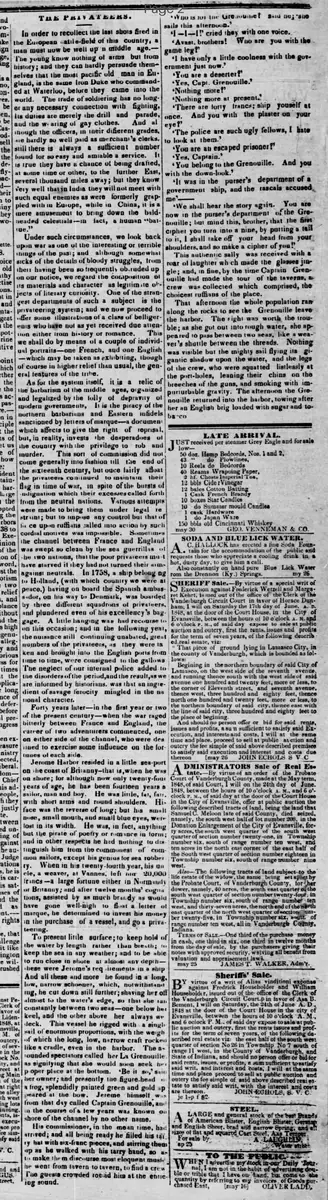
THE PRIVATEERS.
In order to recollect the last shots fired in the European battle-field of this country, a man must now be well up in middle age. The young know nothing of arms but from history; and they can hardly persuade themselves that the most pacific old man in England, is the same Iron Duke who commanded at Waterloo, before they came into the world. The trade of soldiering has no longer any necessary connection with fighting, his duties are merely the drill and parade, and the wearing of gay clothes. And although the officers, in their different grades, are hardly so well paid as merchants clerks, still there is always a sufficient number found for so easy and amiable a service. It is true they have a chance of being drafted, at some time or other, to the further East, several thousand miles away; but they know very well that in India they will not meet with such equal enemies as were formerly grappled with in Europe, while in China, it is a mere amusement to bring down the bald-headed celestials--in fact, a human "bal-rue."
Under such circumstances, we look back upon war as one of the interesting or terrible things of the past; and although somewhat sated of the details of bloody struggles, from their having been so frequently obtruded upon our notice, we regard the composition of its materials and character as legitimate objects of literary curiosity. One of the strangest departments of such a subject is the privateering system; and we now proceed to offer some illustrations of a class of belligerents who have not as yet received due attention either from history or romance. This we shall do by means of a couple of individual portraits--one French, and one English -which may be taken as exhibiting, though of course in higher relief than usual, the general features of the tribe.
As for the system itself, it is a relic of the barbarism of the middle ages, organized and legalized by the folly of depravity of modern governments. It is the piracy of the northern barbarians and Eastern infidels sanctioned by letters of marque--a document which affects to give the right of reprisal, but, in reality, invests the desperadoes of the country with the privilege to rob and murder. This sort of commission did not come generally into fashion till the end of the sixteenth century, but once fairly afloat the privateers continued to maintain their flag in time of war, in spite of the bursts of indignation which their excesses called forth from the neutral nations. Various attempts were made to bring them under legal restraint; but to impose any control but that of force upon ruffians called into action by such cordial motives was impossible. Sometimes the channel between France and England was swept so clean by the sea guerrillas of the two nations, that the poor privateers must have starved if they had not turned their arms against neutrals. In 1758, a ship belonging to Holland, (with which country we were at peace,) having on board the Spanish ambassador, on his way to Denmark, was boarded by three different squadrons of privateers, and plundered even of his excellency's baggage. A little hanging was had recourse to on this occasion; and in the following year, the nuisance still continuing unabated, great numbers of the privateers, as they were taken and brought into the English ports from time to time, were consigned to the gallows The neglect of our internal police added to the disorders of the period, and the result, as we are informed by historians, was that an ingredient of savage ferocity mingled in the national character.
Forty years later--in the first year or two of the present century--when the war raged bitterly between France and England, the career of two adventurers commenced, one on either side of the channel, who were destined to exercise some influence on the fortunes of each side.
Jerome Harbor resided in a little sea-port on the coast of Brittany--that is, when he was on shore; for although now only twenty-four years of age, he had been fourteen years a sailor, man and boy. He was little, fat, fair, with short arms and round shoulders. His face was the reverse of long; but his small nose, small mouth, and small blue eyes, were lost in its width. He was, in fact, anything but the pirate of poetry or romance in form; and in other respects he had nothing to distinguish him from the commonest of common sailors, except his genius for sea robbery.
When in his twenty-fourth year, his uncle, a weaver, at Vannes, left him 20,000 francs--a large fortune either in Normandy or Brittany; and after twelve months' cogitations, assisted by as much brandy as would have gone well-nigh to fit out a letter of marque, he determined to invest his money in the purchase of a vessel, and go a privateering.
To present little surface; to keep hold of the water by length rather than breadth; to keep the sea in any weather; and to be able to run close in shore at almost any depth--these were Jerome's requirements in a ship And all these and more he found in a long, low, narrow schooner, which, notwithstanding, he cut down still further; shaving her off almost to the water's edge, so that she ran constantly between two seas--one below her keel, and the other above her always wet deck. This vessel he rigged with a single sail of enormous proportions, with the weight of which the long, low, narrow craft rocked like a cradle, even in the harbor. The astonished spectators called her La Grenouille as signifying that she would soon seek her proper place at the bottom. Be it so, said her owner; and presently the figure-head a frog, splendidly painted green and gold appeared at the bow. Jerome himself was from that day called Captain Grenouille, and in the course of a few years was known on shore of the channel by no other name.
His commissioner, in the meantime, had arrived; and all being ready he filled his tarry hat with six-franc pieces, and stirring them up as he walked with his tarry hand, so as to make them discourse most eloquent music he went from tavern to tavern, to find a crew The guests crowded round him at the jingling sound.
Who is for the Grenouille? said he; who sails this afternoon?
Hurrah! cried they with one voice.
Avast, brothers! Who are you with the game leg?
I have only a little coolness with the government just now.
You are a deserter?
Yes, Capt. Grenouille.
Nothing more?
Nothing more at present.
There are forty francs; ship yourself at once. And you with the plaster on your eye?
The police are such ugly fellows, I hate to look at them.
You are an escaped prisoner?
Yes, Captain.
You belong to the Grenouille. And you with the down-look.
It was in the purser's department of a government ship, and the rascals accused me?
We shall hear the story again. You are now in the purser's department of the Grenouille; but mind this, brother, that the first cipher you turn into a nine, by putting a tail to it, I shall take off your head from your shoulders, and so make a cipher of you!
This authentic sally was received with roar of laughter which made the glasses jingle; and, in fine, by the time Captain Grenouille had made the tour of the taverns, a crew was collected which comprised, the choicest ruffians of the place.
That afternoon the whole population ran along the rocks to see the Grenouille leave the harbor. The sight was worth the trouble; as she got out into rough water, she appeared to pass between two seas, like a weaver's shuttle between the threads. Nothing was visible but the mighty sail flying its gigantic shadow upon the water, and the logs of the crew, who were squatted listlessly at the port-holes, leaning their chins on the breeches of the guns, and smoking with imperturbable gravity. The afternoon the Grenouille returned into the harbor, towing after her an English brig loaded with sugar and tobacco.
In order to recollect the last shots fired in the European battle-field of this country, a man must now be well up in middle age. The young know nothing of arms but from history; and they can hardly persuade themselves that the most pacific old man in England, is the same Iron Duke who commanded at Waterloo, before they came into the world. The trade of soldiering has no longer any necessary connection with fighting, his duties are merely the drill and parade, and the wearing of gay clothes. And although the officers, in their different grades, are hardly so well paid as merchants clerks, still there is always a sufficient number found for so easy and amiable a service. It is true they have a chance of being drafted, at some time or other, to the further East, several thousand miles away; but they know very well that in India they will not meet with such equal enemies as were formerly grappled with in Europe, while in China, it is a mere amusement to bring down the bald-headed celestials--in fact, a human "bal-rue."
Under such circumstances, we look back upon war as one of the interesting or terrible things of the past; and although somewhat sated of the details of bloody struggles, from their having been so frequently obtruded upon our notice, we regard the composition of its materials and character as legitimate objects of literary curiosity. One of the strangest departments of such a subject is the privateering system; and we now proceed to offer some illustrations of a class of belligerents who have not as yet received due attention either from history or romance. This we shall do by means of a couple of individual portraits--one French, and one English -which may be taken as exhibiting, though of course in higher relief than usual, the general features of the tribe.
As for the system itself, it is a relic of the barbarism of the middle ages, organized and legalized by the folly of depravity of modern governments. It is the piracy of the northern barbarians and Eastern infidels sanctioned by letters of marque--a document which affects to give the right of reprisal, but, in reality, invests the desperadoes of the country with the privilege to rob and murder. This sort of commission did not come generally into fashion till the end of the sixteenth century, but once fairly afloat the privateers continued to maintain their flag in time of war, in spite of the bursts of indignation which their excesses called forth from the neutral nations. Various attempts were made to bring them under legal restraint; but to impose any control but that of force upon ruffians called into action by such cordial motives was impossible. Sometimes the channel between France and England was swept so clean by the sea guerrillas of the two nations, that the poor privateers must have starved if they had not turned their arms against neutrals. In 1758, a ship belonging to Holland, (with which country we were at peace,) having on board the Spanish ambassador, on his way to Denmark, was boarded by three different squadrons of privateers, and plundered even of his excellency's baggage. A little hanging was had recourse to on this occasion; and in the following year, the nuisance still continuing unabated, great numbers of the privateers, as they were taken and brought into the English ports from time to time, were consigned to the gallows The neglect of our internal police added to the disorders of the period, and the result, as we are informed by historians, was that an ingredient of savage ferocity mingled in the national character.
Forty years later--in the first year or two of the present century--when the war raged bitterly between France and England, the career of two adventurers commenced, one on either side of the channel, who were destined to exercise some influence on the fortunes of each side.
Jerome Harbor resided in a little sea-port on the coast of Brittany--that is, when he was on shore; for although now only twenty-four years of age, he had been fourteen years a sailor, man and boy. He was little, fat, fair, with short arms and round shoulders. His face was the reverse of long; but his small nose, small mouth, and small blue eyes, were lost in its width. He was, in fact, anything but the pirate of poetry or romance in form; and in other respects he had nothing to distinguish him from the commonest of common sailors, except his genius for sea robbery.
When in his twenty-fourth year, his uncle, a weaver, at Vannes, left him 20,000 francs--a large fortune either in Normandy or Brittany; and after twelve months' cogitations, assisted by as much brandy as would have gone well-nigh to fit out a letter of marque, he determined to invest his money in the purchase of a vessel, and go a privateering.
To present little surface; to keep hold of the water by length rather than breadth; to keep the sea in any weather; and to be able to run close in shore at almost any depth--these were Jerome's requirements in a ship And all these and more he found in a long, low, narrow schooner, which, notwithstanding, he cut down still further; shaving her off almost to the water's edge, so that she ran constantly between two seas--one below her keel, and the other above her always wet deck. This vessel he rigged with a single sail of enormous proportions, with the weight of which the long, low, narrow craft rocked like a cradle, even in the harbor. The astonished spectators called her La Grenouille as signifying that she would soon seek her proper place at the bottom. Be it so, said her owner; and presently the figure-head a frog, splendidly painted green and gold appeared at the bow. Jerome himself was from that day called Captain Grenouille, and in the course of a few years was known on shore of the channel by no other name.
His commissioner, in the meantime, had arrived; and all being ready he filled his tarry hat with six-franc pieces, and stirring them up as he walked with his tarry hand, so as to make them discourse most eloquent music he went from tavern to tavern, to find a crew The guests crowded round him at the jingling sound.
Who is for the Grenouille? said he; who sails this afternoon?
Hurrah! cried they with one voice.
Avast, brothers! Who are you with the game leg?
I have only a little coolness with the government just now.
You are a deserter?
Yes, Capt. Grenouille.
Nothing more?
Nothing more at present.
There are forty francs; ship yourself at once. And you with the plaster on your eye?
The police are such ugly fellows, I hate to look at them.
You are an escaped prisoner?
Yes, Captain.
You belong to the Grenouille. And you with the down-look.
It was in the purser's department of a government ship, and the rascals accused me?
We shall hear the story again. You are now in the purser's department of the Grenouille; but mind this, brother, that the first cipher you turn into a nine, by putting a tail to it, I shall take off your head from your shoulders, and so make a cipher of you!
This authentic sally was received with roar of laughter which made the glasses jingle; and, in fine, by the time Captain Grenouille had made the tour of the taverns, a crew was collected which comprised, the choicest ruffians of the place.
That afternoon the whole population ran along the rocks to see the Grenouille leave the harbor. The sight was worth the trouble; as she got out into rough water, she appeared to pass between two seas, like a weaver's shuttle between the threads. Nothing was visible but the mighty sail flying its gigantic shadow upon the water, and the logs of the crew, who were squatted listlessly at the port-holes, leaning their chins on the breeches of the guns, and smoking with imperturbable gravity. The afternoon the Grenouille returned into the harbor, towing after her an English brig loaded with sugar and tobacco.
What sub-type of article is it?
Essay
Prose Fiction
What themes does it cover?
War Peace
Political
What keywords are associated?
Privateers
Grenouille
War
France
England
Piracy
Schooner
Literary Details
Title
The Privateers.
Subject
Illustrations Of Privateers Through Individual Portraits
Form / Style
Narrative Essay With Fictional Biography
Key Lines
Who Is For The Grenouille? Said He; Who Sails This Afternoon?
Hurrah! Cried They With One Voice.
This Authentic Sally Was Received With Roar Of Laughter Which Made The Glasses Jingle; And, In Fine, By The Time Captain Grenouille Had Made The Tour Of The Taverns, A Crew Was Collected Which Comprised, The Choicest Ruffians Of The Place.