Thank you for visiting SNEWPapers!
Sign up free
Story
March 20, 1897
The Ketchum Keystone
Ketchum, Alturas County, Blaine County, Idaho
What is this article about?
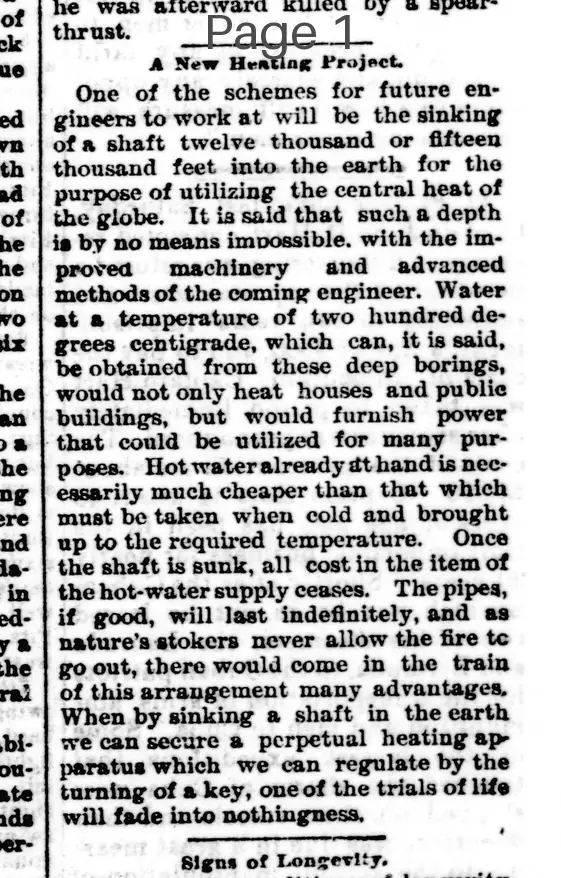
A proposed engineering project to sink a shaft 12,000-15,000 feet into the Earth to access central heat, providing hot water at 200°C for heating buildings and generating power, offering perpetual and cost-effective supply.
Clipping
OCR Quality
98%
Excellent
Full Text
A New Heating Project.
One of the schemes for future engineers to work at will be the sinking
of a shaft twelve thousand or fifteen
thousand feet into the earth for the
purpose of utilizing the central heat of
the globe. It is said that such a depth
is by no means impossible, with the improved machinery and advanced
methods of the coming engineer. Water
at a temperature of two hundred degrees centigrade, which can, it is said,
be obtained from these deep borings,
would not only heat houses and public
buildings, but would furnish power
that could be utilized for many purposes. Hot water already at hand is necessarily much cheaper than that which
must be taken when cold and brought
up to the required temperature. Once
the shaft is sunk, all cost in the item of
the hot-water supply ceases. The pipes,
if good, will last indefinitely, and as
nature's stokers never allow the fire to
go out, there would come in the train
of this arrangement many advantages.
When by sinking a shaft in the earth
we can secure a perpetual heating apparatus which we can regulate by the
turning of a key, one of the trials of life
will fade into nothingness.
One of the schemes for future engineers to work at will be the sinking
of a shaft twelve thousand or fifteen
thousand feet into the earth for the
purpose of utilizing the central heat of
the globe. It is said that such a depth
is by no means impossible, with the improved machinery and advanced
methods of the coming engineer. Water
at a temperature of two hundred degrees centigrade, which can, it is said,
be obtained from these deep borings,
would not only heat houses and public
buildings, but would furnish power
that could be utilized for many purposes. Hot water already at hand is necessarily much cheaper than that which
must be taken when cold and brought
up to the required temperature. Once
the shaft is sunk, all cost in the item of
the hot-water supply ceases. The pipes,
if good, will last indefinitely, and as
nature's stokers never allow the fire to
go out, there would come in the train
of this arrangement many advantages.
When by sinking a shaft in the earth
we can secure a perpetual heating apparatus which we can regulate by the
turning of a key, one of the trials of life
will fade into nothingness.
What sub-type of article is it?
Curiosity
Extraordinary Event
What themes does it cover?
Nature
Triumph
What keywords are associated?
Geothermal Heating
Deep Earth Shaft
Central Heat Utilization
Engineering Project
Hot Water Power
Where did it happen?
Within The Earth
Story Details
Location
Within The Earth
Event Date
Future
Story Details
Future engineers plan to sink a deep shaft to utilize Earth's central heat for perpetual hot water supply to heat buildings and generate power, eliminating ongoing costs and providing reliable regulation.