Thank you for visiting SNEWPapers!
Sign up free
The Virginia Gazette
Richmond, Williamsburg, Richmond County, Virginia
What is this article about?
A gentleman from Detroit writes to a friend in Quebec in September 1777, detailing Lieutenant Governor Henry Hamilton's tyrannical rule, including illegal persecutions, unjust treatments, and unauthorized executions of Joseph Hecker and Jean Contancinau, urging exposure in England to end the oppression.
Merged-components note: Continuation of a signed letter complaining about the Lieutenant Governor's actions, spanning across pages; relabeled from domestic_news to letter_to_editor as it fits reader letter format.
Clippings
1 of 2
OCR Quality
Full Text
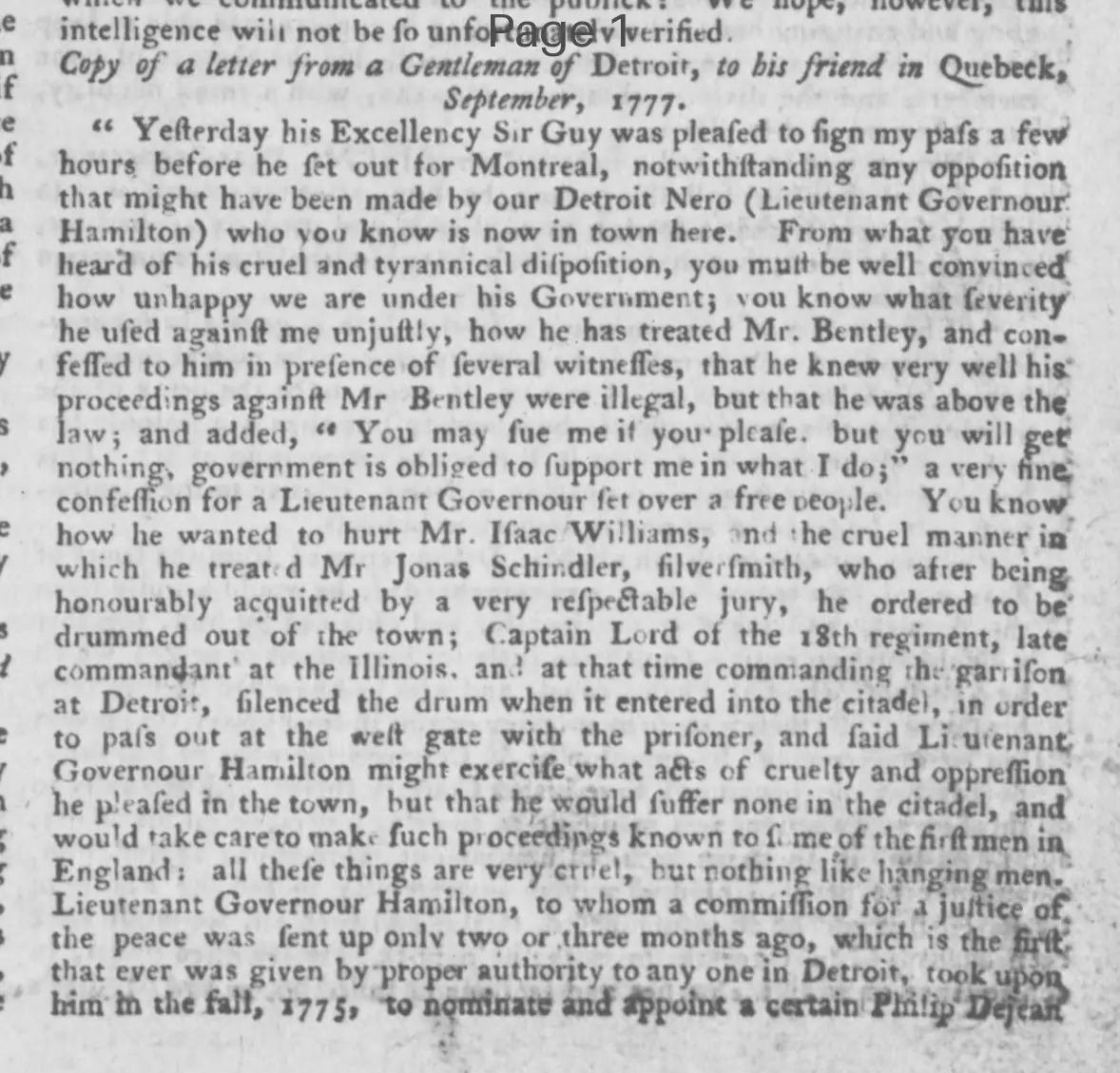
Yesterday his Excellency Sir Guy was pleased to sign my pass a few hours before he set out for Montreal, notwithstanding any opposition that might have been made by our Detroit Nero (Lieutenant Governour Hamilton) who you know is now in town here. From what you have heard of his cruel and tyrannical disposition, you must be well convinced how unhappy we are under his Government; you know what severity he used against me unjustly, how he has treated Mr. Bentley, and confessed to him in presence of several witnesses, that he knew very well his proceedings against Mr Bentley were illegal, but that he was above the law; and added, "You may sue me if you please. but you will get nothing, government is obliged to support me in what I do;" a very fine confession for a Lieutenant Governour set over a free people. You know how he wanted to hurt Mr. Isaac Williams, and the cruel manner in which he treated Mr Jonas Schindler, silversmith, who after being honourably acquitted by a very respectable jury, he ordered to be drummed out of the town; Captain Lord of the 18th regiment, late commandant at the Illinois. and at that time commanding the garrison at Detroit, silenced the drum when it entered into the citadel, in order to pass out at the west gate with the prisoner, and said Lieutenant Governour Hamilton might exercise what acts of cruelty and oppression he pleased in the town, but that he would suffer none in the citadel, and would take care to make such proceedings known to one of the first men in England: all these things are very cruel, but nothing like hanging men.
Lieutenant Governour Hamilton, to whom a commission for a justice of the peace was sent up only two or three months ago, which is the first that ever was given by proper authority to any one in Detroit, took upon him in the fall, 1775, to nominate and appoint a certain Philip Dejean
(who run away from hence some years ago, and fled to Detroit to screen himself from his creditors) to act as judge on the trial of Joseph Hecker (formerly a furrier in this town) for having killed his brother in law, Monsieur Moran, in a quarrel; he was found guilty, and judge Dejean passed sentence of death upon him, which was approved of by Governor Hamilton, and put in execution a few days after under a guard of soldiers, who surrounded the gallows whilst he was hanged. In the spring, 1776, they condemned and hanged also Jean Contancinau, a Canadian, for having stolen some money, &c. from his master, and being concerned with a negro wench in attempting to set fire to his master's house. You will readily allow that these criminals deserved death; but how dared Lieutenant Governor Hamilton, and an infamous judge of his own making, take upon them to try them, and execute them without authority? I mentioned all the above circumstances to judge Livius, and to Mr. Monk (the Attorney General) they were much surprised at such rash and unwarranted proceedings, and said Lieutenant Governor Hamilton and his judge, Philip Dejean, were both liable to be prosecuted for murder. I beg you may make those things known in England, that we may be freed from usurpation, tyranny, and oppression.
"I return you my most hearty and sincere thanks, for your very polite and obliging behaviour to me since I first came to this town, and your interesting yourself in such a friendly manner in my behalf with his Excellency Sir Guy Carleton, whereof I beg you may be assured I shall always retain the most grateful sense; and am, with much truth and sincerity, dear Sir, your much obliged, and most humble servant."
March 31.
What sub-type of article is it?
What themes does it cover?
What keywords are associated?
What entities or persons were involved?
Letter to Editor Details
Author
A Gentleman Of Detroit
Recipient
His Friend In Quebeck
Main Argument
lieutenant governor hamilton's rule in detroit is tyrannical and illegal, involving unjust persecutions and unauthorized executions; these abuses must be exposed in england to end the oppression.
Notable Details