Thank you for visiting SNEWPapers!
Sign up free
Story
August 15, 1872
New Orleans Republican
New Orleans, Orleans County, Louisiana
What is this article about?
In a 1872 speech at New Orleans' Republican Convention, Mr. Bell urges colored delegates to ally with white Liberals, endorse Greeley-Brown ticket over Grant-Wilson, to secure rights and avoid electoral defeat by a unified white opposition. (214 chars)
Clipping
OCR Quality
95%
Excellent
Full Text
SPEECH OF BELL.
Delivered Before the Regular Republican Convention on the Resolution Indorsing Greeley and Brown and the Liberal State Ticket, New Orleans, August 12, 1872.
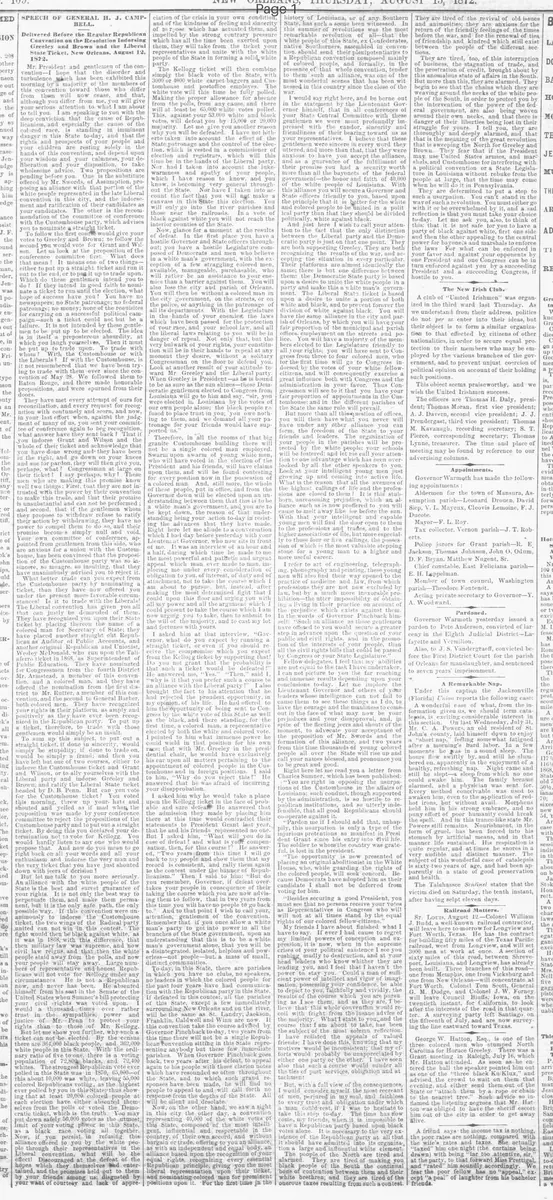
Mr. President and gentlemen of the convention—I hope that the disorder and turbulence which has been exhibited this morning by a majority of the members of this convention toward those who differ from them will now cease, and that, although you differ from me, you will give your serious attention to what I am about to tell you. I am speaking to you with the deep conviction that the cause of Republicanism, and especially the cause of the colored race, is standing in imminent danger in this State to-day, and that the rights and prospects of your people and your children are resting solely in the hands of this convention, and depend upon your wisdom and your calmness, your deliberation and your disposition, to take wholesome advice. Two propositions are pending before you. One is the substitute offered by Mr. Swords, of Assumption, proposing an alliance with that portion of the white people represented in the late Liberal convention in this city, and the indorsement and ratification of their candidates as your candidates. The other is the recommendation of the committee of conference with the Customhouse party, which advises you to nominate a straight ticket. To follow the first course would give your votes to Greeley and Brown; to follow the second you would vote for Grant and Wilson. Let us look at the proposition of the conference committee first. What does that mean? It means one of two things—either to put up a straight ticket and run it out to the end, or to put it up to trade upon. Which do these gentlemen intend you to do? If they intend in good faith to nominate a ticket to run until the election, what hope of success have you? You have no newspapers; no State patronage; no federal patronage; no money; none of the requisites for carrying on a successful political campaign—such a ticket could not but be a failure. It is not intended by these gentlemen to be put up to be elected. The idea is in itself a preposterous absurdity, at which you laugh yourselves. Then it must be put up to trade upon. To trade with whom? With the Customhouse or with the Liberals? If with the Customhouse, is it not remembered that we have been trying to trade with them ever since the convention of May 28. We followed them to Baton Rouge, and there made honorable propositions, and were spurned from their doors. They have met every attempt of ours for reconciliation, and every request for recognition with contumely and scorn, and now, in your last effort when, against the judgment of many of us, you sent your committee of conference again to beg recognition, what answer have they sent back? That if you indorse Grant and Wilson and the whole of their ticket and acknowledge that you have done wrong and they have been in the right, and go down on your knees and sue for pardon, they will then give you, perhaps, what? Congressman at large on their ticket? I say perhaps, why? These men who are making this promise know well two things: First, that they are not intrusted with the power by their convention to make this trade, and that their promise is unsubstantial and cannot be performed; and second, that if the gentlemen whom they propose to withdraw refuse to ratify their action by withdrawing, they have no power to compel them to do so, and their promise becomes simply null and void. Your own committee of conference, appointed from gentlemen from this side, who are anxious for a union with the Customhouse, has been convinced that the proposition of the Customhouse party was so insincere, so meagre, so insulting, that they have unanimously advised you to reject it. What better trade can you expect from the Customhouse party by nominating a ticket, than they have now offered you under the present more favorable circumstances? Is it to trade with the Liberals? The Liberal convention has given you all that can justly be demanded of them. They have recognized you upon their State ticket by placing thereon the name of a colored man for Secretary of State; they have placed another straight out Republican as Auditor of Public Accounts, and another original Republican and Unionist, Wesley McDonald, who run upon the Talfierro ticket in 1868, as Superintendent of Public Education. They have nominated for Congressmen from the fourth District Mr. Armstead, a member of this convention, and a colored man, and they have offered the nomination from the first district to Mr. Rutter, a member of this convention, and the second to General Barber, both colored men. They have recognized your rights in their platform as amply and positively as they have ever been recognized in the Republican party. To put up a ticket, therefore, to trade with those gentlemen would simply be an insult. To sum up this subject, to put out a straight ticket, if done in sincerity, would simply be stupidity; if done to trade on, would be simply a fraud; and then you have left but one of two courses, either to indorse the Customhouse ticket and (Grant and Wilson), or to ally yourselves with the Liberal party and indorse Greeley and Brown, and ratify the Liberal State ticket headed by D. B. Penn. But can you vote for the Customhouse ticket? You voted this morning, threw up your hats and shouted and yelled as if mad when the proposition was made by your conference committee to reject the propositions of the Customhouse party and to put out a straight ticket. By doing this you declared your determination not to vote for Kellogg. You would hardly listen to any one who would propose that. And now do you mean to go right back on all your words and all your enthusiasm and indorse the very man and the very ticket that you have just shouted down with jeers of derision? But let me talk to you more seriously. An alliance with the white people of the State is the best and surest guarantee of your rights. It is not only the best way to perpetuate them, and make them permanent, but it is the only safe path, the only possible way. If this convention were unanimously to indorse the Customhouse ticket, the two wings of the Radical party united cannot win in this contest. The fight would then be black against white, as it was in 1868, with this difference, that then military law was supreme, and now civil law reigns, and that then the white people stayed away from the polls, and now your people will stay away. Large numbers of representative and honest Republicans will not vote for Kellogg under any circumstances. He is not a Republican now, and never has been. He absented himself from his seat in the Senate of the United States when Sumner's bill protecting your civil rights was voted upon. I would a thousand times over rather trust in the sympathies, power and justice of Mr. Penn to protect your rights than to those of Mr. Kellogg. But let me show you further, why such a ticket cannot be elected. By the census there are 364,000 black people, and 362,000 white people in this State. With the ordinary ratio of five to one, there is a voting population of 72,800 blacks, and 72,400 whites. The strongest Republican vote ever polled in this State was in 1870, 65,000—of this about 10,000 was white, leaving 55,000 colored Republicans voting, as the highest ever polled by you in this State; thus showing that at least 20,000 colored people at each election have either absented themselves from the polls or voted the Democratic ticket, which is the truth. You may put down safely 50,000 votes as the utmost limit of your voting power in this State, as a black race voting all together. Now, if you persist in refusing this alliance offered to you by the white people through their representatives in the Liberal convention, what will be the effect! Discouraged at the defeat of the hopes which they themselves had entertained, and the promises held out to them by your friends among us; disgusted by your want of courtesy and lack of appreciation of the crisis in your own condition and of the kindness of feeling and sincerity of purpose which has actuated them, and impelled by the strong contrary pressure which has all the time been exerted upon them, they will take from the ticket your representatives and unite with the white people of the State in forming a solid white party. The Kellogg ticket will then combine simply the black vote of the State, with 3000 or 4000 white carpet baggers and Customhouse and postoffice employes. The white vote will this time be fully polled. Making the proper allowance for absence from the polls, from any cause, and there will at least be 60,000 white votes polled. This, against your 50,000 white and black votes, will defeat you by 15,000 or 20,000 majority. Let me give you another reason why you will be defeated. I have not hitherto taken into account the effect of the State patronage and the control of the election, which is vested in a commissioner of election and registrars, which will this time be in the hands of the Liberal party. Nor had I taken into account the lukewarmness and apathy of your people, which I have reason to know, and you know, is becoming very general throughout the State. Nor have I taken into account the fact that you will not make a canvass in this State this election. You will only go into the river parishes and those near the railroads. In a vote of black against white you will not reach the interior counties of the State. Now, glance for a moment at the results of defeat. In the first place you have a hostile Governor and State officers throughout; you have a hostile Legislature composed of Democrats and men who believe in a white man's government, with the exception of a few straggling colored men, available, manageable, purchasable, who will rather be an assistance to your enemies than a barrier against them. You will also lose the city and parish of Orleans. You will then be without a colored man in the city government, on the streets, or on the police, or anything in the patronage of all its departments. With the Legislature in the hands of your enemies, the laws which have been passed for the protection of your race, and your school law, and all the liberal laws relating to you will be in danger of repeal. Not only that, but the very bulwark of your rights, your constitution will be in their hands to repeal at any moment they desire, without a solitary Congressman on the floor to defend you. Look at another result of your attitude toward Mr. Greeley and the Liberal party. When Greeley is President—as he is bound to be as sure as the sun shines—these Democratic gentlemen elected to Congress from Louisiana will go to him and say, "sir, you were elected in Louisiana by the votes of our own people alone; the black people refused to place trust in you; you owe nothing to them, and we demand all your patronage for your friends would have supported us." Therefore, in all the rooms of that big granite Customhouse building there will not be a single colored man employed. Swarm upon swarm of young white men, who will have voted in the election of the President and his friends, will have claims upon them, and will be found contesting for every position now in the possession of a colored man. And, still more, the whole of these people, put in office, and from the Governor down will be elected upon an understanding between them that this is to be a white man's government, and you are to be kept down, the reason of that understanding being your action to-day in resisting the advances that they have made. Right here let me allude to a conversation which I had day before yesterday with your Lieutenant Governor, who now sits in front of me. It was an interview of an hour and a half, during which time he made to me the most powerful and pathetic and urgent appeal which man ever made to man, imploring me under every consideration of obligation to you, of interest, of duty and of attachment, not to take the course which I am about to pursue, but, instead, after making the most determined fight that I could upon this floor and urging you with all my power and all the argument which I could present to take the course which I am now urging you to take, then to submit to the will of the majority, and to cast my lot and fortunes with yours. I asked him at that interview, "Governor, what do you expect by running a straight ticket, or even if you should receive the compromise which you expect from the Kellogg ticket by supporting that? Do you not grant that the probability is that such a ticket would be defeated?" He answered me, "Yes." "Then," said I, "why is it that you prefer such a course to an alliance with the Liberal party?" I also brought the fact to his attention that he had rejected the proudest opportunity, in my opinion, of his life. He had offered to him the opportunity of being sent to Congress by the white vote of this State as well as the black, and there standing, for the first time, a colored man, a representative elected by both the white and colored vote. I pointed to him what immense power he could wield in that position for his own race; that with Mr. Greeley in the presidential chair, he would have exclusively his ear upon all matters pertaining to the appointment of colored people in the Customhouse and in foreign positions. I said to him, "Why do you reject this?" He answered that he was afraid of incurring your disapprobation. I asked him why he would take a place upon the Kellogg ticket in the face of probable and sure defeat. He answered that the admission they made by placing him there at this time would contradict their statements to President Grant last year, that he and his friends represented no one. But I asked him, "What will you do in case of defeat? and what is your compensation, then, for this course?" He answered, "Two years from this time I will go back to my people and show them that my record is consistent, and rally them again to the contest under the banner of Republicanism." Then I said to him: "But do you remember, Governor, if defeat overtakes your people in consequence of their taking the course which you are now advising them to follow, that in two years from this time you will have no people to go back to." And to that point I wish to call your attention, gentlemen of the convention. Remember that if you once allow a white man's party to get into power in all the branches of the State government, upon an understanding that this is to be a white man's government alone, that you will be a disintegrated, isolated, helpless and powerless—not people—but a mass of small, distinct communities. To-day, in this State, there are parishes in which you have no clubs, no speakers, no leaders in which the colored people for the past four years have had communication with the Republican party in this State. If defeated in this contest, all the parishes of this State, except a few immediately surrounding New Orleans and on the river, will be the same as St. Landry, Jackson, Franklin, Caldwell and Winn are now. If this convention take the course advised by Governor Pinchback to-day, two years from this time there will not be a single Republican convention sitting in this State representing anybody but these few immediate parishes. When Governor Pinchback goes back, two years after his defeat, to appeal again to his people with those clarion notes which have resounded so often throughout the State, and to which such grand responses have been made, he will find no people to appeal to and will call forth no response from the depths of the State. All will be silent and desolate. Now, on the other hand, we saw a sight in this city the other day, a convention representing 40,000 of the white votes of this State, composed of the most intelligent, influential and respectable in the country, of their own accord, and without bargain or trade, offering to you an alliance, as with an independent and equal body, an alliance based upon the recognition of your equal rights, recognizing every essential Republican principle, giving you the most liberal representation upon their ticket, and nominating colored men for prominent positions upon it. For the first time in the history of Louisiana, or of any Southern State, has such a scene been witnessed. In this summer of revolutions was the most remarkable revolution of all—that the white people of this State, ex Confederates, native Southerners, assembled in convention, should send their plenipotentiaries to a Republican convention composed mainly of colored people, and formally, in the presence of that whole convention, tender to them such an alliance, was one of the most wonderful scenes that has been witnessed in this country since the close of the war. I would say right here, and be borne out in the statement by the Lieutenant Governor himself, that in all conferences of your State Central Committee with these gentlemen we were most profoundly impressed with the candor, sincerity and friendliness of their bearing toward us as your representatives. I believe that these gentlemen were sincere in every word they uttered, and more than that, that they were anxious to have you accept the alliance, and as a guarantee of the fulfillment of their promise you had a security worth more than all the bayonets of the federal government—the honor and faith of 40,000 of the white people of Louisiana. With this alliance you will secure a Governor and State officers friendly to you, based upon the principle that it is better for the white and colored people to be united in a political party than that they should be divided politically, white against black. And just here I wish to call your attention to the fact that the only distinction between the Liberal party and the Democratic party is just on that one point. They are both supporting Greeley. They are both recognizing the results of the war, and accepting the situation in every particular. Their platforms are almost identically the same; there is but one difference between them: the Democratic State party is based upon a desire to unite the white people in a party and make this a white man's government. The Liberal State ticket is based upon a desire to unite a portion of both white and black, and to prevent forever the division of white against black. You will have the same alliance in the city and parish of Orleans, by which you will have your fair proportion of the municipal and parish offices, employment on the streets and police. You will have a majority of the members elected to the Legislature friendly to all your rights; you will have sent to Congress from three to four colored men, who for the first time will go to Congress indorsed by the votes of your white fellow-citizens, and will consequently exercise a great influence both with Congress and the administration in your favor. Thus Congressmen will see to it that you have your fair proportion of appointments in the Customhouse; and in the different parishes of the State the same rule will prevail. But more than all this question of offices, you will then have what you never will have under any other alliance you can form, the freedom of the State to your friends and leaders. The organization of your people in the parishes will be protected by the white people; your schools will be fostered; and let me call your attention to one advantage which has been overlooked by all the other speakers to you. Look at your intelligent young men just growing up and coming into active life. What is the reason that all the avenues of the highest callings of life and the professions are closed to them? It is this stubborn, unreasoning prejudice, which an alliance such as is now proffered to you will cause to melt away like ice before the sun. With that your intelligent and capable young men will find the door open to them to the professions and trades, and to the higher associations of life, but more especially to those four or five callings, the possession of which is the most valuable stepping stone for a young man to a higher and more useful career. I refer to art of engineering, telegraphing, phonography and printing, these young men will also find their way opened to the practice of medicine and law, from which professions they are not now excluded by law, but by a much more inexorable prohibition—the utter impossibility of obtaining a living in their practice on account of the prejudice which exists against them. In the words of Governor Pinchback himself: "Such an alliance as those gentlemen have offered to you would secure a greater step in advance upon the question of your public and civil rights, and in the promotion of the interests of your people, than all the civil rights bills that could be passed by Congress or your State Legislature." Fellow-delegates, I feel that my abilities are not equal to the task I have undertaken. I cannot picture to you the far reaching and immense results depending upon your conclusions to-day. Let me implore the Lieutenant Governor and others of your leaders whose intelligence cannot fail to cause them to see these things as I do, to have the courage and the manliness to come out in the face of what may now be your prejudices and your disapproval, and, in spite of the fleeting jeers and shouts of the moment, to advocate your acceptance of the proposition of Mr. Swords and the formation of this alliance, and two years from this time thousands of young colored people all over the State will rise up and call your names blessed, and pronounce you to be great and good. Right here let me read you a letter from Charles Sumner, which has been published: "You are right in opposing the usurpations of the Customhouse in the affairs of Louisiana; such conduct, though supported by the administration, is so hostile to republican institutions, and so utterly indefensible, that all good Republicans should co-operate against it. Pardon me if I should add that, unhappily, this usurpation is only a type of the injurious pretentions so manifest in President Grant since his entry into civil life. The soldier to whom the country was grateful, is lost in the president. "The opportunity is now presented of placing an original abolitionist in the White House, who, while guarding the rights of the colored people, will seek concord. Because Democrats have adopted him as their candidate I shall not be deterred from voting for him. "Besides securing a good President, you must see that no persons receive your votes as Representatives in Congress who will not at all times stand by the equal rights of our colored fellow-citizens." My friends I have about finished what I have to say. If ever I had cause to regret my limited powers of conception and expression, it is now, when in the supreme crises of your political existence I see you rushing madly to destruction, and at your head leaders who know whither they are leading you, and I feel that I haven't the power to stay you. Could a man of sufficient power of intellect and vigor of imagination, possessing your confidence, be able to depict to you, faithfully and vividly, the results of the course which you are pursuing as I see them, and as they are, I believe that this whole convention would recoil with fright from the insane advice of the majority. What I state to you, and the course that I am about to take, has been the subject of the most solemn reflection. I have resisted the appeals of valued friends; I have done this, knowing that my motives would be misconstrued; that my efforts would probably be unappreciated by either one party or the other. I have seen also that such a course would sunder all the ties of past services, obligation and attachment. But, with a full view of the consequences, I would consider myself the most recreant of men, perjured in my soul, and faithless to every trust and obligation under which a man could rest, if I was to hesitate to take this step to-day. The time has now come, my friends, when it is impossible to have a Republican party based upon black votes alone. It is necessary to the very existence of the Republican party at all that it should have admitted into its organization a large and influential white element. The people of the North are tired and alarmed. They are tired of making you black people of the South the continual bone of contention between them and their white brethren; and they are tired of the onerous taxes resulting from such a contest. They are tired of the revival of old issues and animosities; they are anxious for the return of the friendly feelings of the times before the war, and for the renewal of ties of friendship and kindred which still exist between the people of the different sections. They are tired, too, of this interruption of business, the stagnation of trade, and the prostration of credit, brought about by this anomalous state of affairs in the South. But more than this, they are alarmed. They begin to see that the chains which they are weaving around the necks of the white people of the South, in order to protect you by the intervention of the power of the federal government, are also being woven around their own necks, and that there is danger of their liberties being lost in their struggle for yours. I tell you, they are thoroughly and deeply alarmed, and that is the meaning of the great revolution that is sweeping the North for Greeley and Brown. They fear that if the President may use United States armies, and marshals, and Customhouse for interfering with a political convention or a State Legislature in Louisiana without rebuke from the people at large, that the time may come when he will do it in Pennsylvania. They are determined to put a stop to such a usurpation. You can't stand in the way of such a revolution. You must either go with it or be overwhelmed by it, and a sad reflection is that you must take your choice to-day. Let me ask you, also, to think of this: that it is not safe for you to have a party of black against white, first one side and then the other appealing to the central power for bayonets and marshals to enforce the laws. For what can be enforced in your favor and against your opponents by one President and one Congress can be in turn enforced against you by a succeeding President and a succeeding Congress, if hostile to you.
Delivered Before the Regular Republican Convention on the Resolution Indorsing Greeley and Brown and the Liberal State Ticket, New Orleans, August 12, 1872.
Mr. President and gentlemen of the convention—I hope that the disorder and turbulence which has been exhibited this morning by a majority of the members of this convention toward those who differ from them will now cease, and that, although you differ from me, you will give your serious attention to what I am about to tell you. I am speaking to you with the deep conviction that the cause of Republicanism, and especially the cause of the colored race, is standing in imminent danger in this State to-day, and that the rights and prospects of your people and your children are resting solely in the hands of this convention, and depend upon your wisdom and your calmness, your deliberation and your disposition, to take wholesome advice. Two propositions are pending before you. One is the substitute offered by Mr. Swords, of Assumption, proposing an alliance with that portion of the white people represented in the late Liberal convention in this city, and the indorsement and ratification of their candidates as your candidates. The other is the recommendation of the committee of conference with the Customhouse party, which advises you to nominate a straight ticket. To follow the first course would give your votes to Greeley and Brown; to follow the second you would vote for Grant and Wilson. Let us look at the proposition of the conference committee first. What does that mean? It means one of two things—either to put up a straight ticket and run it out to the end, or to put it up to trade upon. Which do these gentlemen intend you to do? If they intend in good faith to nominate a ticket to run until the election, what hope of success have you? You have no newspapers; no State patronage; no federal patronage; no money; none of the requisites for carrying on a successful political campaign—such a ticket could not but be a failure. It is not intended by these gentlemen to be put up to be elected. The idea is in itself a preposterous absurdity, at which you laugh yourselves. Then it must be put up to trade upon. To trade with whom? With the Customhouse or with the Liberals? If with the Customhouse, is it not remembered that we have been trying to trade with them ever since the convention of May 28. We followed them to Baton Rouge, and there made honorable propositions, and were spurned from their doors. They have met every attempt of ours for reconciliation, and every request for recognition with contumely and scorn, and now, in your last effort when, against the judgment of many of us, you sent your committee of conference again to beg recognition, what answer have they sent back? That if you indorse Grant and Wilson and the whole of their ticket and acknowledge that you have done wrong and they have been in the right, and go down on your knees and sue for pardon, they will then give you, perhaps, what? Congressman at large on their ticket? I say perhaps, why? These men who are making this promise know well two things: First, that they are not intrusted with the power by their convention to make this trade, and that their promise is unsubstantial and cannot be performed; and second, that if the gentlemen whom they propose to withdraw refuse to ratify their action by withdrawing, they have no power to compel them to do so, and their promise becomes simply null and void. Your own committee of conference, appointed from gentlemen from this side, who are anxious for a union with the Customhouse, has been convinced that the proposition of the Customhouse party was so insincere, so meagre, so insulting, that they have unanimously advised you to reject it. What better trade can you expect from the Customhouse party by nominating a ticket, than they have now offered you under the present more favorable circumstances? Is it to trade with the Liberals? The Liberal convention has given you all that can justly be demanded of them. They have recognized you upon their State ticket by placing thereon the name of a colored man for Secretary of State; they have placed another straight out Republican as Auditor of Public Accounts, and another original Republican and Unionist, Wesley McDonald, who run upon the Talfierro ticket in 1868, as Superintendent of Public Education. They have nominated for Congressmen from the fourth District Mr. Armstead, a member of this convention, and a colored man, and they have offered the nomination from the first district to Mr. Rutter, a member of this convention, and the second to General Barber, both colored men. They have recognized your rights in their platform as amply and positively as they have ever been recognized in the Republican party. To put up a ticket, therefore, to trade with those gentlemen would simply be an insult. To sum up this subject, to put out a straight ticket, if done in sincerity, would simply be stupidity; if done to trade on, would be simply a fraud; and then you have left but one of two courses, either to indorse the Customhouse ticket and (Grant and Wilson), or to ally yourselves with the Liberal party and indorse Greeley and Brown, and ratify the Liberal State ticket headed by D. B. Penn. But can you vote for the Customhouse ticket? You voted this morning, threw up your hats and shouted and yelled as if mad when the proposition was made by your conference committee to reject the propositions of the Customhouse party and to put out a straight ticket. By doing this you declared your determination not to vote for Kellogg. You would hardly listen to any one who would propose that. And now do you mean to go right back on all your words and all your enthusiasm and indorse the very man and the very ticket that you have just shouted down with jeers of derision? But let me talk to you more seriously. An alliance with the white people of the State is the best and surest guarantee of your rights. It is not only the best way to perpetuate them, and make them permanent, but it is the only safe path, the only possible way. If this convention were unanimously to indorse the Customhouse ticket, the two wings of the Radical party united cannot win in this contest. The fight would then be black against white, as it was in 1868, with this difference, that then military law was supreme, and now civil law reigns, and that then the white people stayed away from the polls, and now your people will stay away. Large numbers of representative and honest Republicans will not vote for Kellogg under any circumstances. He is not a Republican now, and never has been. He absented himself from his seat in the Senate of the United States when Sumner's bill protecting your civil rights was voted upon. I would a thousand times over rather trust in the sympathies, power and justice of Mr. Penn to protect your rights than to those of Mr. Kellogg. But let me show you further, why such a ticket cannot be elected. By the census there are 364,000 black people, and 362,000 white people in this State. With the ordinary ratio of five to one, there is a voting population of 72,800 blacks, and 72,400 whites. The strongest Republican vote ever polled in this State was in 1870, 65,000—of this about 10,000 was white, leaving 55,000 colored Republicans voting, as the highest ever polled by you in this State; thus showing that at least 20,000 colored people at each election have either absented themselves from the polls or voted the Democratic ticket, which is the truth. You may put down safely 50,000 votes as the utmost limit of your voting power in this State, as a black race voting all together. Now, if you persist in refusing this alliance offered to you by the white people through their representatives in the Liberal convention, what will be the effect! Discouraged at the defeat of the hopes which they themselves had entertained, and the promises held out to them by your friends among us; disgusted by your want of courtesy and lack of appreciation of the crisis in your own condition and of the kindness of feeling and sincerity of purpose which has actuated them, and impelled by the strong contrary pressure which has all the time been exerted upon them, they will take from the ticket your representatives and unite with the white people of the State in forming a solid white party. The Kellogg ticket will then combine simply the black vote of the State, with 3000 or 4000 white carpet baggers and Customhouse and postoffice employes. The white vote will this time be fully polled. Making the proper allowance for absence from the polls, from any cause, and there will at least be 60,000 white votes polled. This, against your 50,000 white and black votes, will defeat you by 15,000 or 20,000 majority. Let me give you another reason why you will be defeated. I have not hitherto taken into account the effect of the State patronage and the control of the election, which is vested in a commissioner of election and registrars, which will this time be in the hands of the Liberal party. Nor had I taken into account the lukewarmness and apathy of your people, which I have reason to know, and you know, is becoming very general throughout the State. Nor have I taken into account the fact that you will not make a canvass in this State this election. You will only go into the river parishes and those near the railroads. In a vote of black against white you will not reach the interior counties of the State. Now, glance for a moment at the results of defeat. In the first place you have a hostile Governor and State officers throughout; you have a hostile Legislature composed of Democrats and men who believe in a white man's government, with the exception of a few straggling colored men, available, manageable, purchasable, who will rather be an assistance to your enemies than a barrier against them. You will also lose the city and parish of Orleans. You will then be without a colored man in the city government, on the streets, or on the police, or anything in the patronage of all its departments. With the Legislature in the hands of your enemies, the laws which have been passed for the protection of your race, and your school law, and all the liberal laws relating to you will be in danger of repeal. Not only that, but the very bulwark of your rights, your constitution will be in their hands to repeal at any moment they desire, without a solitary Congressman on the floor to defend you. Look at another result of your attitude toward Mr. Greeley and the Liberal party. When Greeley is President—as he is bound to be as sure as the sun shines—these Democratic gentlemen elected to Congress from Louisiana will go to him and say, "sir, you were elected in Louisiana by the votes of our own people alone; the black people refused to place trust in you; you owe nothing to them, and we demand all your patronage for your friends would have supported us." Therefore, in all the rooms of that big granite Customhouse building there will not be a single colored man employed. Swarm upon swarm of young white men, who will have voted in the election of the President and his friends, will have claims upon them, and will be found contesting for every position now in the possession of a colored man. And, still more, the whole of these people, put in office, and from the Governor down will be elected upon an understanding between them that this is to be a white man's government, and you are to be kept down, the reason of that understanding being your action to-day in resisting the advances that they have made. Right here let me allude to a conversation which I had day before yesterday with your Lieutenant Governor, who now sits in front of me. It was an interview of an hour and a half, during which time he made to me the most powerful and pathetic and urgent appeal which man ever made to man, imploring me under every consideration of obligation to you, of interest, of duty and of attachment, not to take the course which I am about to pursue, but, instead, after making the most determined fight that I could upon this floor and urging you with all my power and all the argument which I could present to take the course which I am now urging you to take, then to submit to the will of the majority, and to cast my lot and fortunes with yours. I asked him at that interview, "Governor, what do you expect by running a straight ticket, or even if you should receive the compromise which you expect from the Kellogg ticket by supporting that? Do you not grant that the probability is that such a ticket would be defeated?" He answered me, "Yes." "Then," said I, "why is it that you prefer such a course to an alliance with the Liberal party?" I also brought the fact to his attention that he had rejected the proudest opportunity, in my opinion, of his life. He had offered to him the opportunity of being sent to Congress by the white vote of this State as well as the black, and there standing, for the first time, a colored man, a representative elected by both the white and colored vote. I pointed to him what immense power he could wield in that position for his own race; that with Mr. Greeley in the presidential chair, he would have exclusively his ear upon all matters pertaining to the appointment of colored people in the Customhouse and in foreign positions. I said to him, "Why do you reject this?" He answered that he was afraid of incurring your disapprobation. I asked him why he would take a place upon the Kellogg ticket in the face of probable and sure defeat. He answered that the admission they made by placing him there at this time would contradict their statements to President Grant last year, that he and his friends represented no one. But I asked him, "What will you do in case of defeat? and what is your compensation, then, for this course?" He answered, "Two years from this time I will go back to my people and show them that my record is consistent, and rally them again to the contest under the banner of Republicanism." Then I said to him: "But do you remember, Governor, if defeat overtakes your people in consequence of their taking the course which you are now advising them to follow, that in two years from this time you will have no people to go back to." And to that point I wish to call your attention, gentlemen of the convention. Remember that if you once allow a white man's party to get into power in all the branches of the State government, upon an understanding that this is to be a white man's government alone, that you will be a disintegrated, isolated, helpless and powerless—not people—but a mass of small, distinct communities. To-day, in this State, there are parishes in which you have no clubs, no speakers, no leaders in which the colored people for the past four years have had communication with the Republican party in this State. If defeated in this contest, all the parishes of this State, except a few immediately surrounding New Orleans and on the river, will be the same as St. Landry, Jackson, Franklin, Caldwell and Winn are now. If this convention take the course advised by Governor Pinchback to-day, two years from this time there will not be a single Republican convention sitting in this State representing anybody but these few immediate parishes. When Governor Pinchback goes back, two years after his defeat, to appeal again to his people with those clarion notes which have resounded so often throughout the State, and to which such grand responses have been made, he will find no people to appeal to and will call forth no response from the depths of the State. All will be silent and desolate. Now, on the other hand, we saw a sight in this city the other day, a convention representing 40,000 of the white votes of this State, composed of the most intelligent, influential and respectable in the country, of their own accord, and without bargain or trade, offering to you an alliance, as with an independent and equal body, an alliance based upon the recognition of your equal rights, recognizing every essential Republican principle, giving you the most liberal representation upon their ticket, and nominating colored men for prominent positions upon it. For the first time in the history of Louisiana, or of any Southern State, has such a scene been witnessed. In this summer of revolutions was the most remarkable revolution of all—that the white people of this State, ex Confederates, native Southerners, assembled in convention, should send their plenipotentiaries to a Republican convention composed mainly of colored people, and formally, in the presence of that whole convention, tender to them such an alliance, was one of the most wonderful scenes that has been witnessed in this country since the close of the war. I would say right here, and be borne out in the statement by the Lieutenant Governor himself, that in all conferences of your State Central Committee with these gentlemen we were most profoundly impressed with the candor, sincerity and friendliness of their bearing toward us as your representatives. I believe that these gentlemen were sincere in every word they uttered, and more than that, that they were anxious to have you accept the alliance, and as a guarantee of the fulfillment of their promise you had a security worth more than all the bayonets of the federal government—the honor and faith of 40,000 of the white people of Louisiana. With this alliance you will secure a Governor and State officers friendly to you, based upon the principle that it is better for the white and colored people to be united in a political party than that they should be divided politically, white against black. And just here I wish to call your attention to the fact that the only distinction between the Liberal party and the Democratic party is just on that one point. They are both supporting Greeley. They are both recognizing the results of the war, and accepting the situation in every particular. Their platforms are almost identically the same; there is but one difference between them: the Democratic State party is based upon a desire to unite the white people in a party and make this a white man's government. The Liberal State ticket is based upon a desire to unite a portion of both white and black, and to prevent forever the division of white against black. You will have the same alliance in the city and parish of Orleans, by which you will have your fair proportion of the municipal and parish offices, employment on the streets and police. You will have a majority of the members elected to the Legislature friendly to all your rights; you will have sent to Congress from three to four colored men, who for the first time will go to Congress indorsed by the votes of your white fellow-citizens, and will consequently exercise a great influence both with Congress and the administration in your favor. Thus Congressmen will see to it that you have your fair proportion of appointments in the Customhouse; and in the different parishes of the State the same rule will prevail. But more than all this question of offices, you will then have what you never will have under any other alliance you can form, the freedom of the State to your friends and leaders. The organization of your people in the parishes will be protected by the white people; your schools will be fostered; and let me call your attention to one advantage which has been overlooked by all the other speakers to you. Look at your intelligent young men just growing up and coming into active life. What is the reason that all the avenues of the highest callings of life and the professions are closed to them? It is this stubborn, unreasoning prejudice, which an alliance such as is now proffered to you will cause to melt away like ice before the sun. With that your intelligent and capable young men will find the door open to them to the professions and trades, and to the higher associations of life, but more especially to those four or five callings, the possession of which is the most valuable stepping stone for a young man to a higher and more useful career. I refer to art of engineering, telegraphing, phonography and printing, these young men will also find their way opened to the practice of medicine and law, from which professions they are not now excluded by law, but by a much more inexorable prohibition—the utter impossibility of obtaining a living in their practice on account of the prejudice which exists against them. In the words of Governor Pinchback himself: "Such an alliance as those gentlemen have offered to you would secure a greater step in advance upon the question of your public and civil rights, and in the promotion of the interests of your people, than all the civil rights bills that could be passed by Congress or your State Legislature." Fellow-delegates, I feel that my abilities are not equal to the task I have undertaken. I cannot picture to you the far reaching and immense results depending upon your conclusions to-day. Let me implore the Lieutenant Governor and others of your leaders whose intelligence cannot fail to cause them to see these things as I do, to have the courage and the manliness to come out in the face of what may now be your prejudices and your disapproval, and, in spite of the fleeting jeers and shouts of the moment, to advocate your acceptance of the proposition of Mr. Swords and the formation of this alliance, and two years from this time thousands of young colored people all over the State will rise up and call your names blessed, and pronounce you to be great and good. Right here let me read you a letter from Charles Sumner, which has been published: "You are right in opposing the usurpations of the Customhouse in the affairs of Louisiana; such conduct, though supported by the administration, is so hostile to republican institutions, and so utterly indefensible, that all good Republicans should co-operate against it. Pardon me if I should add that, unhappily, this usurpation is only a type of the injurious pretentions so manifest in President Grant since his entry into civil life. The soldier to whom the country was grateful, is lost in the president. "The opportunity is now presented of placing an original abolitionist in the White House, who, while guarding the rights of the colored people, will seek concord. Because Democrats have adopted him as their candidate I shall not be deterred from voting for him. "Besides securing a good President, you must see that no persons receive your votes as Representatives in Congress who will not at all times stand by the equal rights of our colored fellow-citizens." My friends I have about finished what I have to say. If ever I had cause to regret my limited powers of conception and expression, it is now, when in the supreme crises of your political existence I see you rushing madly to destruction, and at your head leaders who know whither they are leading you, and I feel that I haven't the power to stay you. Could a man of sufficient power of intellect and vigor of imagination, possessing your confidence, be able to depict to you, faithfully and vividly, the results of the course which you are pursuing as I see them, and as they are, I believe that this whole convention would recoil with fright from the insane advice of the majority. What I state to you, and the course that I am about to take, has been the subject of the most solemn reflection. I have resisted the appeals of valued friends; I have done this, knowing that my motives would be misconstrued; that my efforts would probably be unappreciated by either one party or the other. I have seen also that such a course would sunder all the ties of past services, obligation and attachment. But, with a full view of the consequences, I would consider myself the most recreant of men, perjured in my soul, and faithless to every trust and obligation under which a man could rest, if I was to hesitate to take this step to-day. The time has now come, my friends, when it is impossible to have a Republican party based upon black votes alone. It is necessary to the very existence of the Republican party at all that it should have admitted into its organization a large and influential white element. The people of the North are tired and alarmed. They are tired of making you black people of the South the continual bone of contention between them and their white brethren; and they are tired of the onerous taxes resulting from such a contest. They are tired of the revival of old issues and animosities; they are anxious for the return of the friendly feelings of the times before the war, and for the renewal of ties of friendship and kindred which still exist between the people of the different sections. They are tired, too, of this interruption of business, the stagnation of trade, and the prostration of credit, brought about by this anomalous state of affairs in the South. But more than this, they are alarmed. They begin to see that the chains which they are weaving around the necks of the white people of the South, in order to protect you by the intervention of the power of the federal government, are also being woven around their own necks, and that there is danger of their liberties being lost in their struggle for yours. I tell you, they are thoroughly and deeply alarmed, and that is the meaning of the great revolution that is sweeping the North for Greeley and Brown. They fear that if the President may use United States armies, and marshals, and Customhouse for interfering with a political convention or a State Legislature in Louisiana without rebuke from the people at large, that the time may come when he will do it in Pennsylvania. They are determined to put a stop to such a usurpation. You can't stand in the way of such a revolution. You must either go with it or be overwhelmed by it, and a sad reflection is that you must take your choice to-day. Let me ask you, also, to think of this: that it is not safe for you to have a party of black against white, first one side and then the other appealing to the central power for bayonets and marshals to enforce the laws. For what can be enforced in your favor and against your opponents by one President and one Congress can be in turn enforced against you by a succeeding President and a succeeding Congress, if hostile to you.
What sub-type of article is it?
Historical Event
What themes does it cover?
Justice
Survival
Moral Virtue
What keywords are associated?
Republican Convention
Liberal Alliance
Colored Rights
Greeley Brown
Grant Wilson
Louisiana Politics
Racial Alliance
Political Speech
What entities or persons were involved?
Bell
Greeley
Brown
Grant
Wilson
Swords
Kellogg
D. B. Penn
Wesley Mcdonald
Armstead
Rutter
General Barber
Pinchback
Charles Sumner
Where did it happen?
New Orleans, Louisiana
Story Details
Key Persons
Bell
Greeley
Brown
Grant
Wilson
Swords
Kellogg
D. B. Penn
Wesley Mcdonald
Armstead
Rutter
General Barber
Pinchback
Charles Sumner
Location
New Orleans, Louisiana
Event Date
August 12, 1872
Story Details
Mr. Bell delivers a speech at the Republican Convention urging delegates to endorse the Liberal party's candidates, including Greeley and Brown, and form an alliance with white Liberals to protect colored rights, warning against a straight Republican ticket that would lead to defeat and loss of political power.