Thank you for visiting SNEWPapers!
Sign up free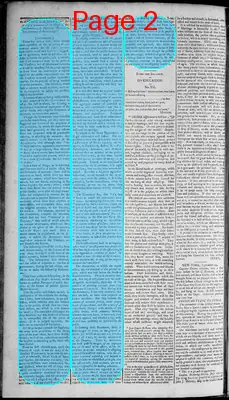
Alexandria Advertiser And Commercial Intelligencer
Alexandria, Virginia
What is this article about?
Oliver Wolcott, former Secretary of the Treasury, defends the propriety of public financial advances and account settlements against a House committee's report, asserting no delinquency in key offices and contracts, with references to events up to 1800.
Clipping
OCR Quality
Full Text
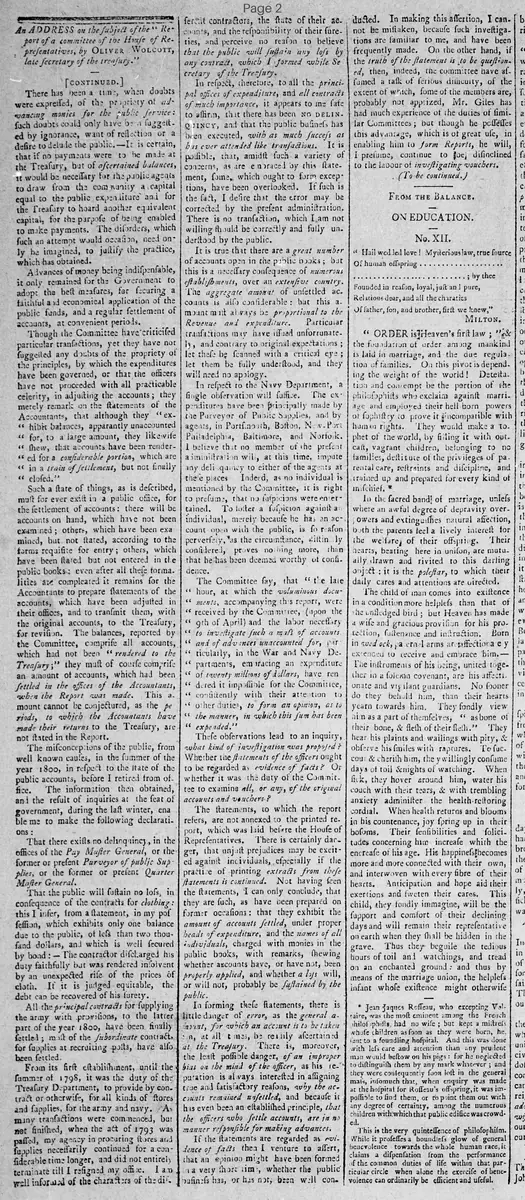
[Continued.]
There has been a time, when doubts were expressed, of the propriety of advancing monies for the public service: such doubts could only have been suggested by ignorance, want of reflection or a desire to delude the public. It is certain, that if no payments were to be made at the Treasury, but of ascertained balances, it would be necessary for the public agents to draw from the community a capital equal to the public expenditure and for the Treasury to hoard another equivalent capital, for the purpose of being enabled to make payments. The disorders, which such an attempt would occasion, need only be imagined, to justify the practice, which has obtained.
Advances of money being indispensable, it only remained for the Government to adopt the best measures, for securing a faithful and economical application of the public funds, and a regular settlement of accounts, at convenient periods.
Though the Committee have criticized particular transactions, yet they have not suggested any doubts of the propriety of the principles, by which the expenditures have been governed, or that the officers have not proceeded with all practicable celerity, in adjusting the accounts; they merely remark on the statements of the Accountants, that although they "exhibit balances, apparently unaccounted for, to a large amount, they likewise shew, that accounts have been rendered for a considerable portion, which are in a train of settlement, but not finally closed."
Such a state of things, as is described, must for ever exist in a public office, for the settlement of accounts: there will be accounts on hand, which have not been examined; others, which have been examined, but not stated, according to the forms requisite for entry; others, which have been stated but not entered in the public books: even after all these formalities are completed it remains for the Accountants to prepare statements of the accounts, which have been adjusted in their offices, and to transmit them, with the original accounts, to the Treasury, for revision. The balances, reported by the Committee, comprise all accounts, which had not been "rendered to the Treasury;" they must of course comprise an amount of accounts, which had been settled in the offices of the Accountants, when the Report was made. This amount cannot be conjectured, as the periods, to which the Accountants have made their returns to the Treasury, are not stated in the Report.
The misconcepions of the public, from well known causes, in the summer of the year 1800, in respect to the state of the public accounts, before I retired from office. The information then obtained, and the result of inquiries at the seat of government, during the last winter, enable me to make the following declarations:
That there exists no delinquency, in the offices of the Pay Master General, or the former or present Purveyor of public Supplies, or the former or present Quarter Master General.
That the public will sustain no loss, in consequence of the contracts for clothing: this I infer, from a statement, in my possession, which exhibits only one balance due to the public, of less than two thousand dollars, and which is well secured by bond: The contractor discharged his duty faithfully but was rendered insolvent by an unexpected rise of the prices of cloth. If it is judged equitable, the debt can be recovered of his surety.
All the principal contracts for supplying the army with provisions, to the latter part of the year 1800, have been finally settled; most of the subordinate contracts for supplies at recruiting posts, have also been settled.
From its first establishment, until the summer of 1798, it was the duty of the Treasury Department, to provide by contract or otherwise, for all kinds of stores and supplies, for the army and navy. As many transactions were commenced, but not finished, when the act of 1798 was passed, my agency in procuring stores and supplies necessarily continued for a considerable time longer, and did not entirely terminate till I resigned my office. I am well informed of the characters of the different contractors, the state of their accounts, and the responsibility of their sureties, and perceive no reason to believe that the public will sustain any loss by any contract, which I formed while Secretary of the Treasury.
In respect, therefore, to all the principal offices of expenditure, and all contracts of much importance, it appears to me safe to affirm, that there has been No DELINQUENCY, and that the public business has been executed, with as much success as has ever attended like transactions. It is possible, that, amidst such a variety of concerns, as are embraced by this statement, some, which ought to form exceptions, have been overlooked. If such is the fact, I desire that the error may be corrected by the present administration.
There is no transaction, which I am not willing should be correctly and fully understood by the public.
It is true that there are a great number of accounts open in the public books; but this is a necessary consequence of numerous establishments, over an extensive country. The aggregate amount of unsettled accounts is also considerable: but this amount must always be proportional to the Revenue and expenditure. Particular transactions may have issued unfortunately, and contrary to original expectations; let these be scanned with a critical eye: let them be fully understood, and they will need no apology.
In respect to the Navy Department, a single observation will suffice. The expenditures have been principally made by the Purveyor of Public Supplies, and by agents, in Portsmouth, Boston, New-Port, Philadelphia, Baltimore, and Norfolk.
I believe that no member of the present administration will, at this time, impute any delinquency to either of the agents at these places. Indeed, as no individual is mentioned by the Committee, it is right to presume, that no suspicions were ever entertained. To foster a suspicion against an individual, merely because he has an account open with the public, is so unreasonable, as the circumstance, distinctly considered, proves nothing more, than that he has been deemed worthy of confidence.
The Committee say, that "the late hour, at which the voluminous documents, accompanying this report, were received by the Committee, (upon the 9th of April) and the labor necessary to investigate such a mass of accounts, and of advances unaccounted for, particularly, in the War and Navy Departments, embracing an expenditure of twenty millions of dollars, have rendered it impossible for the Committee, consistently with their attention to other duties, to form an opinion, as to the manner, in which this sum has been expended."
These observations lead to an inquiry, what kind of investigation was proposed? Whether the statements of the officers ought to be regarded as evidence of facts? Or whether it was the duty of the Committee to examine all, or any, of the original accounts and vouchers?
The statements, to which the report refers, are not annexed to the printed report, which was laid before the House of Representatives. There is certainly danger, that unjust prejudices may be excited against individuals, especially if the practice of printing extracts from these statements is continued. Not having seen the statements, I can only conclude, that they are such, as have been prepared on former occasions: that they exhibit the amount of accounts settled, under proper heads of expenditure, and the names of all individuals, charged with monies in the public books, with remarks, shewing whether accounts have, or have not, been properly applied, and whether a loss will, or will not, probably be sustained by the public.
In forming these statements, there is little danger of error, as the general amount, for which an account is to be taken in, at all times, be readily ascertained at the Treasury. There is, moreover, the least possible danger, of an improper bias on the mind of the officer, as his reputation is always interested in assigning true and satisfactory reasons, why the accounts remained unsettled, and because it has even been an established principle, that the officers who settle accounts, are in no manner responsible for making advances.
If the statements are regarded as evidence of facts then I venture to assert, that an opinion might have been formed in a very short time, whether the public business has, or has not, been well conducted. In making this assertion, I cannot be mistaken, because such investigations are familiar to me, and have been frequently made. On the other hand, if the truth of the statement is to be questioned, then, indeed, the committee have assumed a task of serious difficulty, of the extent of which, some of the members are, probably not apprized. Mr. Giles has had much experience of the duties of similar Committees; but though he possesses this advantage, which is of great use, in enabling him to form Reports, he will, I presume, continue to be disinclined to the labour of investigating vouchers.
(To be continued.)
What sub-type of article is it?
What themes does it cover?
What keywords are associated?
What entities or persons were involved?
Where did it happen?
Story Details
Key Persons
Location
Treasury Department, Seat Of Government, Portsmouth, Boston, New Port, Philadelphia, Baltimore, Norfolk
Event Date
Summer Of The Year 1800, Summer Of 1798, 9th Of April
Story Details
Oliver Wolcott addresses misconceptions about public accounts, defends advances of money as necessary, asserts no delinquency in key offices and contracts for army and navy supplies up to 1800, criticizes the committee's report for lacking thorough investigation, and affirms the public's funds were handled faithfully.