Thank you for visiting SNEWPapers!
Sign up free
Editorial
January 8, 1848
The Daily National Whig
Washington, District Of Columbia
What is this article about?
Editorial urges Whig party to hold a National Convention for presidential nomination without pre-commitments to candidates like Gen. Taylor, to maintain unity; criticizes Taylor supporters' tactics and praises deference shown by Clay and Webster backers.
Clipping
OCR Quality
100%
Excellent
Full Text
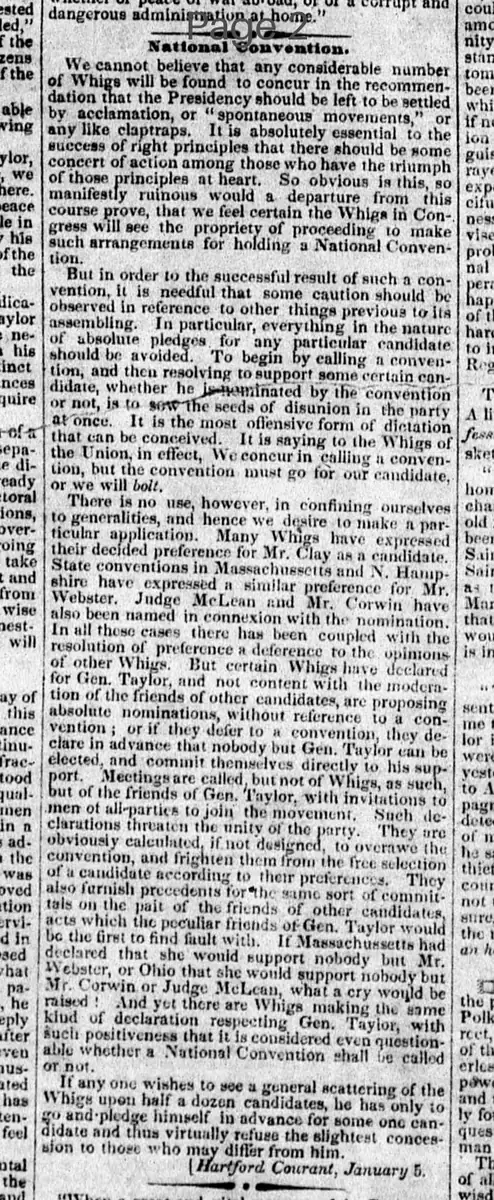
We cannot believe that any considerable number of Whigs will be found to concur in the recommendation that the Presidency should be left to be settled by acclamation, or "spontaneous" movements, or any like claptrap. It is absolutely essential to the success of right principles that there should be some concert of action among those who have the triumph of those principles at heart. So obvious is this, so manifestly ruinous would a departure from this course prove, that we feel certain the Whigs in Congress will see the propriety of proceeding to make such arrangements for holding a National Convention.
But in order to the successful result of such a convention, it is needful that some caution should be observed in reference to other things previous to its assembling. In particular, everything in the nature of absolute pledges for any particular candidate should be avoided. To begin by calling a convention, and then resolving to support some certain candidate, whether nominated by the convention or not, is to strike the seeds of disunion in the party at once. It is the most offensive form of dictation that can be conceived. It is saying to the Whigs of the Union, in effect, We concur in calling a convention, but the convention must go for our candidate, or we will bolt.
There is no use, however, in confining ourselves to generalities, and hence we desire to make a particular application. Many Whigs have expressed their decided preference for Mr. Clay as a candidate. State conventions in Massachusetts and N. Hampshire have expressed a similar preference for Mr. Webster. Judge McLean and Mr. Corwin have also been named in connexion with the nomination. In all those cases there has been coupled with the resolution of preference a deference to the opinions of other Whigs. But certain Whigs have declared for Gen. Taylor, and not content with the moderation of the friends of other candidates, are proposing absolute nominations, without reference to a convention; or if they defer to a convention, they declare in advance that nobody but Gen. Taylor can be elected, and commit themselves directly to his support. Meetings are called, but not of Whigs, as such, but of the friends of Gen. Taylor, with invitations to men of all parties to join the movement. Such declarations threaten the unity of the party. They are obviously calculated, if not designed, to overawe the convention, and frighten them from the free selection of a candidate according to their preferences. They also furnish precedents for the same sort of commitments on the part of the friends of other candidates, acts which the peculiar friends of Gen. Taylor would be the first to find fault with. If Massachusetts had declared that she would support nobody but Mr. Webster, or Ohio that she would support nobody but Mr. Corwin or Judge McLean, what a cry would be raised? And yet there are Whigs making the same kind of declaration respecting Gen. Taylor, with such positiveness that it is considered even questionable whether a National Convention shall be called or not.
If any one wishes to see a general scattering of the Whigs upon half a dozen candidates, he has only to go and pledge himself in advance for some one candidate and thus virtually refuse the slightest concession to those who may differ from him.
But in order to the successful result of such a convention, it is needful that some caution should be observed in reference to other things previous to its assembling. In particular, everything in the nature of absolute pledges for any particular candidate should be avoided. To begin by calling a convention, and then resolving to support some certain candidate, whether nominated by the convention or not, is to strike the seeds of disunion in the party at once. It is the most offensive form of dictation that can be conceived. It is saying to the Whigs of the Union, in effect, We concur in calling a convention, but the convention must go for our candidate, or we will bolt.
There is no use, however, in confining ourselves to generalities, and hence we desire to make a particular application. Many Whigs have expressed their decided preference for Mr. Clay as a candidate. State conventions in Massachusetts and N. Hampshire have expressed a similar preference for Mr. Webster. Judge McLean and Mr. Corwin have also been named in connexion with the nomination. In all those cases there has been coupled with the resolution of preference a deference to the opinions of other Whigs. But certain Whigs have declared for Gen. Taylor, and not content with the moderation of the friends of other candidates, are proposing absolute nominations, without reference to a convention; or if they defer to a convention, they declare in advance that nobody but Gen. Taylor can be elected, and commit themselves directly to his support. Meetings are called, but not of Whigs, as such, but of the friends of Gen. Taylor, with invitations to men of all parties to join the movement. Such declarations threaten the unity of the party. They are obviously calculated, if not designed, to overawe the convention, and frighten them from the free selection of a candidate according to their preferences. They also furnish precedents for the same sort of commitments on the part of the friends of other candidates, acts which the peculiar friends of Gen. Taylor would be the first to find fault with. If Massachusetts had declared that she would support nobody but Mr. Webster, or Ohio that she would support nobody but Mr. Corwin or Judge McLean, what a cry would be raised? And yet there are Whigs making the same kind of declaration respecting Gen. Taylor, with such positiveness that it is considered even questionable whether a National Convention shall be called or not.
If any one wishes to see a general scattering of the Whigs upon half a dozen candidates, he has only to go and pledge himself in advance for some one candidate and thus virtually refuse the slightest concession to those who may differ from him.
What sub-type of article is it?
Partisan Politics
What keywords are associated?
Whig Party
National Convention
Presidential Nomination
Gen Taylor
Party Unity
Candidate Pledges
Election Strategy
What entities or persons were involved?
Whigs
Mr. Clay
Mr. Webster
Judge Mclean
Mr. Corwin
Gen. Taylor
Massachusetts
N. Hampshire
Ohio
Editorial Details
Primary Topic
Advocacy For Whig National Convention And Against Pre Commitments To Candidates
Stance / Tone
Urging Party Unity And Caution Against Dictation By Candidate Supporters
Key Figures
Whigs
Mr. Clay
Mr. Webster
Judge Mclean
Mr. Corwin
Gen. Taylor
Massachusetts
N. Hampshire
Ohio
Key Arguments
Essential For Success Of Right Principles To Have Concert Of Action Among Whigs
Whigs In Congress Should Arrange For National Convention
Avoid Absolute Pledges For Particular Candidates To Prevent Disunion
Pre Committing To A Candidate Offends Party Unity And Dictates To Convention
Criticism Of Gen. Taylor Supporters For Proposing Absolute Nominations Or Advance Commitments
Such Actions Threaten Party Unity And Overawe The Convention
Furnish Precedents For Similar Commitments By Other Candidates' Friends
Pledging In Advance Leads To Scattering Of Whigs On Multiple Candidates