Thank you for visiting SNEWPapers!
Sign up free
The Providence Journal, And Town And Country Advertiser
Providence, Providence County, Rhode Island
What is this article about?
Biographical sketch of Toussaint L'Ouverture, enslaved Black general in St. Domingo, who rose to power during the revolution, demonstrated humanity by aiding his former master and forgiving planters, while professing loyalty to France.
Merged-components note: Continuation of the narrative story on the character of Toussaint L'Ouverture.
Clipping
OCR Quality
Full Text
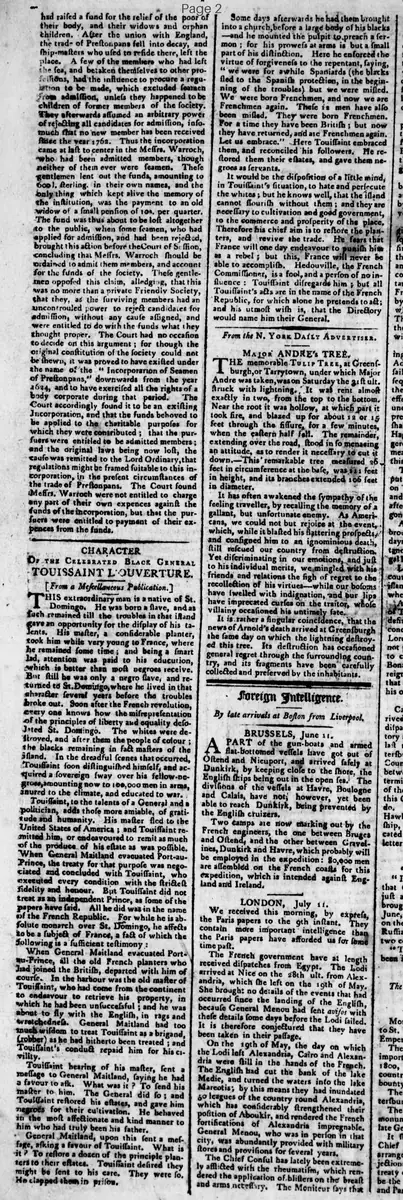
Of the Celebrated Black General
TOUSSAINT L'OUVERTURE
[From a Miscellaneous Publication.]
THIS much remained till the troubles in that island gave an opportunity for the display of his talents. His master, a considerable planter took him while very young to France, where he remained some time; and being a smart lad, attention was paid to his education, which is better than most negroes receive. But till he was only a negro slave; and returned to St. Domingo, where he lived in that character several years before the troubles broke out. Soon after the French revolution, every one knows how the misrepresentation of the principles of liberty and equality desolated St. Domingo. The whites were destroyed, and after them the people of colour; the blacks remaining in fact masters of the island. In the dreadful scenes that occurred, Toussaint soon distinguished himself, and acquired a sovereign sway over his fellow-negroes amounting now to 160,000 men in arms, inured to the climate, and educated to war.
Toussaint, to the talents of a General and a politician, adds those more amiable, of gratitude and humanity. His master fled to the United States of America; and Toussaint assisted him, or endeavoured to remit as much of the produce of his estate as was possible.
When General Maitland evacuated Port-au-Prince, the treaty for that purpose was negotiated and concluded with Toussaint, who executed every condition with the strictest fidelity and honour. But Toussaint did not treat as an independent Prince, as some of the papers have said. All he did was in the name of the French Republic. For while he is absolute monarch over St. Domingo, he affects to be a subject of France, a fact of which the following is a sufficient testimony:
When General Maitland evacuated Port-au-Prince, all the old French planters who had joined the British, departed with him of course. In the harbour was the old master of Toussaint, who had come from the continent to endeavour to retrieve his property, in which he had been unsuccessful; and he was about to fly with the English, in rags and wretchedness. General Maitland had too much wisdom to treat Toussaint as a brigand, (robber) as he had hitherto been treated; and Toussaint's conduct repaid him for his civility.
Toussaint hearing of his master, sent a message to General Maitland, saying he had a favour to ask. What was it? To send his master to him. The General did so; and Toussaint restored his estates, and gave him negroes for their cultivation. He behaved in the most affectionate and kind manner to him who had truly been his father.
General Maitland, upon this sent a message, asking a favour of Toussaint. What is it? To restore a dozen of the principal planters to their estates. - Toussaint desired they might be sent to his care. They were so. He clapped them in prison.
Some days afterwards he had them brought into a church, before a large body of his blacks and he mounted the pulpit to preach a sermon; for his prowess at arms is but a small part of his distinction. Here he enforced the virtue of forgiveness to the repentant, saying, "we were for awhile Spaniards (the blacks fled to the Spanish protection, in the beginning of the troubles) but we were misled. We were born Frenchmen, and now we are Frenchmen again. These 12 men have also been misled. They were born Frenchmen. For a time they have been British; but now they have returned, and are Frenchmen again. Let us embrace." Here Toussaint embraced them, and reconciled his followers: He restored them their estates, and gave them negroes as servants.
It would be the disparagement of a little mind, in Toussaint's situation, to hate and persecute the whites: but he knows well, that the island cannot flourish without them; and they are necessary to cultivation and good government, to the commerce and prosperity of the place. Therefore his chief aim is to restore the planters, and revive the trade. He fears that France will one day endeavour to punish him as a rebel: but this, France will never be able to accomplish. Hedouville, the French Commissioner, is a fool, and a person of no influence: Toussaint disregards him: but all Toussaint's acts are in the name of the French Republic, for which alone he pretends to act; and his utmost wish is, that the Directory would name him their General.
What sub-type of article is it?
What themes does it cover?
What keywords are associated?
What entities or persons were involved?
Where did it happen?
Story Details
Key Persons
Location
St. Domingo
Event Date
Soon After The French Revolution
Story Details
Toussaint L'Ouverture, educated former slave, rises to lead 160,000 black troops in St. Domingo's revolution, aids his fleeing master by remitting estate produce and later restoring his property; negotiates honorably with British General Maitland during evacuation of Port-au-Prince; forgives and restores estates to 12 British-aligned French planters after a sermon on forgiveness and French loyalty.