Thank you for visiting SNEWPapers!
Sign up free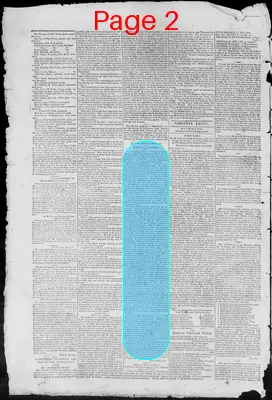
Editorial
September 28, 1812
Virginia Argus
Richmond, Virginia
What is this article about?
An editorial from the Baltimore American critiques De Witt Clinton's suitability for U.S. presidency compared to James Madison, questioning his energy, decision-making on the Bank of America and the War of 1812, and accusing him of political trimming and inconsistency, while supporting Madison's vigorous war stance.
Clipping
OCR Quality
95%
Excellent
Full Text
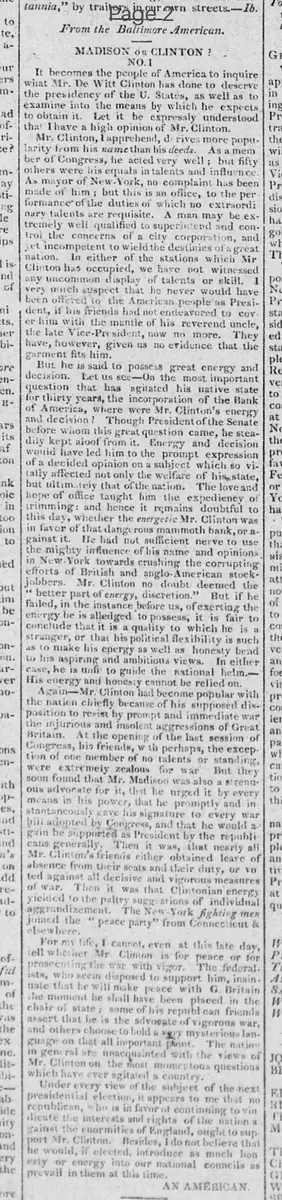
From the Baltimore American.
MADISON OR CLINTON?
NO.I
It becomes the people of America to inquire
what Mr. De Witt Clinton has done to deserve
the presidency of the U. States, as well as to
examine into the means by which he expects
to obtain it. Let it be expressly understood
that I have a high opinion of Mr. Clinton.
Mr. Clinton, I apprehend, derives more popu-
larity from his name than his deeds. As a mem-
ber of Congress, he acted very well; but fifty
others were his equals in talents and influence.
As mayor of New-York, no complaint has been
made of him; but this is an office, to the per-
formance of the duties of which no extraordi-
nary talents are requisite. A man may be ex-
tremely well qualified to superintend and con-
trol the concerns of a city corporation, and
yet incompetent to wield the destinies of a great
nation. In either of the stations which Mr.
Clinton has occupied, we have not witnessed
any uncommon display of talents or skill. I
very much suspect that he never would have
been offered to the American people as Presi-
dent, if his friends had not endeavored to cov-
er him with the mantle of his reverend uncle,
the late Vice-President, now no more. They
have, however, given us no evidence that the
garment fits him.
But he is said to possess great energy and
decision. Let us see-On the most important
question that has agitated his native state
for thirty years, the incorporation of the Bank
of America, where were Mr. Clinton's energy
and decision? Though President of the Senate
before whom this great question came, he stea-
dily kept aloof from it. Energy and decision
would have led him to the prompt expression
of a decided opinion on a subject which so vi-
tally affected not only the welfare of his state,
but ultimately that of the nation. The love and
hope of office taught him the expediency of
trimming: and hence it remains doubtful to
this day, whether the energetic Mr. Clinton was
in favor of that dangerous mammoth bank, or a-
gainst it. He had not sufficient nerve to use
the mighty influence of his name and opinions
in New York towards crushing the corrupting
efforts of British and anglo-American stock-
jobbers. Mr. Clinton no doubt deemed the
"better part of energy, discretion." But if he
failed, in the instance before us, of exerting the
energy he is alleged to possess, it is fair to
conclude that it is a quality to which he is a
stranger, or that his political flexibility is such
as to make his energy as well as honesty bend
to his aspiring and ambitious views. In either
case, he is unfit to guide the national helm.-
His energy and honesty cannot be relied on.
Again—Mr. Clinton had become popular with
the nation chiefly because of his supposed dis-
position to resist by prompt and immediate war
the injurious and insolent aggressions of Great
Britain. At the opening of the last session of
Congress, his friends, with perhaps, the excep.
tion of one member of no talents or standing,
were extremely zealous for war But they
soon found that Mr. Madison was also a strenu-
ous advocate for it, that he urged it by every
means in his power, that he promptly and in-
stantaneously gave his signature to every war
bill adopted by Congress, and that he would a-
gain be supported as President by the republi-
cans generally. Then it was, that nearly all
Mr. Clinton's friends either obtained leave of
absence from their seats and their duty, or vo-
ted against all decisive and vigorous measures
of war. Then it was that Clintonian energy
yielded to the paltry suggestions of individual
aggrandizement. The New York fighting men
joined the " peace party" from Connecticut &
elsewhere.
For my life, I cannot, even at this late day,
tell whether Mr Clinton is for peace or for
prosecuting the war with vigor. The federal.
ists, who seem disposed to support him, insin.
uate that he will make peace with G Britain
the moment he shall have been placed in the
chair of state : some of his republican friends
assert that he is the advocate of vigorous war,
and others choose to hold a very mysterious lan.
guage on that all important point. The nation
in general are unacquainted with the views of
Mr. Clinton on the most momentous questions
which have ever agitated a country.
Under every view of the subject of the next
presidential election, it appears to me that no
republican, who is in favor of continuing to vin-
dicate the interests and rights of the nation a-
gainst the enormities of England, ought to sup-
port Mr. Clinton. Besides, I do not believe that
he would, if elected, introduce as much hon-
esty or energy into our national councils as
prevail in them at this time.
MADISON OR CLINTON?
NO.I
It becomes the people of America to inquire
what Mr. De Witt Clinton has done to deserve
the presidency of the U. States, as well as to
examine into the means by which he expects
to obtain it. Let it be expressly understood
that I have a high opinion of Mr. Clinton.
Mr. Clinton, I apprehend, derives more popu-
larity from his name than his deeds. As a mem-
ber of Congress, he acted very well; but fifty
others were his equals in talents and influence.
As mayor of New-York, no complaint has been
made of him; but this is an office, to the per-
formance of the duties of which no extraordi-
nary talents are requisite. A man may be ex-
tremely well qualified to superintend and con-
trol the concerns of a city corporation, and
yet incompetent to wield the destinies of a great
nation. In either of the stations which Mr.
Clinton has occupied, we have not witnessed
any uncommon display of talents or skill. I
very much suspect that he never would have
been offered to the American people as Presi-
dent, if his friends had not endeavored to cov-
er him with the mantle of his reverend uncle,
the late Vice-President, now no more. They
have, however, given us no evidence that the
garment fits him.
But he is said to possess great energy and
decision. Let us see-On the most important
question that has agitated his native state
for thirty years, the incorporation of the Bank
of America, where were Mr. Clinton's energy
and decision? Though President of the Senate
before whom this great question came, he stea-
dily kept aloof from it. Energy and decision
would have led him to the prompt expression
of a decided opinion on a subject which so vi-
tally affected not only the welfare of his state,
but ultimately that of the nation. The love and
hope of office taught him the expediency of
trimming: and hence it remains doubtful to
this day, whether the energetic Mr. Clinton was
in favor of that dangerous mammoth bank, or a-
gainst it. He had not sufficient nerve to use
the mighty influence of his name and opinions
in New York towards crushing the corrupting
efforts of British and anglo-American stock-
jobbers. Mr. Clinton no doubt deemed the
"better part of energy, discretion." But if he
failed, in the instance before us, of exerting the
energy he is alleged to possess, it is fair to
conclude that it is a quality to which he is a
stranger, or that his political flexibility is such
as to make his energy as well as honesty bend
to his aspiring and ambitious views. In either
case, he is unfit to guide the national helm.-
His energy and honesty cannot be relied on.
Again—Mr. Clinton had become popular with
the nation chiefly because of his supposed dis-
position to resist by prompt and immediate war
the injurious and insolent aggressions of Great
Britain. At the opening of the last session of
Congress, his friends, with perhaps, the excep.
tion of one member of no talents or standing,
were extremely zealous for war But they
soon found that Mr. Madison was also a strenu-
ous advocate for it, that he urged it by every
means in his power, that he promptly and in-
stantaneously gave his signature to every war
bill adopted by Congress, and that he would a-
gain be supported as President by the republi-
cans generally. Then it was, that nearly all
Mr. Clinton's friends either obtained leave of
absence from their seats and their duty, or vo-
ted against all decisive and vigorous measures
of war. Then it was that Clintonian energy
yielded to the paltry suggestions of individual
aggrandizement. The New York fighting men
joined the " peace party" from Connecticut &
elsewhere.
For my life, I cannot, even at this late day,
tell whether Mr Clinton is for peace or for
prosecuting the war with vigor. The federal.
ists, who seem disposed to support him, insin.
uate that he will make peace with G Britain
the moment he shall have been placed in the
chair of state : some of his republican friends
assert that he is the advocate of vigorous war,
and others choose to hold a very mysterious lan.
guage on that all important point. The nation
in general are unacquainted with the views of
Mr. Clinton on the most momentous questions
which have ever agitated a country.
Under every view of the subject of the next
presidential election, it appears to me that no
republican, who is in favor of continuing to vin-
dicate the interests and rights of the nation a-
gainst the enormities of England, ought to sup-
port Mr. Clinton. Besides, I do not believe that
he would, if elected, introduce as much hon-
esty or energy into our national councils as
prevail in them at this time.
What sub-type of article is it?
Partisan Politics
War Or Peace
What keywords are associated?
Presidential Election
De Witt Clinton
James Madison
War Of 1812
Bank Of America
Political Trimming
Republican Support
What entities or persons were involved?
De Witt Clinton
James Madison
Republicans
Federalists
Great Britain
Editorial Details
Primary Topic
Critique Of De Witt Clinton's Presidential Candidacy Versus James Madison
Stance / Tone
Critical Of Clinton, Supportive Of Madison And Vigorous War Prosecution
Key Figures
De Witt Clinton
James Madison
Republicans
Federalists
Great Britain
Key Arguments
Clinton's Popularity Stems From Name Rather Than Deeds
Lacked Energy And Decision On Bank Of America Incorporation
Inconsistent Stance On War With Britain, Influenced By Ambition
Friends Shifted From War Support To Opposition Upon Madison's Advocacy
Unfit To Lead Due To Unreliable Energy And Honesty
Republicans Should Support Madison To Vindicate National Rights