Thank you for visiting SNEWPapers!
Sign up free
The New York Herald
New York, New York County, New York
What is this article about?
On August 10, 1875, Governor Tilden is honored with a large reception by the Buffalo Board of Trade. He speaks on protecting the Erie Canal, reducing tolls and taxes through reform against fraud, and urges citizens to support honest politics. Lieutenant Governor Dorsheimer endorses the efforts. The group tours local sites.
Clipping
OCR Quality
Full Text
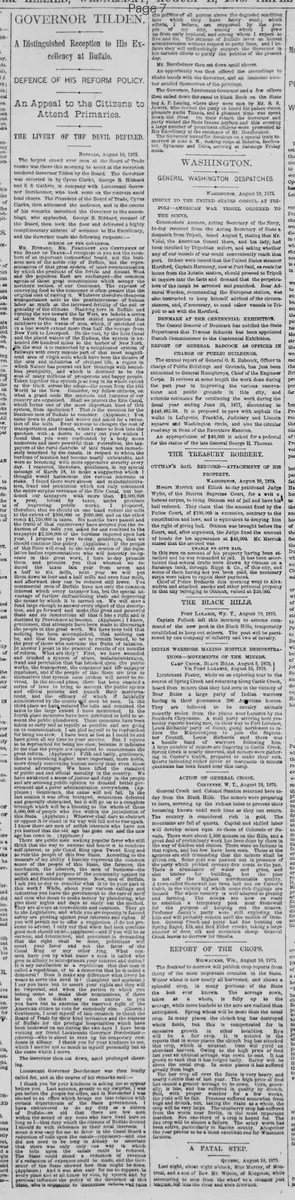
A Distinguished Reception to His Excellency at Buffalo.
Defence of His Reform Policy.
An Appeal to the Citizens to Attend Primaries.
The Livery of the Devil Defined.
Buffalo, August 10, 1875.
The largest crowd ever seen at the Board of Trade rooms was there this morning to assist at the reception tendered Governor Tilden by the Board. The Governor was escorted in by Cyrus Clarke, George B. Hibbard and S. S. Guthrie, in company with Lieutenant Governor Dorsheimer, who took seats on the rostrum amid loud cheers. The President of the Board of Trade, Cyrus Clarke, then addressed the audience, and in the course of his remarks introduced the Governor to the assemblage, who applauded. George B. Hibbard, counsel of the Board, then took the floor and delivered a highly complimentary address of welcome to His Excellency, and the Governor made the following response:—
Speech of the Governor.
Mr. Hibbard, Mr. President and Gentlemen of the Board of Trade—I recognize in you not the members of an important commercial board, not the business men of the noble city of Buffalo, but the representatives of that great system of inter-communication by which the products of the fertile and distant West and the populous East are exchanged—the common agents of those great communities which occupy the northern section of our Continent. The expense of conveying food to the consumer is often greater than the original cost of raising it. Whatever therefore cheapens transportation adds to the productiveness of human labor as much as the increased fertility of the soil or geniality of the climate. Standing here in Buffalo and turning the eye toward the far West, we behold a series of lakes forming the finest inland navigation that ministers to the wants of man, which, if stretched out in a line would extend more than half the voyage from New York to Liverpool. On the east, by the Erie Canal and the placid waters of the Hudson, the system is extended 500 miles to the harbor of New York. On the west it is connected by a complicated system of railways with every minute part of that most magnificent area of virgin soils which have been the theatre of the arts and industries of civilized life, a region in which Nature has poured out her blessings with boundless prodigality, and which is destined to be the seat of many millions of prosperous and happy people. Taken together this system is as long in its whole extent as the track across the ocean—the ocean from the Old World to the New. Consider, my fellow-citizens, on what a grand scale the interests and business of our country are organized. Shall we protect the Erie Canal, which forms one of the most important lines of this system, from spoliation? That is the question for the business men of Buffalo to consider. (Applause.) You came down to Albany last winter and asked for a reduction of the tolls. Ever anxious to cheapen the cost of transportation and transit, when I came to look into the question with a desire to carry out your wishes I found that you were confronted by a body more numerous and more powerful than yourselves, the taxpayers of the rural districts of this State not immediately benefited by the canals, in respect to whom the burdens of taxation had become nearly unbearable, and were so becoming with more oppressive severity every day. I ventured, therefore, gentlemen, in my special message of March 18, to make a suggestion which I thought would harmonize the various interests at stake. I found there were abuses and maladministration, fraud and peculation which not only consumed the entire surplus revenues of the Erie Canal, but burdened our taxpayers with more than $2,000,000 a year, levied by taxes under pretence of improving public works. I proposed, therefore, that we should on one hand reduce the tolls to the extent of $500,000 or $600,000, and on the other remit $1,750,000 in taxes. Six months have passed and the fruits of that controversy have secured you the reduction of the tolls you asked for and remitted to the taxpayers $2,250,000 of the burdens imposed upon last year. I propose to you to-day, gentlemen, that we should continue this policy. (Applause.) If the people of this State will send to the next session of the legislative bodies representatives who will honestly co-operate in this great work, I here to-day promise them and promise you that whereas we reduced the taxes last year from seven and a half to six mills, next year we will put them down to four and a half mills and even four mills, and afterward they can be reduced still lower. You commercial men of Buffalo have not only the common interest which every taxpayer has, but the special advantage of further enfranchising trade and improving the means by which it is carried on. We will save a fund large enough to answer every object of this description, and go forward and make this great and powerful State and its institutions all that it has a right and is destined by Providence to become. (Applause.) I know, gentlemen, that attempts have been made to discourage the people in this great work. We have been told that nothing has been accomplished, that nothing can be, and that the people are to remain bound, to be the prey of those who consume the fruits of taxation. In answer I point to the practical results of six months of reform. What are they? First, we have wounded and crushed a system of abuse, maladministration, fraud and peculation that has fattened upon the public works, the transporter, the consumer and the taxpayer (applause), and if the people of this State are true to themselves that system once broken will never be revived. In the second place, there has been enacted a series of laws to bring to account the public agents and official persons and punish their malversations, and the efficacy of which if faithfully administered by the courts will soon be seen. In the third place we have reduced the tolls and remitted the taxes to the large extent I have mentioned. In the fourth place measures have been instituted to hold to account the public plunderers. These measures have been taken as early and as rapidly as possible and are going on to consummation. I am glad myself to be reproached for being too slow. I have been as fast as I could be and have given all my time to your service. But I rejoice to be reproached for being too slow, because it indicates to me that the people are impatient to consummate the great reform. (Applause.) Fifth and lastly, gentlemen, there is something higher, more important, more noble, more deeply concerning human society than even these natural advantages. We have lifted the standard of public and official morality in the country. We have awakened a sense of justice and duty in the people and are arousing public opinion to demand better government and a purer administration everywhere. (Applause.) Gentlemen, the cause will not fail. In the last session it was often betrayed, sometimes defeated and generally obstructed, but it will go on to a complete triumph which will be a blessing to the whole of these 5,000,000 of people who live within the jurisdiction of this State. (Applause.) Whoever shall dare to obstruct or oppose it or stand in its way will fall not to rise again. I know there are men of selfish interests who have not yet learned that the old age has gone out and the new age has come in. (Applause.) There are public men seeking popular favor who still think that the way to success and honor is to combine self-interest, to pile Canal Ring upon Tweed Ring and so rule the people of this free State. According to the measure of my ability I humbly represent the common sense of the people of this State, the farmers, the mechanics, the laborers, the men of business—the moral sense and purpose of the community against its selfish and fraudulent interests. Now, men of Buffalo, I ask you to-day to consider what is to be your part in this work? While, about your various callings and industries you leave the government to the care of itself and men who mean to make money by plundering, who give their nights and days to study out the method. They are always at conventions and caucuses. They go to the Legislature, and while you are reposing in fancied safety are plotting against your interests and rights. If you will permit me to offer a suggestion (I do not presume to advise), I only say that when bad men combine good men should unite—(applause)—and if you will be as earnest, and determined, and persistent in demanding that the right shall be done, politicians will court your favor and not the favor of the Canal Ring or any other ring. What concern have you by what name a man is called who goes to Albany to misrepresent your interest and duties? Is it any satisfaction to a republican that that man is called a republican, or to a democrat that he is called a democrat? Does it make any difference what livery he wears to serve the devil in? (Laughter and applause.) I say you have but to assert your rights and they will be respected, and when the parties to which you belong come to make their nominations, if there be on the ticket any one untrue to you you have but to exercise the reserved right of the American citizen to vote for somebody else. (Cheers.) Gentlemen, I avail myself of this occasion to thank the Board of Trade for their kind invitation and the citizens of Buffalo for the prodigal hospitalities which have been bestowed on me during the two days I have been visiting my friend Lieutenant Governor Dorsheimer—(cheers)—who is about to take up his temporary residence in Albany. I thank you for your kindness to me, which I ascribe not so much to myself personally but to the cause which I serve.
The Governor then sat down, amid prolonged cheering.
Lieutenant Governor Dorsheimer was then loudly called for, and in the course of his remarks said:
I thank you for your kindness in asking me to appear before you. Last autumn, greatly to my surprise, I was put before the people for office, and in November I was elected to an office which brings me into relation with certain departments of the State government. I have endeavored to do my duty as a citizen of Buffalo—so old that there are few men within the sound of my voice who have lived here so long—that duty which the citizens of Buffalo desired I should do with reference to their local interests. I mean it was easy for me to favor in the Canal Board a reduction of tolls upon the canals—(applause)—and one did not need to be long in Albany to ascertain that there was only one way in which the tolls upon the canals could be reduced.
The State could stand a reduction of revenue if a reduction of expenses could be made, and the Governor of the State showed how that might be done. (Applause.) And it was also easy for me to support, in every place and at all times by vote, by speech and by personal influence the policy of the Governor of this State who is raising the politics of all parties above the degraded condition into which they have lately sunk; which efforts, I believe, are supported by the people of my city, among whom I grew up from early boyhood, and among whom I expect to live and die. The citizens of Buffalo favor an honest administration without respect to party lines, and I believe they will unflinchingly support the Governor in his earnest efforts to purify the politics of the present day.
Mr. Dorsheimer then sat down amid cheers.
An opportunity was then offered the assemblage to shake hands with the Governor, and an immense number availed themselves of the privilege.
The Governor, Lieutenant Governor and a few others then sailed down the canal to Black Rock on the State tug A. P. Laning, where they were met by Mr. S. S. Jewett, who invited the party on board his palace steam pleasure yacht Titania, and a pleasant time was spent down the river. On their return the Governor and party visited the State Insane Asylum and this evening a large number of prominent citizens were presented to His Excellency at the residence of Mr. Dorsheimer.
The Governor leaves for Saratoga on a special train to-morrow at nine A. M., making stops at Batavia, Rochester, Syracuse and Utica, arriving at Saratoga Friday noon.
What sub-type of article is it?
What themes does it cover?
What keywords are associated?
What entities or persons were involved?
Where did it happen?
Story Details
Key Persons
Location
Buffalo
Event Date
August 10, 1875
Story Details
Governor Tilden receives a distinguished reception at the Buffalo Board of Trade, delivers a speech defending his reform policy on reducing canal tolls and taxes while combating fraud, appeals to citizens to attend primaries and support honest representatives, and thanks the hosts; Lieutenant Governor Dorsheimer supports the policy; the party later sails on the canal and visits sites.