Thank you for visiting SNEWPapers!
Sign up free
Editorial
January 20, 1804
The National Intelligencer And Washington Advertiser
Washington, District Of Columbia
What is this article about?
An editorial advocating for increased salaries for the Post Master General and assistant, arguing that their arduous, increasing duties warrant fair compensation beyond mere subsistence, balancing economy with liberality. It criticizes the House's rejection of the Senate's resolve and urges reconsideration.
Clipping
OCR Quality
98%
Excellent
Full Text
FOR THE NATIONAL INTELLIGENCER
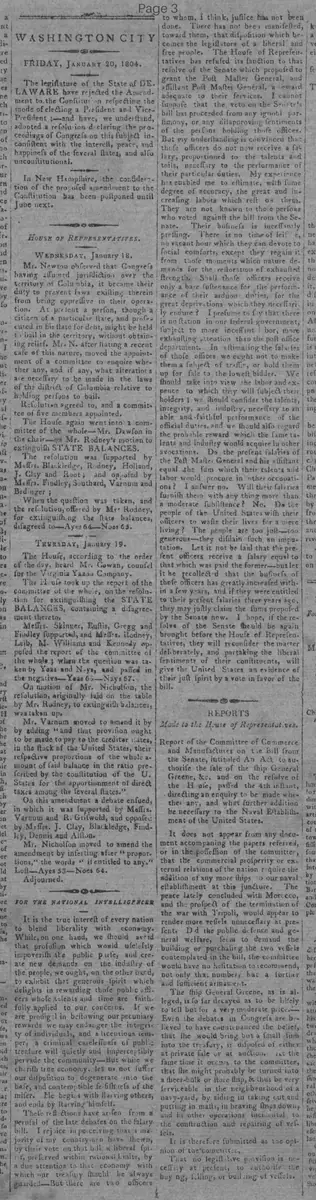
It is the true interest of every nation to blend liberality with economy. While, on one hand, we should avoid that profusion which would uselessly impoverish the public purse, and create new demands on the industry of the people, we ought, on the other hand, to exhibit that generous spirit which delights in rewarding those public officers whose talents and time are faithfully applied to our concerns. If we are prodigal in bestowing our pecuniary rewards we may endanger the integrity of individuals, and a licentious temper, a criminal carelessness of public treasure will quietly and imperceptibly pervade the Community--But while we cherish true economy, let us not suffer our disposition to degenerate into the base and contemptible selfishness of the miser. He begins with starving others, and ends by starving himself.
These reflections have arisen from a perusal of the late debates on the salary bill. I rejoice in perceiving that a majority of my countrymen have shown, by their vote on that bill, a liberal spirit, preserved within rational limits, by a due attention to that economy with which our treasury should be always guarded. But there are two officers to whom, I think, justice has not been done. There has not been manifested, toward them, that disposition which becomes the legislators of a liberal and free people. The House of Representatives has refused its sanction to that resolve of the Senate which proposed to grant the Post Master General, and assistant Post Master General, a reward adequate to their services. I cannot suppose that the veto on the Senate's bill has proceeded from any ignoble parsimony, or any disapproving sentiments of the persons holding those offices. But my understanding is convinced that those officers do not now receive a salary, proportioned to the talents and toils, necessary to the performance of their particular duties. My experience has enabled me to estimate, with some degree of accuracy, the great and increasing labors which rest on them. They are not known to those persons who voted against the bill from the Senate. Their business is incessantly pressing. There is no time of leisure, no vacant hour which they can devote to social comforts, except they regain it from those moments which nature demands for the restoration of exhausted strength. Shall those officers receive only a bare sustenance for the performance of their arduous duties, for the great deprivations which they necessarily endure? I presume to say that there is no station in our federal government, subject to more incessant labor, more exhausting attention than the post office department. In estimating the salaries of those offices we ought not to make them a subject of traffic, or hold them up for sale to the lowest bidder. We should take into view the labor and expense to which they will subject their holders: we should consider the talents, integrity, and industry, necessary to an able and faithful performance of the official duties, and we should also regard the probable reward which the same talents and industry would acquire in other avocations. Do the present salaries of the Post Master General and his assistant equal the sum which their talents and labor would procure in other occupations? I answer no. Will their salaries furnish them with any thing more than a moderate subsistence? No. Do the people of the United States wish their officers to waste their lives for a mere living? The people are too just--too generous--they disdain such an imputation. Let it not be said that the present officers receive a salary equal to that which was paid the former--but let it be recollected that the business of these officers has greatly increased within a few years, and if they were entitled to their present salaries three years ago, they may justly claim the sums proposed by the Senate now. I hope, if the resolve of the Senate should be again brought before the House of Representatives, they will reconsider the matter deliberately, and partaking the liberal sentiments of their constituents, will give the United States an evidence of their just spirit by a vote in favor of the bill.
It is the true interest of every nation to blend liberality with economy. While, on one hand, we should avoid that profusion which would uselessly impoverish the public purse, and create new demands on the industry of the people, we ought, on the other hand, to exhibit that generous spirit which delights in rewarding those public officers whose talents and time are faithfully applied to our concerns. If we are prodigal in bestowing our pecuniary rewards we may endanger the integrity of individuals, and a licentious temper, a criminal carelessness of public treasure will quietly and imperceptibly pervade the Community--But while we cherish true economy, let us not suffer our disposition to degenerate into the base and contemptible selfishness of the miser. He begins with starving others, and ends by starving himself.
These reflections have arisen from a perusal of the late debates on the salary bill. I rejoice in perceiving that a majority of my countrymen have shown, by their vote on that bill, a liberal spirit, preserved within rational limits, by a due attention to that economy with which our treasury should be always guarded. But there are two officers to whom, I think, justice has not been done. There has not been manifested, toward them, that disposition which becomes the legislators of a liberal and free people. The House of Representatives has refused its sanction to that resolve of the Senate which proposed to grant the Post Master General, and assistant Post Master General, a reward adequate to their services. I cannot suppose that the veto on the Senate's bill has proceeded from any ignoble parsimony, or any disapproving sentiments of the persons holding those offices. But my understanding is convinced that those officers do not now receive a salary, proportioned to the talents and toils, necessary to the performance of their particular duties. My experience has enabled me to estimate, with some degree of accuracy, the great and increasing labors which rest on them. They are not known to those persons who voted against the bill from the Senate. Their business is incessantly pressing. There is no time of leisure, no vacant hour which they can devote to social comforts, except they regain it from those moments which nature demands for the restoration of exhausted strength. Shall those officers receive only a bare sustenance for the performance of their arduous duties, for the great deprivations which they necessarily endure? I presume to say that there is no station in our federal government, subject to more incessant labor, more exhausting attention than the post office department. In estimating the salaries of those offices we ought not to make them a subject of traffic, or hold them up for sale to the lowest bidder. We should take into view the labor and expense to which they will subject their holders: we should consider the talents, integrity, and industry, necessary to an able and faithful performance of the official duties, and we should also regard the probable reward which the same talents and industry would acquire in other avocations. Do the present salaries of the Post Master General and his assistant equal the sum which their talents and labor would procure in other occupations? I answer no. Will their salaries furnish them with any thing more than a moderate subsistence? No. Do the people of the United States wish their officers to waste their lives for a mere living? The people are too just--too generous--they disdain such an imputation. Let it not be said that the present officers receive a salary equal to that which was paid the former--but let it be recollected that the business of these officers has greatly increased within a few years, and if they were entitled to their present salaries three years ago, they may justly claim the sums proposed by the Senate now. I hope, if the resolve of the Senate should be again brought before the House of Representatives, they will reconsider the matter deliberately, and partaking the liberal sentiments of their constituents, will give the United States an evidence of their just spirit by a vote in favor of the bill.
What sub-type of article is it?
Economic Policy
What keywords are associated?
Post Master General
Salaries
Public Officers
Economy
Senate Resolve
House Of Representatives
Post Office Department
What entities or persons were involved?
Post Master General
Assistant Post Master General
House Of Representatives
Senate
Editorial Details
Primary Topic
Increasing Salaries For Post Master General And Assistant
Stance / Tone
Advocacy For Fair Compensation Balancing Economy And Liberality
Key Figures
Post Master General
Assistant Post Master General
House Of Representatives
Senate
Key Arguments
Nations Should Blend Liberality With Economy In Rewarding Public Officers.
Post Office Duties Involve Incessant, Exhausting Labor With No Leisure.
Current Salaries Provide Only Bare Sustenance, Not Proportional To Talents And Toils.
Business Of The Post Office Has Greatly Increased In Recent Years.
Salaries Should Reflect Labor, Talents, And Comparable Private Rewards.
House Should Reconsider And Approve Senate's Resolve For Adequate Rewards.