Thank you for visiting SNEWPapers!
Sign up free
Miami Citizen
Miami, Dade County, Florida
What is this article about?
News article discusses the Thomas Bill's provisions to restore the original Wagner Act, repeal key parts of Taft-Hartley, enhance labor protections, and support President Truman's program amid opposition from Dixiecrats, GOP, and lobbies. Details changes to NLRB, unfair practices, emergency procedures, and policy on bargaining.
Merged-components note: Continuation of the Thomas Bill article across pages, maintaining original story label as it describes legislative content coherently.
Clippings
1 of 2
OCR Quality
Full Text
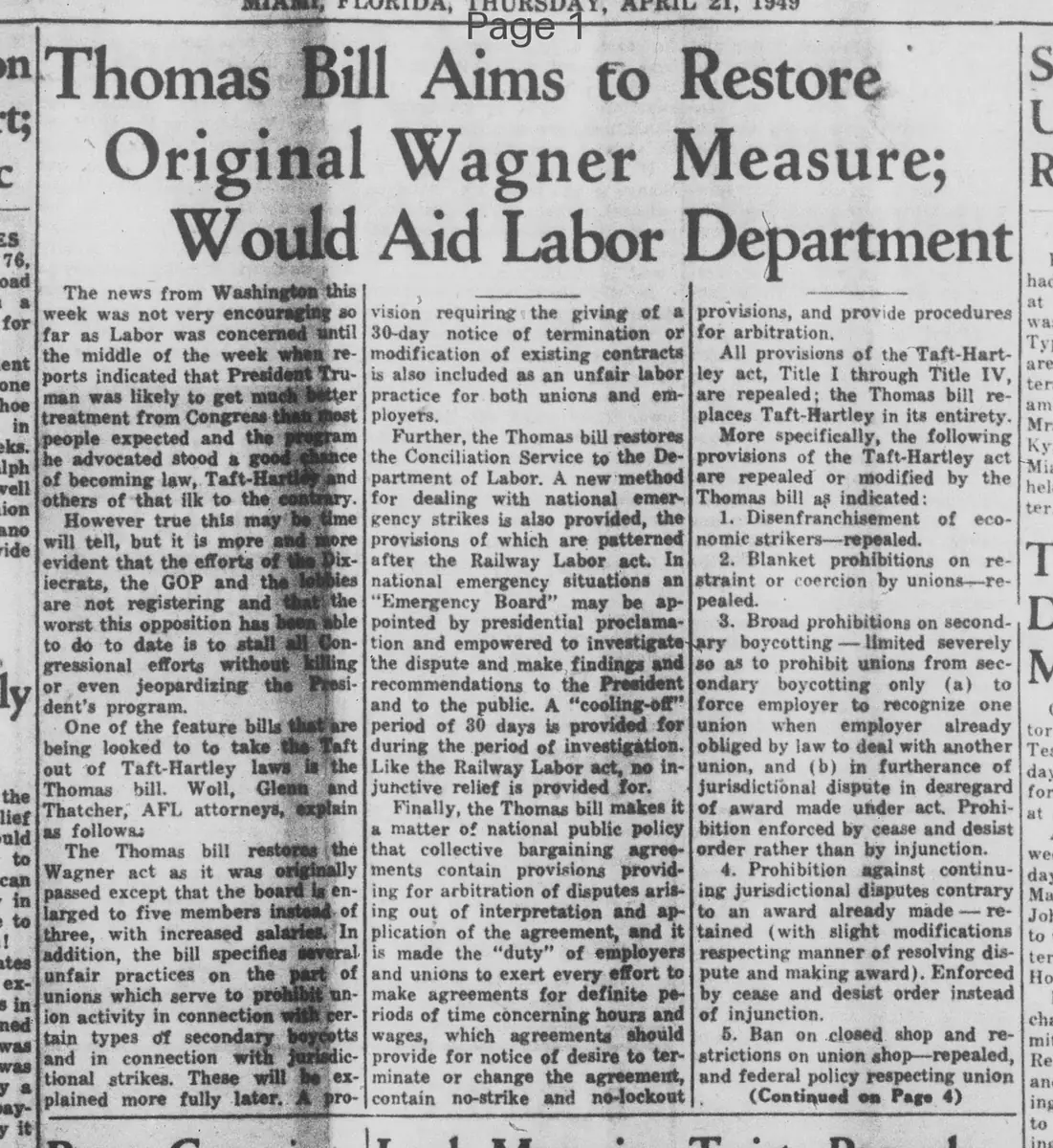
Aims to
Restore
Original Wagner
Measure;
Would
Aid Labor Department
The news from Washington this
week was not very encouraging so
far as Labor was concerned until
the middle of the week when reports
indicated that President Truman
was likely to get much better
treatment from Congress than most
people expected and the program
he advocated stood a good chance
of becoming law. Taft-Hartley and
others of that ilk to the contrary.
However true this may be time
will tell, but it is more and more
evident that the efforts of the Dixiecrats,
the GOP and the lobbies
are not registering and that the
worst this opposition has been able
to do to date is to stall all Congressional
efforts without killing
or even jeopardizing the President's
program.
One of the feature bills that are
being looked to to take the Taft
out of Taft-Hartley laws is the
Thomas bill. Woll, Glenn and
Thatcher, AFL attorneys, explain
as follows:
The Thomas bill restores the
Wagner act as it was originally
passed except that the board is enlarged
to five members instead of
three, with increased salaries. In
addition, the bill specifies several
unfair practices on the part of
unions which serve to prohibit union
activity in connection with certain
types of secondary boycotts
and in connection with jurisdictional
strikes. These will be explained
more fully later. A provision
requiring the giving of a
30-day notice of termination or
modification of existing contracts
is also included as an unfair labor
practice for both unions and employers.
Further, the Thomas bill restores
the Conciliation Service to the Department
of Labor. A new method
for dealing with national emergency
strikes is also provided, the
provisions of which are patterned
after the Railway Labor act. In
national emergency situations an
"Emergency Board" may be appointed
by presidential proclamation
and empowered to investigate
the dispute and make findings and
recommendations to the President
and to the public. A "cooling-off"
period of 30 days is provided for
during the period of investigation.
Like the Railway Labor act, no injunctive
relief is provided for.
Finally, the Thomas bill makes it
a matter of national public policy
that collective bargaining agreements
contain provisions providing
for arbitration of disputes arising
out of interpretation and application
of the agreement, and it
is made the "duty" of employers
and unions to exert every effort to
make agreements for definite periods
of time concerning hours and
wages, which agreements should
provide for notice of desire to terminate
or change the agreement,
contain no-strike and no-lockout
provisions, and provide procedures
for arbitration.
All provisions of the Taft-Hartley
act, Title I through Title IV,
are repealed; the Thomas bill replaces
Taft-Hartley in its entirety.
More specifically, the following
provisions of the Taft-Hartley act
are repealed or modified by the
Thomas bill as indicated:
1. Disenfranchisement of economic
strikers-repealed.
2. Blanket prohibitions on restraint
or coercion by unions-repealed.
3. Broad prohibitions on secondary
boycotting -limited severely
so as to prohibit unions from secondary
boycotting only (a) to
force employer to recognize one
union when employer already
obliged by law to deal with another
union, and (b) in furtherance of
jurisdictional dispute in disregard
of award made under act. Prohibition
enforced by cease and desist
order rather than by injunction.
4. Prohibition against continuing
jurisdictional disputes contrary
to an award already made-retained
(with slight modifications
respecting manner of resolving dispute
and making award). Enforced
by cease and desist order instead
of injunction.
5. Ban on closed shop and restrictions
on union shop-repealed,
and federal policy respecting union
(Continued on Page 4)
MORE about Thomas Bill (Continued from Page 1)
security agreements specifically made to supersede state laws.
6. Exclusion of supervisors from all protection against employer discrimination-repealed.
7. The proviso for employer free speech if no threat of reprisal-repealed.
8. Non-communist affidavit and other filing requirements -eliminated.
9. Restrictions on excessive initiation fees-repealed
10. Restrictions on featherbedding-repealed.
11. Definition of good-faith bargaining-repealed. and Wagner Act definition restored.
12. Employer petitions and decertification provisions-repealed.
13. Opening of federal courts to damage suits for breaches of contract and for violation of secondary boycott provisions-repealed.
14. Restrictions on welfare funds and check-off-repealed.
15. Craft unit proviso -repealed.
16. Provision for 60-day notice of termination or modification of existing agreements-modified to 30-day notice. which it is an unfair practice to fail to give.
17. Separate conciliation service -repealed, and service restored to Department of Labor.
18. Provision for enjoining strikes in emergency situations and 80-day "cooling off" period and "last offer" election-repealed, and procedure patterned on Railway Labor act, with 30-day "cooling off"period, substituted.
19. Restrictions on political contributions by labor organizations-repealed.
What sub-type of article is it?
What themes does it cover?
What keywords are associated?
What entities or persons were involved?
Where did it happen?
Story Details
Key Persons
Location
Washington
Story Details
The Thomas Bill aims to restore the original Wagner Act by enlarging the board to five members, prohibiting certain union unfair practices like secondary boycotts and jurisdictional strikes, requiring 30-day notice for contract changes, restoring the Conciliation Service to the Department of Labor, providing for Emergency Boards in national strikes with a 30-day cooling-off period, and mandating arbitration provisions in collective bargaining agreements. It repeals Titles I-IV of the Taft-Hartley Act and modifies or eliminates many of its provisions, including disenfranchisement of economic strikers, bans on closed shops, non-communist affidavits, and restrictions on political contributions by labor.