Thank you for visiting SNEWPapers!
Sign up free
Delaware Journal
Wilmington, New Castle County, Delaware
What is this article about?
Publicola's Letter III urges Delaware legislators to implement common schools using the existing fund, modeled on New York's successful system, which educated increasing numbers of children from 140,106 in 1816 to 431,601 in 1826. The editor supports the discussion and offers resources.
Merged-components note: Table of increasing school scholars is integral to the letter discussing common school systems and funding
Clipping
OCR Quality
Full Text
To any Member of the Delaware Legislature who feels a proper interest in Common Schools.
LETTER III.
Dear Sir,
In my last, it was shown, I think clearly, that New-York with our School Fund would educate 37,000 children; and the State of Maine 189,000 children, or ten times the whole number of children in Delaware. All we want is to provide for the education of 14,000, or at most 18,000, and yet we are constantly told—"the Fund is too small,—nothing as yet can be done." Now what can be more evident than that these opinions are groundless. Surely the Fund ought to go as far here as a similar amount in New-York or Maine, or Massachusetts. All we want is some leading man, or men to put the fund in operation.
But how shall this be done? By what ingenious plan is so much good accomplished by funds considerably less than ours (in proportion to the population) in other States. The plan is among the simplest in the world.
The difficulty of organizing a school district, and establishing a school in some places, was hinted at in a former letter. The many will not help the few. Now it is a duty which all owe to the State to join their hands and hearts in promoting education throughout their own neighborhood; and the State ought to see to it, that every citizen does bear his proportion of a burden so necessary to the welfare of the commonwealth. It is upon this principle the New-York and other school systems are founded.
The State, by Commissioners chosen for the purpose, divides the Counties and Hundreds into School Districts of a proper size and extent. This is the first thing. The next is to notify all the freeholders in that district to hold a meeting, at such a time and place, and then and there organize themselves according to law. Thus organized, the meeting has power to lay a tax on all the freeholders of the district, of the necessary sum to build a School House.—if a suitable one, in a suitable place, be not already built. In New-York the sum thus levied must not exceed 400 dollars. The School House, once built, they are also empowered to lay a tax on the District, for the support of a Teacher, equal to the amount received from the State. This amount in New-York at present is about 10 dollars. These taxes the State authorizes them to collect in the same way as other County or State taxes.
Thus by a very light burden, and an equal division of expense, the whole community is influenced to tax and help itself in the support of common schools. In this way every member of community is brought into contact with a school; and from being a supporter, he soon becomes a voluntary promoter of general education. Some may perhaps imagine, that the donation from the State is so trifling, that few districts will deem it worth while to take the trouble of organizing themselves to secure their portion of the fund. But both philosophy and fact testify to the contrary. The scheme invariably, and speedily enlists the whole community. In New-York State, for instance, out of 723 towns, only 2 last year failed to send up regular reports; and of the failure of these two, the reasons are not given. It is very possible, they are new townships, or are organized and not yet ready to report.
Now what is to prevent the introduction of such a simple and useful system into Delaware? Certainly not a want of funds. Our fund is abundant, and by appropriating a little less than the total income, might be still increasing every year. Let the Act be passed—the Hundreds divided into Districts,—a Superintendent be appointed to manage the annual appropriation of the State: to distribute the same annually to the County Treasurers, or the Treasurer of each District: Let Inspectors of Schools be appointed, to examine the Teachers and certify to their qualifications, and report the number of scholars, &c. of each school; —and in less than 3 years time the system would be completed and established. And blessed be the man who shall introduce it.
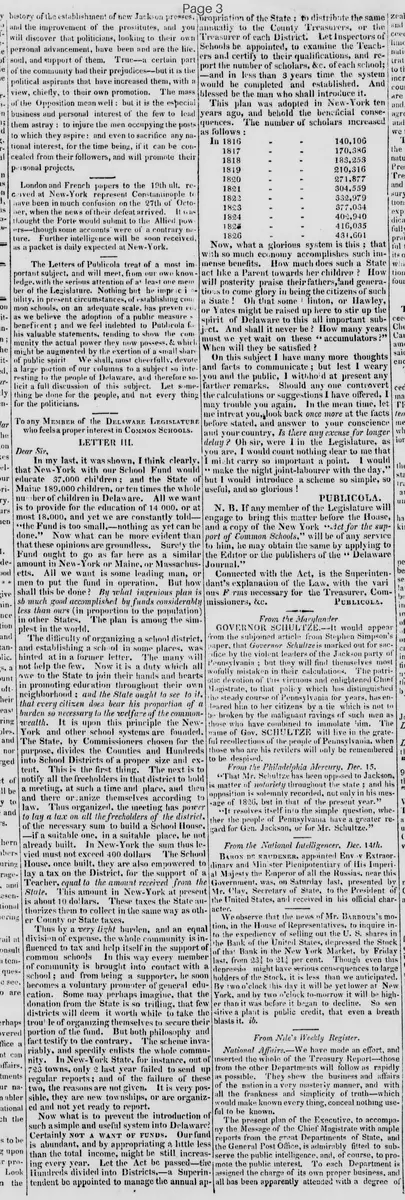
This plan was adopted in New-York ten years ago, and behold the beneficial consequences. The number of scholars increased as follows:
| In 1816 | - | - | 140,106 |
| 1817 | - | - | 170,386 |
| 1818 | - | - | 183,253 |
| 1819 | - | - | 210,316 |
| 1820 | - | - | 271,877 |
| 1821 | - | - | 304,559 |
| 1822 | - | - | 332,979 |
| 1823 | - | - | 377,034 |
| 1824 | - | - | 402,940 |
| 1825 | - | - | 416,035 |
| 1826 | - | - | 431,601 |
Now, what a glorious system is this; that with so much economy accomplishes such immense benefits. How much does such a State act like a Parent towards her children? How will posterity praise their fathers, and generations to come glory in being the citizens of such a State! Oh that some Clinton, or Hawley, or Yates might be raised up here to stir up the spirit of Delaware to this all important subject. And shall it never be? How many years must we yet wait on these "accumulators?" When will they be satisfied?
On this subject I have many more thoughts and facts to communicate; but lest I weary you and the public, I withhold at present any farther remarks. Should any one controvert the calculations or suggestions I have offered, I may trouble you again. In the mean time, let me intreat you, look back once more at the facts before stated, and answer to your conscience and your country, Is there any excuse for longer delay? Oh sir, were I in the Legislature, as you are, I would count nothing dear to me that I might carry so important a point. I would "make the night joint-labourer with the day." but I would introduce a scheme so simple, so useful, and so glorious!
PUBLICOLA.
N. B. If any member of the Legislature will engage to bring this matter before the House, and a copy of the New York "act for the support of Common Schools," will be of any service to him, he may obtain the same by applying to the Editor or the publishers of the "Delaware Journal."
Connected with the Act, is the Superintendent's explanation of the Law, with the various Forms necessary for the Treasurer, Commissioners, &c.
PUBLICOLA.
What sub-type of article is it?
What themes does it cover?
What keywords are associated?
What entities or persons were involved?
Letter to Editor Details
Author
Publicola
Recipient
Any Member Of The Delaware Legislature
Main Argument
delaware should implement a common schools system using its school fund, following new york's simple and effective model of district organization, taxation, and state support to educate 14,000-18,000 children, countering claims that the fund is insufficient.
Notable Details