Thank you for visiting SNEWPapers!
Sign up free
Story
September 25, 1824
Concord Register
Concord, Merrimack County, New Hampshire
What is this article about?
Eyewitness account by Gen. Henry Lee of the British surrender at Yorktown on Oct. 19, 1781, led by Gen. O'Hara in Cornwallis's absence, to Washington and allies, marking a pivotal American victory in the Revolutionary War with 7,107 British troops captured.
Clipping
OCR Quality
98%
Excellent
Full Text
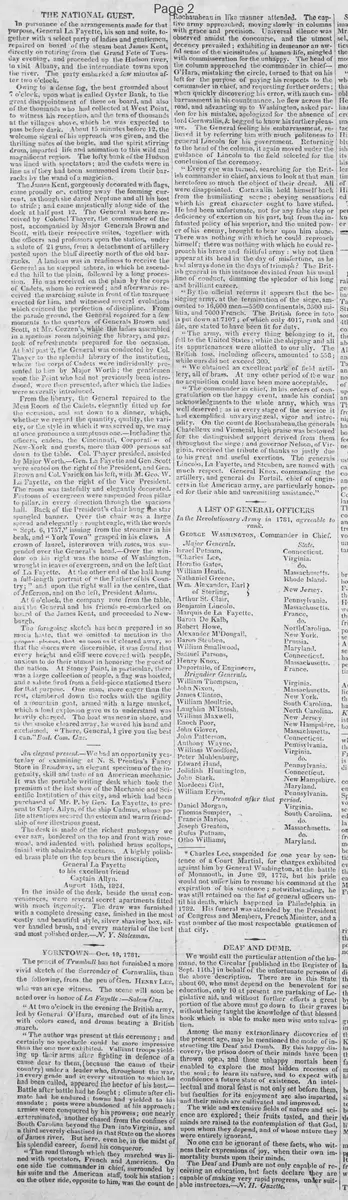
YORKTOWN-Oct. 19, 1781.
The pencil of Trumbull has not furnished a more vivid sketch of the Surrender of Cornwallis, than the following, from the pen of Gen. Henry Lee, who was an eye witness. The scene will soon be acted over in honor of La Fayette :—Salem Gaz.
"At two o'clock in the evening the British army, led by General O'Hara, marched out of its lines with colors cased, and drums beating a British march.
"The author was present at this ceremony; and certainly no spectacle could be more impressive than the one now exhibited. Valiant troops yielding up their arms after fighting in defence of a cause dear to them, (because the cause of their country) under a leader who, throughout the war, in every grade and in every situation to which he had been called, appeared the Hector of his host. Battle after battle had he fought; climate after climate had he endured: towns had yielded to his mandate; posts were abandoned at his approach; armies were conquered by his prowess; one nearly exterminated, another chased from the confines of South Carolina beyond the Dan into Virginia, and a third severely chastised in that State on the shores of James river. But here, even he, in the midst of his splendid career, found his conqueror.
"The road through which they marched was lined with spectators, French and American. On one side the commander in chief, surrounded by his suite and the American staff, took his station; on the other side, opposite to him, was the count de Rochambeau in like manner attended. The captive army approached; moving slowly in columns with grace and precision. Universal silence was observed amidst the concourse, and the utmost decency prevailed; exhibiting in demeanor an awful sense of the vicissitudes of human life, mingled with commisseration for the unhappy. The head of the column approached the commander in chief—O'Hara, mistaking the circle, turned to that on his left for the purpose of paying his respects to the commander in chief, and requesting further orders; when quickly discovering his error, with much embarrassment in his countenance, he flew across the road, and advancing up to Washington, asked pardon for his mistake, apologized for the absence of lord Cornwallis, & begged to know his further pleasure. The General feeling his embarrassment, relieved it by referring him with much politeness to general Lincoln for his government. Returning to the head of the column, it again moved under the guidance of Lincoln to the field selected for the conclusion of the ceremony.
"Every eye was turned, searching for the British commander in chief, anxious to look at that man heretofore so much the object of their dread. All were disappointed. Cornwallis held himself back from the humiliating scene; obeying sensations which his great character ought to have stifled. He had been unfortunate, not for any false step or deficiency of exertion on his part, but from the infatuated policy of his superior, and the united power of his enemy, brought to bear upon him alone. There was nothing with which he could reproach himself; there was nothing with which he could reproach his brave and faithful army: why not then appear at its head in the day of misfortune, as he had always done in the days of triumph? The British general in this instance deviated from his usual line of conduct, dimming the splendor of his long and brilliant career.
"By the official returns it appears that the besieging army, at the termination of the siege, amounted to 16,000 men—5500 continentals, 3500 militia, and 7000 French. The British force in toto is put down at 7107; of which only 4017, rank and file, are stated to have been fit for duty.
"The army, with every thing belonging to it, fell to the United States; while the shipping and all its appurtenances were allotted to our ally. The British loss, including officers, amounted to 558; while ours did not exceed 300.
"We obtained an excellent park of field artillery, all of brass. At any other period of the war no acquisition could have been more acceptable.
"The commander in chief, in his orders of congratulation on the happy event, made his cordial acknowledgments to the whole army, which was well deserved; as in every stage of the service it had exemplified unvarying zeal, vigor and intrepidity. On the count de Rochambeau, the generals Chatelleux and Viomenil, high praise was bestowed for the distinguished support derived from them throughout the siege; and governor Nelson, of Virginia, received the tribute of thanks so justly due to his great and useful exertions. The generals Lincoln, La Fayette, and Steuben, are named with much respect. General Knox, commanding the artillery, and general du Portail, chief of engineers in the American army, are particularly honored for their able and unremitting assistance."
The pencil of Trumbull has not furnished a more vivid sketch of the Surrender of Cornwallis, than the following, from the pen of Gen. Henry Lee, who was an eye witness. The scene will soon be acted over in honor of La Fayette :—Salem Gaz.
"At two o'clock in the evening the British army, led by General O'Hara, marched out of its lines with colors cased, and drums beating a British march.
"The author was present at this ceremony; and certainly no spectacle could be more impressive than the one now exhibited. Valiant troops yielding up their arms after fighting in defence of a cause dear to them, (because the cause of their country) under a leader who, throughout the war, in every grade and in every situation to which he had been called, appeared the Hector of his host. Battle after battle had he fought; climate after climate had he endured: towns had yielded to his mandate; posts were abandoned at his approach; armies were conquered by his prowess; one nearly exterminated, another chased from the confines of South Carolina beyond the Dan into Virginia, and a third severely chastised in that State on the shores of James river. But here, even he, in the midst of his splendid career, found his conqueror.
"The road through which they marched was lined with spectators, French and American. On one side the commander in chief, surrounded by his suite and the American staff, took his station; on the other side, opposite to him, was the count de Rochambeau in like manner attended. The captive army approached; moving slowly in columns with grace and precision. Universal silence was observed amidst the concourse, and the utmost decency prevailed; exhibiting in demeanor an awful sense of the vicissitudes of human life, mingled with commisseration for the unhappy. The head of the column approached the commander in chief—O'Hara, mistaking the circle, turned to that on his left for the purpose of paying his respects to the commander in chief, and requesting further orders; when quickly discovering his error, with much embarrassment in his countenance, he flew across the road, and advancing up to Washington, asked pardon for his mistake, apologized for the absence of lord Cornwallis, & begged to know his further pleasure. The General feeling his embarrassment, relieved it by referring him with much politeness to general Lincoln for his government. Returning to the head of the column, it again moved under the guidance of Lincoln to the field selected for the conclusion of the ceremony.
"Every eye was turned, searching for the British commander in chief, anxious to look at that man heretofore so much the object of their dread. All were disappointed. Cornwallis held himself back from the humiliating scene; obeying sensations which his great character ought to have stifled. He had been unfortunate, not for any false step or deficiency of exertion on his part, but from the infatuated policy of his superior, and the united power of his enemy, brought to bear upon him alone. There was nothing with which he could reproach himself; there was nothing with which he could reproach his brave and faithful army: why not then appear at its head in the day of misfortune, as he had always done in the days of triumph? The British general in this instance deviated from his usual line of conduct, dimming the splendor of his long and brilliant career.
"By the official returns it appears that the besieging army, at the termination of the siege, amounted to 16,000 men—5500 continentals, 3500 militia, and 7000 French. The British force in toto is put down at 7107; of which only 4017, rank and file, are stated to have been fit for duty.
"The army, with every thing belonging to it, fell to the United States; while the shipping and all its appurtenances were allotted to our ally. The British loss, including officers, amounted to 558; while ours did not exceed 300.
"We obtained an excellent park of field artillery, all of brass. At any other period of the war no acquisition could have been more acceptable.
"The commander in chief, in his orders of congratulation on the happy event, made his cordial acknowledgments to the whole army, which was well deserved; as in every stage of the service it had exemplified unvarying zeal, vigor and intrepidity. On the count de Rochambeau, the generals Chatelleux and Viomenil, high praise was bestowed for the distinguished support derived from them throughout the siege; and governor Nelson, of Virginia, received the tribute of thanks so justly due to his great and useful exertions. The generals Lincoln, La Fayette, and Steuben, are named with much respect. General Knox, commanding the artillery, and general du Portail, chief of engineers in the American army, are particularly honored for their able and unremitting assistance."
What sub-type of article is it?
Historical Event
Military Action
What themes does it cover?
Triumph
Fortune Reversal
Bravery Heroism
What keywords are associated?
Yorktown Surrender
Cornwallis
Washington
American Revolution
British Defeat
O'hara
Rochambeau
What entities or persons were involved?
General Washington
Lord Cornwallis
General O'hara
General Lincoln
Count De Rochambeau
General Henry Lee
La Fayette
Governor Nelson
Where did it happen?
Yorktown
Story Details
Key Persons
General Washington
Lord Cornwallis
General O'hara
General Lincoln
Count De Rochambeau
General Henry Lee
La Fayette
Governor Nelson
Location
Yorktown
Event Date
Oct. 19, 1781
Story Details
British army under O'Hara surrenders to Washington at Yorktown; Cornwallis absent; detailed ceremony description, troop numbers, losses, and commendations to allied forces.